


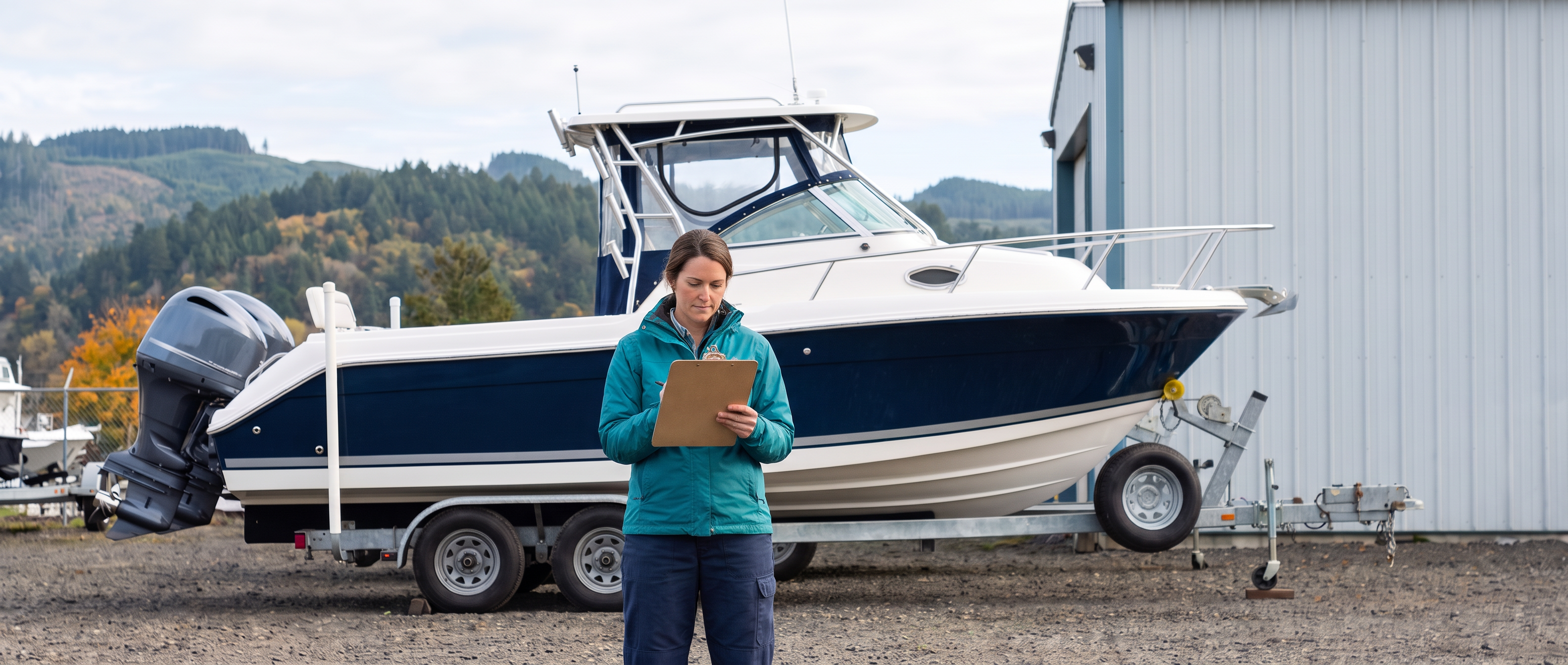

Putting a fishing boat away does not put every risk away with it. A covered boat in a driveway, a vessel tied to a winter slip and a boat waiting at a repair yard can all need an insurance review—even when no fishing trip is planned. The useful question is what your actual policy protects during that particular storage arrangement.[1]
For Oregon and Northern California owners, the off-season might involve coastal rain and wind, inland freezing, a haul-out, engine service or simply fewer trips. This guide explains how to review storage, storm damage, theft, repairs and lay-up restrictions without assuming that every boat policy follows the same calendar or covers the same losses.
The essential distinction
Not using the boat is different from not having exposure
Fire, theft, severe weather and accidental damage can affect a stored boat. Liability-only protection is not hull protection. Winterization is not an insurance endorsement. A marina's policy is not automatically your boat policy. Review each question separately.[1] [2] [7]
Begin with how the fishing boat is actually used
Start a boat insurance review with the vessel, its equipment and its real use. A privately owned boat used for recreational fishing presents different questions from a vessel carrying paying anglers or harvesting fish commercially. The appearance of the boat does not establish which policy is suitable.
This guide primarily addresses recreational fishing boat owners, with a separate business-use discussion below. Tell the agent about occasional guiding, paid passengers, shared ownership or a planned change in operations. BoatUS lists fishing-guide coverage as a distinct optional feature in its public product description; that illustrates why paid use needs disclosure, not a promise that every guide qualifies.[2]
Next, separate physical damage to the boat from liability to other people. Comprehensive and collision features, hull wording and liability provisions do different jobs. Some marine forms use different terminology. The existing marine insurance guide can help organize those broader questions, but the issued policy determines the protection.
Follow the boat through three off-season stages
Before storage
Confirm the storage site, lay-up dates, preparation duties, insured values and contracts before the boat goes out of commission.
During the off-season
Monitor storms, security, drainage and changing plans. Tell the insurer before changing the storage arrangement or using the boat.
Before returning to service
Coordinate repairs and commissioning, confirm permission to operate, and review equipment or fishing-use changes before launch.
Before reducing coverage, identify what must continue
A smaller winter premium is not automatically a better arrangement. Progressive's winter-insurance guidance notes that stored boats retain fire, theft, severe-weather and incidental-movement exposures. It also explains that lenders, marinas and storage facilities may require ongoing insurance.[1] Check your actual agreements rather than assuming that a boat ashore is outside those requirements.
Ask what a proposed seasonal adjustment would remove, what limits would remain and when changes take effect. Liability-only coverage should not be described as paying for your damaged hull. Conversely, a physical-damage arrangement should not be assumed to satisfy every contractual liability requirement. Request an explanation of the specific change before authorizing it.
Review values at the same time. BoatUS distinguishes agreed hull value from actual cash value in its public descriptions; settlement terms for partial losses can be different again.[2] Recent engines, electronics or other upgrades deserve attention. Our boat purchase and insurance checklist also helps identify ownership, financing and equipment details worth updating.
Lay-up restrictions: read the dates and the permitted activity
A lay-up provision can specify when a boat must be out of commission and whether it must be kept ashore or may remain afloat. Gallagher Charter Lakes explains that a storage-method mismatch can matter to coverage.[3] Do not turn that example into a rule for every insurer: some policies use different restrictions, and not every boat policy has the same lay-up warranty.
Locate the provision and write down its actual dates, location requirements, storage method and any restrictions on use. Ask whether visits aboard, maintenance, movement within a yard, towing, harbor relocation, a test run or a repair sea trial require approval. There is no universal exception simply because the trip is short or the owner considers it necessary.
If good weather creates an unexpected fishing opportunity, confirm permission before launching. Likewise, explain a repair appointment that would require taking the boat from one marina to another. Keep the insurer's written response and any endorsement with the policy. An unanswered request or an agent message alone is not proof that the original restriction has changed.
Consider a hypothetical owner whose schedule lists ashore storage but who decides to keep the boat in a slip for convenience. The preparation plan and the policy assumptions have both changed. The right step is to raise that change before it happens, not assume that “winter storage” means the same thing in both places. This is a review illustration, not an agency claim story.
Putting your fishing boat away for the season?
Bring your policy, storage dates, planned location and equipment list to Gerald Ross Agency for a policy-specific discussion before making coverage changes.
Request an off-season boat insurance reviewAfloat storage: plan for water, weather and unattended systems
A boat remaining in the water still needs vessel-specific attention to through-hull fittings, hoses, cockpit drains, bilge pumps, electrical supply, docklines and chafe protection. BoatUS's winterizing guide discusses sinking and storm exposures that can persist while a boat is unattended.[4] Have a qualified marine professional explain the preparation appropriate to your vessel rather than applying a generic checklist blindly.
Confirm who will visit, what will be checked and how a problem will be reported. Paying for a slip does not necessarily purchase bilge inspections, battery checks or storm response. Record the written service scope and identify a backup contact. Design the plan for a power interruption or failed device, not only normal conditions.
Use official forecasts as one input to that plan. National Weather Service Eureka's marine resource page links Oregon and Northern California forecasts, observations and tide information.[5] Check the relevant location and current advisories; an offshore forecast is not a guarantee about a protected slip. Do not stay aboard or enter hazardous areas to save property when emergency officials advise otherwise.
Ashore and trailered storage: out of the water is not risk-free
A boat in a driveway, a fenced yard or indoor storage avoids some in-water exposures but can still suffer theft, fire, falling objects, cover damage or accidental movement. Progressive specifically notes that staff movement and nearby machinery can create stored-boat damage.[1] Ask how your policy treats haul-out, transport, storage and later launching as separate activities.
BoatUS recommends suitable hull support and attention to ground conditions, drainage and cover loads. It warns against attaching covers to jackstands or support blocks because wind can disturb the supports.[4] Use a knowledgeable yard and manufacturer guidance for blocking or trailering. Do not reposition stands, climb under an unsupported vessel or improvise a support system from an insurance article.
Include the trailer in the discussion. Identify its value, theft exposure, storage address and any planned road travel. Insurance for the tow vehicle, the trailer and the boat carried on it are not interchangeable. Before a move, ask whose coverage addresses liability, physical damage and any hired transportation; avoid assuming one policy answers all three questions.
Storm damage: separate the cause of loss from the weather label
“Storm damage” can mean wind-driven impact, a falling branch, a broken cover, sinking after water enters or a different chain of events. Ask what physical-damage protection applies, which exclusions matter and whether special deductibles or conditions are involved. A public list of weather perils is not a guarantee for every storm-related loss.[1] [6]
Review preventive movement and haul-out costs separately from damage claims. Progressive's advertised hurricane-haul-out benefit uses specific tropical-storm or hurricane watch/warning triggers.[6] Ordinary Pacific winter weather should not be assumed to qualify merely because a forecast is serious. Your policy may have another arrangement—or no such benefit—so ask before relying on reimbursement.
Liability deserves its own review if the boat could damage another vessel, a dock or someone's property. Where additional limits are appropriate, an umbrella insurance review should confirm the underlying watercraft requirements and exclusions. An umbrella is not hull insurance and should not be assumed to cover undisclosed commercial boating.
Freezing and winterization: prevention does not establish coverage
A mild coast does not justify ignoring a possible freeze or relying entirely on a heater. BoatUS's winterizing guide describes an Oregon power-outage example and warns that heaters are not a substitute for winterization.[4] The practical lesson is to prepare systems for the actual storage conditions, including what happens when shore power is unavailable.
Ask separately whether freezing is covered. BoatUS's public description of one optional ice-and-freezing endorsement requires winterization by a marine professional.[2] That is an example of a product-specific condition, not a universal professional-service requirement. Other policies can have different exclusions, preparation duties or endorsements. Neither hiring a professional nor doing careful work yourself automatically creates coverage.
Fishing boats contain more water systems than an engine alone: livewells, bait tanks, washdown pumps, freshwater lines, heads and other plumbing can need attention. Follow equipment and engine manufacturers' instructions and obtain professional advice for unfamiliar systems. Do not assume one antifreeze, draining or fuel procedure suits every outboard, inboard or accessory.[4]
Retain a dated invoice and written work scope. “Winterized” on a receipt may not explain which systems were serviced or left out. Ask for completion details, recommended inspections and restart instructions. Records can help establish the work performed, but they do not guarantee claim payment or substitute for the policy's conditions.
Theft: review the boat, motor, electronics and fishing gear individually
A locked storage gate does not answer the coverage question. Ask about theft of the entire boat, outboards, permanently installed electronics, portable fish finders, rods, tackle and personal belongings. Progressive lists fishing-equipment and carry-on protection as distinct options; BoatUS describes personal-effects protection with its own location/activity wording.[2] [6]
Record identifying numbers, receipts, photographs and realistic replacement values before storage. Different items may fall under hull, equipment, personal-effects or trailer provisions. Review limits, deductibles, valuation and any scheduling conditions. Avoid assuming that “agreed value” for the boat establishes the same settlement basis for everything aboard.
Removing portable gear can reduce exposure aboard, but ask what happens at the new location. Property in a garage, storage unit, vehicle or repair facility may not have the same protection as property on the boat. BoatUS discusses taking portable electronics and small outboards home as a prevention step; that recommendation does not establish off-boat insurance.[4]
Use appropriate locks, secure keys and access codes, and ask the facility about monitoring and reporting. Keep the inventory somewhere other than only on the boat. These measures support prevention and documentation; they should not be described as eliminating theft risk or satisfying every insurer's security condition.
Moving the boat, upgrading equipment or planning a winter trip?
Discuss the changed location, values, work or proposed use before assuming that the existing storage terms still fit.
Talk through your boat insurance changesStorage and repair contracts: know what you are agreeing to
A marina or yard can have insurance without guaranteeing payment for every boat owner's loss. BoatUS consumer guidance reproduced by Waterway Guide discusses contract provisions addressing releases, indemnity, waivers of subrogation and insurance requirements.[7] The marina and boatyard insurance guide provides related context without replacing your own hull-policy review.
Share the actual agreement with your insurer before signing and use qualified legal advice for interpreting risk-shifting language. A request to add a facility as an additional insured, a certificate requirement and a waiver of recovery rights are different issues. Do not assume that a certificate expands coverage or that an endorsement protects your boat from every facility-caused loss.
Ask the yard to define its work: engine service, plumbing preparation, cover installation, haul-out, storage, inspections and recommissioning. Identify exclusions from the service and responsibility for subcontractors or unattended periods. A storage fee may buy a space, not an ongoing inspection program. Written scope makes the arrangement clearer for everyone involved.[4]
Repairs also need a cause-of-loss discussion. Routine maintenance, wear, corrosion, a pre-existing defect and sudden insured damage are not the same thing. Public marine-insurer descriptions offer particular mechanical-breakdown options, but those are not blanket warranties.[2] [6] Ask which provision might apply rather than treating every invoice as an insurance claim.
Private fishing, guiding and commercial operations need different reviews
Before using the boat again, confirm that the insured use still matches reality. A private river boat, a paid guide boat and a commercial fishing vessel should not be grouped together simply because each carries fishing gear. The inland fishing guide insurance article explains related questions for drift boats, jet boats and lake trips.
Owners operating commercially should discuss the actual business, crew, equipment and any continuing contractual obligations through a commercial fishing insurance review. A recreational product description does not establish coverage for commercial fishing, catch, crew injuries or lost business income. Those questions need operation-specific forms and underwriting.
If paid passenger trips are planned, the fishing charter insurance guide provides a separate starting point. Disclose the activity before accepting bookings. Lay-up permission and commercial-use approval are separate questions; neither an early launch nor a fishing-guide endorsement should be treated as proof of regulatory compliance.[2] [3]
If damage occurs, protect people and preserve the facts
Prioritize safety and contact emergency services when needed. When it is safe, document overall conditions, damage, the discovery time and any immediate protective work. Report through the insurer's claims channel under the policy's instructions and coordinate with qualified marine professionals. Do not place yourself at risk to photograph a boat in an active storm or unstable yard.
Keep storage contracts, winterization records, inspection notes, equipment inventories and receipts accessible. For theft, contact law enforcement and retain the report information. Ask the adjuster about damaged components, repair estimates and what can be discarded. These are practical evidence-preservation recommendations, not a substitute for the reporting and cooperation duties in your own policy.
Separate necessary emergency protection from permanent repairs or extensive teardown. Ask how to proceed, retain receipts and document changes where safe. Do not delay urgent protection merely to complete a routine estimate, but do not assume every salvage, relocation or repair expense will be reimbursed. Coverage and the repair authorization process require their own confirmation.
Before launch: commissioning and coverage permission are separate
BoatUS's spring commissioning checklist addresses hull condition, hoses, fittings, pumps, batteries, fuel systems, steering, trailers and safety equipment, with manufacturer instructions as a foundation.[8] Have appropriate systems checked before launch. Its advice to install a stern drain plug, if equipped, concerns preparation for launching—not a universal instruction for every storage method.
Then confirm the insurance side: launch date, lay-up ending or amended terms, storage changes, navigation area, updated values and any new private or paid use. A successful maintenance inspection does not amend the policy. An insurer's permission to operate does not establish that the boat is mechanically ready. Resolve both before relying on the next trip.
Eight items for your off-season boat review
- 1
Declarations, hull/physical-damage wording, liability forms, endorsements, exclusions, deductibles and the exact lay-up provision.
- 2
Boat, engine and trailer identifiers, current photographs, values, equipment inventory and receipts for recent upgrades.
- 3
Actual storage address, ashore or afloat arrangement, transport plans, lay-up dates and anticipated first launch.
- 4
Marina, storage and repair contracts, lender requirements, requested certificates and any proposed risk-shifting terms.
- 5
Winterization invoice and written scope covering the engine, plumbing, pumps, livewells and other relevant water systems.
- 6
Inspection and alarm responsibilities, emergency contacts, storm preparations and records of visits or maintenance.
- 7
Repair estimates, intended modifications, work dates and any movement, test operation or sea trial planned during lay-up.
- 8
Updated private fishing, guiding, charter or commercial-use details, operating area and property kept away from the boat.
Frequently asked questions
Should I cancel fishing boat insurance when I put the boat in storage?
Not without reviewing what remains exposed and what your agreements require. Stored boats can still suffer fire, theft, storm damage and accidental damage. A lender, marina or storage contract may require ongoing insurance. Ask about permissible seasonal changes and the coverages that would remain; liability-only protection does not establish coverage for damage to your own boat.
Can I take a fishing trip during a policy's lay-up period?
Check the actual lay-up wording before operating the boat. Some policies specify an out-of-commission period, storage method or restrictions on navigation. An early fishing trip, harbor move or repair sea trial should not be assumed to be an exception. Ask the insurer for any required approval or endorsement in advance and keep written confirmation.
Does winterization automatically make freeze damage covered?
No. Prevention work and insurance protection are separate questions. Read the freezing exclusion and any relevant endorsement. BoatUS's public description of one optional ice-and-freezing endorsement requires marine-professional winterization, but that is a particular product condition, not a rule for every policy. Ask about your own preparation requirements and retain the service records.
Are rods, tackle and portable electronics insured in my garage?
Do not assume the same coverage follows every item off the boat. Permanently installed equipment, fishing gear, personal effects, removable motors and trailers may have different limits or provisions. Ask specifically about property kept at home, in a vehicle or at a repair yard, and confirm valuation, deductibles and any scheduling requirements.
Will a marina's or repair yard's insurance replace my boat policy?
Not automatically. Responsibility for damage depends on the facts, contracts and applicable insurance. A facility's liability policy is not the same as a first-party hull policy for your boat. Share storage or repair agreements with your insurer and seek qualified legal advice for risk-shifting clauses; do not assume every incident will be paid by the facility.
Does a winter storm qualify for a named-storm haul-out benefit?
Not simply because the storm is severe. Such benefits can have specific named-storm, hurricane or tropical-storm triggers, locations and expense rules. Ordinary Pacific winter weather does not automatically meet those conditions. Ask how your policy treats wind, sinking, freezing, emergency movement and preventive haul-out costs before relying on reimbursement.
Sources and further reading
These insurer, boating-safety and weather resources informed the guide. Public product descriptions illustrate policy questions, not your issued coverage or Gerald Ross Agency's appointment with a referenced insurer. The older dock-contract resource is educational background, not a determination of current Oregon or California contract law.
- [1] Progressive: Do you need boat insurance in the winter?
- [2] BoatUS / GEICO Marine: Boat insurance — hull valuation and optional endorsements
- [3] Gallagher Charter Lakes: Keeping a lay-up warranty updated
- [4] BoatUS: The Boater's Guide to Winterizing
- [5] NOAA / National Weather Service Eureka: Oregon and Northern California marine forecast resources
- [6] Progressive: Boat insurance coverages — gear, valuation and storm-benefit examples
- [7] Waterway Guide / BoatUS: What's really in your marina dock contract?
- [8] BoatUS: Spring commissioning checklist
Make the off-season review part of your next fishing season
Gerald Ross Agency can help Oregon and Northern California boat owners organize questions about storage, equipment, repairs and policy restrictions. Bring the actual forms and your plans so the discussion fits your boat—not a generic winter calendar.
Request a fishing boat insurance quoteImportant: General educational information only, not legal, mechanical, safety or individualized coverage advice. Follow manufacturer instructions and qualified professional guidance for storage and service. Coverage availability and claim outcomes depend on underwriting, issued forms, endorsements, exclusions, limits, deductibles, valuations and the facts of the loss. A quote request does not bind coverage. No preparation measure, contract review or record discussed here guarantees compliance, reimbursement or a particular outcome.


