
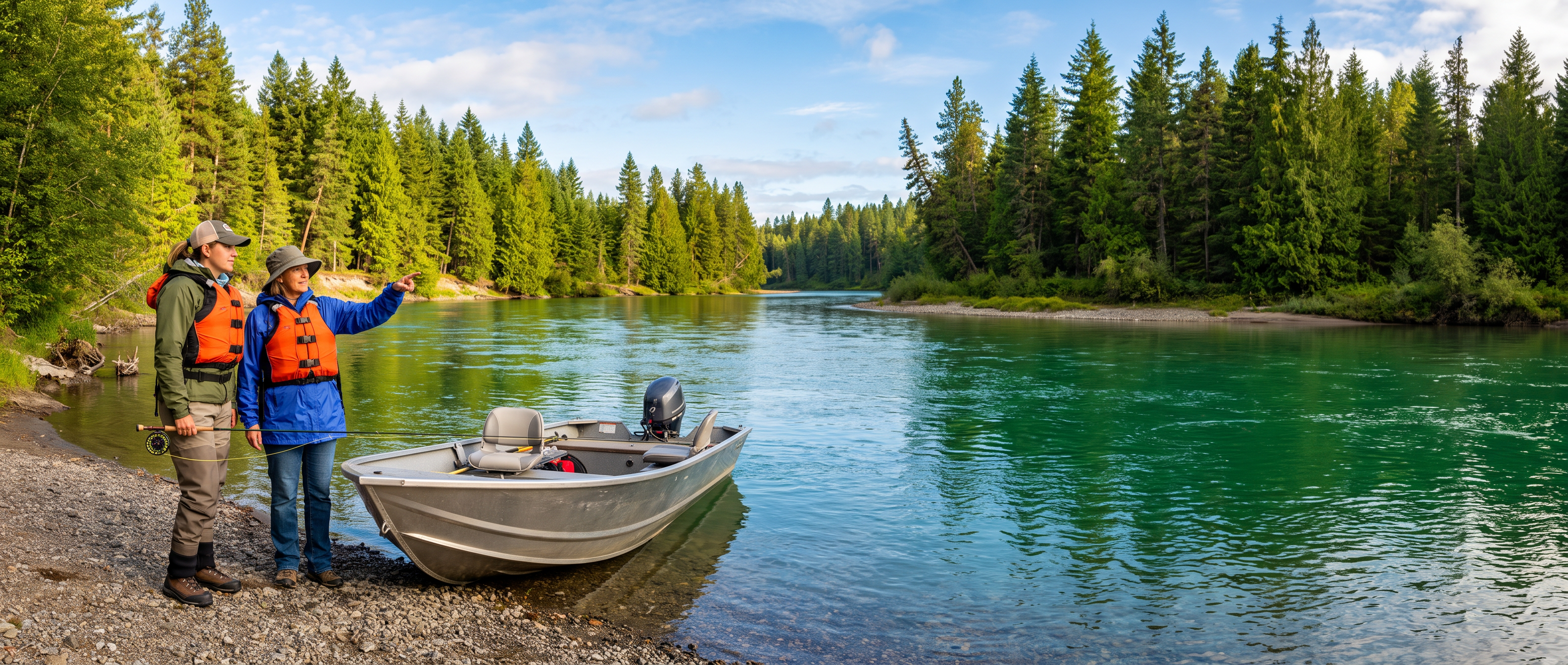

A guided fishing day may begin on a trailer, continue down a river, pause on a gravel bar and end with a customer shuttle. Insurance needs to reflect that entire operation—not simply the fact that a boat never reaches the ocean. Drift boats, jet boats and lake fishing businesses can face passenger injuries, damaged equipment, vehicle claims, permit conditions and lost bookings that belong in different parts of an insurance review.
For guides working Oregon rivers, Southern Oregon lakes or Northern California waterways, the useful question is not just “Do I have boat insurance?” It is “Does my insurance describe the boats, people, activities, waters and business arrangements I actually use?” This guide explains what to bring to that conversation, where regulatory requirements differ from coverage and which assumptions deserve a closer look before another paid trip.
The central distinction
A guide license, a captain's credential and an insurance policy do different jobs
A registration identifies an authorized guide under a particular program. An operator credential addresses qualifications for a defined type of service. A land-use permit addresses access and commercial activity. Insurance responds only as its wording allows. Having one does not automatically establish the others, and a certificate is not a substitute for reading the policy.[1–7]
Start with the whole itinerary, not the label “fishing charter”
Two businesses advertising “river fishing” can operate very differently. One rows an owned drift boat with two customers. Another runs powered trips with a seasonal crew, transports guests from a lodge, supplies lunch and occasionally hires another guide. A third mostly fishes a reservoir but moves to a different river when conditions change. Each description raises different questions about commercial use, passenger liability, navigation, vehicles, staffing and contracts.
A commercial marine insurance review should start with a written inventory of those facts. List the boats and motors, maximum customers, usual launch points, operating reaches, dates, guide experience, ownership and any planned expansion. Include the activities performed off the boat. If the application only describes a basic lake trip, ask what must change before adding rapids, wading instruction, a new vessel or an overnight camp.
Four operating profiles
Describe what happens before, during and after the fishing
Drift boats and float trips
Review launch and landing assistance, rowing, anchors, wading stops, rapids, changing flows, passenger mobility and where the boat and gear are stored.
Jet boats and powered trips
Identify passenger counts, horsepower, waterway jurisdiction, operating credentials, navigation limits, debris strikes, propulsion damage and rescue plans.
Lake and reservoir adventures
Describe wind exposure, cold water, distance from help, docks, launch ramps, rentals, overnight storage and any waters outside the normal operating area.
The trip before and after the boat
Include trailering, customer shuttles, bank fishing, lunches, equipment loading, parking arrangements and subcontracted guides in the operating description.
Passenger liability and boat damage are separate questions
Hull coverage concerns physical damage to the insured vessel and specified equipment. Marine liability, sometimes described through protection and indemnity coverage, can address defined liabilities arising from vessel operations. Neither label tells you everything about passenger injuries, defense costs, pollution, wreck removal, salvage, uninsured boaters or damage to someone else's property. Ask which provisions are included, which are optional and how deductibles and limits apply.
A recreational boat policy should not be assumed to cover passengers for hire. Tell the insurer when customers pay, how bookings are made and whether the boat carries a guide, crew, clients or a combination. Confirm whether limits depend on the number of passengers, the vessel listed, its operator or the waters used. A trip that seems casual to the owner may still be a commercial operation for licensing and insurance purposes.[1–3]
Also compare marine liability with commercial general liability. A shoreside slip, loading incident, bank-fishing lesson or damage at a launch may involve different provisions from an injury aboard a boat. Watercraft exclusions, participant exclusions and activity descriptions matter. Do not assume two policies overlap neatly; ask the agent and insurers to explain the boundaries using your actual itinerary.
Drift boats, jet boats and lake trips need different operating details
Drift-boat guiding and wading stops
No motor does not mean no business exposure. A drift-boat customer may fall while boarding, be struck by tackle or be injured during a shore stop. Review rowing and anchoring practices, passenger movement, guide-to-guest ratios and whether a stop includes wading in current. Explain any whitewater, overnight, youth or instructional activities rather than treating them as incidental. Oregon's outfitter framework expressly includes drift-boat trips and other outdoor activities.[2]
Jet boats and other powered guide boats
Describe the engine and drive, navigation area, shallow-water exposure and who operates the vessel. A debris strike, grounding, machinery failure or damage during recovery may receive different treatment under the policy. Ask about wear and tear, maintenance, mechanical breakdown, towing, salvage costs and borrowed replacement boats. Owning a second boat does not automatically make it an insured substitute for the primary vessel.
Lakes and reservoirs
Lake trips can involve wind, cold water, changing water levels, remote shorelines and long distances from emergency help. Review permitted waters, seasonal storage and theft protections, launch access and any rented dock or marina space. A new lake outside the scheduled territory should prompt a coverage and permit check before reservations are accepted—not after the guide has trailered there.
If the business also offers non-fishing excursions, nature viewing or other activities, include them in an adventure-tour insurance discussion. A fishing-focused description may not capture everything sold through a lodge, outfitter partner or booking website.
Adding a river, another boat or a shuttle service?
Bring the route, vessel details, passenger counts and current policies to Gerald Ross Agency before the new service becomes part of your regular bookings.
Request a fishing guide insurance reviewOregon guide registration: minimum insurance is only the starting point
The Oregon State Marine Board states that compensated outdoor guiding on land or water the guide does not own or control requires registration. Its published liability requirement is at least $500,000 combined single limit per occurrence for bodily injury or property damage, covering the guide and employees. The certificate must match the application names, identify covered activities and, when applicable, the types and number of boats.[1] ORS 704.020 also addresses that insurance requirement.[2]
That minimum is not a recommendation that every fishing business should stop at that limit. Passenger exposure, contracts, land managers, vessel use and other circumstances may justify or require a different program. A certificate showing the requested number does not establish that every boat, river, customer activity or subcontractor is insured. Verify the actual endorsements, exclusions and named insureds.
The Marine Board describes a $5,000 surety bond when a guide, charter operation or agent accepts advance deposits of more than $100 per person.[1] A surety-bond review is separate from the liability review. The deposit bond is not a blanket promise to reimburse all business losses or customer refunds. Discuss who collects deposits, including online booking agents, and confirm how the current requirement applies.
Oregon also distinguishes motorized operations on federally navigable waters from those operating only on non-federally navigable waters. The Marine Board describes a Coast Guard merchant mariner credential for the former and an MMC or its Motorized Passenger Boat Operator's Certification for the latter.[1] The 2026 crew-member registration framework adds another reason to review who assists with angling and boat operations. Confirm each person's registration, insurance and First Aid/CPR status with the Marine Board rather than assuming a payroll title settles it.
Northern California guides should separate licensing from passenger-service requirements
California Department of Fish and Wildlife guidance requires a guide license for compensated guiding and describes activities beyond merely handling the fishing rod, including certain transportation to and from fishing areas. It also describes an employee exemption only when specified conditions are met.[4] Do not assume that a drift boat is exempt from guide licensing simply because it lacks an engine.
California Boating and Waterways separately describes a state For-Hire Vessel Operator's License for powered vessels carrying four or more passengers for compensation on California waters outside federal jurisdiction.[5] That specific threshold should not be copied into every other licensing or insurance question. Boats, waters and passenger-service arrangements can fall under different requirements; confirm the route and service with DBW and, when relevant, the Coast Guard.
DBW also administers a distinct For-Hire Insurance Verification Certificate Program that includes compensated fishing charters.[6] A CDFW guide license, vessel-operator credential and insurance-verification certificate serve different purposes. Ask DBW which current classification, order and limits apply to the operation rather than relying on a single generic minimum found online.
At the federal level, the Coast Guard describes an Operator of Uninspected Passenger Vessels endorsement for vessels limited to six or fewer passengers for hire and lists inland credentials.[3] “Six-pack” does not mean unregulated. Confirm the actual credential, vessel and jurisdiction requirements; inland rivers and lakes are not automatically outside federal oversight.
Trailers, tow vehicles and passenger shuttles deserve their own review
The boat can be out of the water when a major loss occurs. A collision while towing, a trailer theft, a loading accident or a customer injury in a shuttle may involve different policies and deductibles. List the tow vehicle, trailer, boat and permanently attached equipment separately. Ask who insures each item during transit, loading, launching and storage.
A commercial auto insurance review should disclose paid customer transportation, employee drivers and personal vehicles used for business. Hired and non-owned auto liability is not automatically physical-damage coverage for a rented vehicle, and auto liability is not automatically boat or trailer physical-damage coverage. If another company provides the shuttle, review its contract, insurance evidence and responsibility for passengers with qualified advisors.
Include deadhead runs and vehicle repositioning between launch and takeout. A friend who moves the truck, a contractor who picks up customers or a guide who uses an employee's vehicle can change the facts the insurer needs. Document permission, driver qualifications and who has responsibility for keys, passengers and equipment.
Protect rods, electronics and the equipment that makes trips possible
Fishing guides may have considerable value in rods, reels, tackle, sonar, trolling motors, batteries, communications devices, flotation equipment and cameras. Build an inventory with receipts or supportable values. Ask whether items are covered while aboard the boat, in a locked truck, at home, at a rented storage location and while being carried to a launch. Review theft conditions, unattended-vehicle limitations, accidental loss, water damage and valuation methods.
Specialty outfitter programs illustrate that property, inland marine and accident-medical coverages are separate categories from general liability.[9] Those categories are not a promise that a particular item or incident is covered. Customer-owned gear, rented equipment and a borrowed boat deserve specific questions about custody, responsibility and whether a schedule or endorsement is needed. Ask what happens if valuable electronics are removed for storage or moved between boats.
Crew, subcontractors and partner lodges can change the insurance picture
Hiring a second guide or seasonal helper changes more than capacity. Someone may drive, row, maintain equipment, handle hooks or assist an injured guest. Discuss workers compensation and any potentially applicable maritime employment obligations with professionals who understand the actual duties and waters. State workers compensation, maritime remedies and marine employer coverages are not interchangeable, and this article cannot determine which framework applies to a worker.
Calling someone an independent contractor does not by itself settle employment status, guide registration or insurance. Obtain the business names, duties, credential information and policies, and identify whose vessel and equipment will be used. For lodge and referral partnerships, establish who sells the trip, takes deposits, hires the guide and communicates changes. Have counsel review waivers, indemnity and contracts; a waiver does not replace insurance.
If a lodge or public agency requests higher liability limits, a commercial umbrella or excess liability review should check the underlying policies and marine exclusions. An umbrella is not guaranteed to sit over passenger-boat liability merely because it sits over general liability or auto. Have the actual coverage structure confirmed.
Does the paperwork match the trip you sell?
Compare the website description, booking contract, guide permits, boat schedule and policy endorsements together. Small operating changes are easier to discuss before a loss.
Talk through your guide insurance questionsPermits, cold water and canceled trips are not just administrative details
Oregon's guide registration does not replace location-specific permission.[1] BLM describes Special Recreation Permits for certain managed commercial uses on public lands and waters, with requirements varying by location.[7] Check the actual river reach, launch, takeout and land manager. Insurance certificates and additional-insured requests should be reviewed against the permit or agreement, not issued on assumptions about a familiar fishing area.
The National Weather Service warns that cold water remains a serious boating hazard even when people are comfortable outdoors.[8] Build trip procedures around suitable life jackets, passenger briefings, changing flows and weather, communication, emergency access and a float plan. Establish who can cancel or change a trip when conditions deteriorate. Safety planning reduces uncertainty; it cannot promise an accident-free trip or guarantee coverage.
Do not assume a river closure, wildfire smoke, low water, fishing restriction or breakdown triggers business-income coverage. Ask about any covered physical-loss trigger, civil-authority language, access restrictions, waiting periods, equipment provisions and exclusions. Clear refund terms, flexible itineraries and cash reserves remain important where insurance does not respond. Customer travel insurance, if purchased separately, addresses the customer's contract and terms rather than automatically protecting the guide's revenue.
Online bookings also create information and payment exposures. Review cyber liability insurance alongside your reservation provider, payment controls and access permissions. A stolen login or fraudulent refund instruction is not the same event as a damaged boat. Ask which policy, if any, addresses data response, social-engineering losses and payment diversion.
Prepare a guide-operation file before renewal or a new season
A useful review file should let an insurer understand a day in the business without guessing. Include every service advertised and note the differences between regular operations and occasional trips. Update it when adding a guide, changing ownership, increasing passenger counts, borrowing a boat or entering a new partnership. Ask for clarification in writing when the operation is unclear; do not treat silence or an unchanged certificate as approval.
Eight things to bring to a fishing-guide insurance review
- 1
Legal business and owner names; all guides, crew and subcontractors; payroll and seasonal staffing; current registrations and credentials.
- 2
Every boat, motor and trailer, with identifying numbers, ownership, purchase details, current values and any rented or borrowed arrangements.
- 3
Named rivers, lakes and reservoirs; specific reaches and launch points; passenger maximums; trip length; propulsion; rapids and wading activities.
- 4
Guide permits and access agreements, lodge or booking contracts, insurance exhibits, additional-insured requests and any client waiver forms.
- 5
Equipment inventory and receipts for rods, electronics, safety gear and communications devices, plus where items are stored and transported.
- 6
Tow vehicles and passenger shuttles, driver lists, hired or non-owned vehicles, trailer values and who handles each transfer.
- 7
Incident and claims history, inspection logs, maintenance, safety briefings, emergency response, weather decisions and alternative-route procedures.
- 8
Current policies and endorsements, limits, deductibles, exclusions, bond documents, deposit practices, refund terms and insurer notice contacts.
If an incident occurs, protect people first, obtain emergency help and follow the appropriate reporting procedures. Preserve trip records, photographs, witness details and communications, and notify insurers promptly under the policies. Oregon's Marine Board has its own incident-reporting requirements for specified events, including a 48-hour reporting framework.[1] Regulatory reporting and insurance claim notice are separate duties; do not assume satisfying one satisfies the other.
Frequently asked questions
Does a personal boat policy cover paid fishing trips?
Do not assume so. Recreational boat insurance may restrict business use or carrying passengers for compensation. Disclose the actual guiding operation, boats, propulsion, waters, passenger counts and activities, and have the insurer confirm what the issued commercial policy covers. Registration and a certificate of insurance do not remove exclusions.
Do drift-boat guides need insurance even without a motor?
Nonmotorized operation does not remove passenger, guiding, shoreside or property risks. Oregon's outfitter-guide registration framework can apply to compensated drift-boat trips. California guide licensing is also distinct from powered-vessel licensing. Ask the relevant agencies about the actual operation and have the insurance program reviewed for all listed activities.
What insurance minimum does Oregon publish for outfitter guides?
The Oregon State Marine Board currently describes at least $500,000 combined single limit per occurrence for bodily injury or property damage, covering the guide and employees and identifying the covered activities and applicable boats. This is a registration minimum, not a recommended limit for every business. Contracts, permits, passengers, vessels and other requirements may call for a different insurance program.
Is an Oregon guide's deposit bond the same as trip-cancellation insurance?
No. The Marine Board describes a $5,000 surety bond for guides or their agents accepting advance deposits of more than $100 per person. The bond protects qualifying client deposit interests under its terms; it is not a general policy covering a guide's lost revenue, bad weather, refunds or every canceled trip. Verify the current requirement and the actual bond wording.
Does a six-passenger trip avoid Coast Guard requirements?
No. The Coast Guard describes an OUPV endorsement for uninspected passenger vessels limited to six or fewer passengers for hire. That is not a blanket exemption from credentials, vessel rules, safety duties or insurance. Confirm jurisdiction, vessel type, propulsion, passenger count and route with the relevant agencies.
Will insurance replace income when a river closes or smoke cancels trips?
Not automatically. Business-income coverage commonly depends on defined covered causes, physical-loss requirements, waiting periods and other conditions. A fishing closure, low flow, wildfire smoke, unsafe weather, mechanical downtime or a customer cancellation may not satisfy those terms. Review any available extensions and build an operating reserve and clear refund policy.
Sources and further reading
These regulator, safety and specialist resources informed the article. Operating requirements can change and may vary by vessel, waterway, passenger count, activity and permit. Confirm current requirements directly with the responsible agencies and review actual policies with the insurer. Specialist program examples are educational references, not a statement that Gerald Ross Agency represents that program or that its terms apply to your business.
- [1] Oregon State Marine Board: Outfitter Guides & Charters: registration, insurance, credentials, deposits and crew
- [2] Oregon Legislature: ORS Chapter 704 — Outfitters and Guides
- [3] U.S. Coast Guard National Maritime Center: Charter Boat Captain endorsements, including OUPV and inland service
- [4] California Department of Fish and Wildlife: Guide License
- [5] California Boating and Waterways: For-Hire Vessel Operator Licensing Program
- [6] California Boating and Waterways: For-Hire Insurance Verification Certificate Program
- [7] Bureau of Land Management: Special Recreation Permits
- [8] National Weather Service: Cold Water Safety
- [9] Veracity Insurance: Fishing Guide & Outfitters Insurance — examples of separate coverage categories
Insurance for the whole guided fishing operation
Gerald Ross Agency can help Oregon and Northern California guides organize a policy-specific review of boats, passengers, equipment, vehicles and business arrangements. Bring the itinerary and current documents so the conversation reflects how you actually work.
Request a fishing guide insurance quoteImportant: General educational information only, not legal, maritime, licensing, safety, employment or coverage advice. Coverage availability and claim outcomes depend on underwriting, issued policy wording, endorsements, exclusions, limits, deductibles, operating facts and applicable law. No policy, bond, credential, permit or certificate discussed here guarantees compliance, protection, payment or a particular result. Confirm requirements with the responsible agencies and qualified advisors before operating or changing services.