


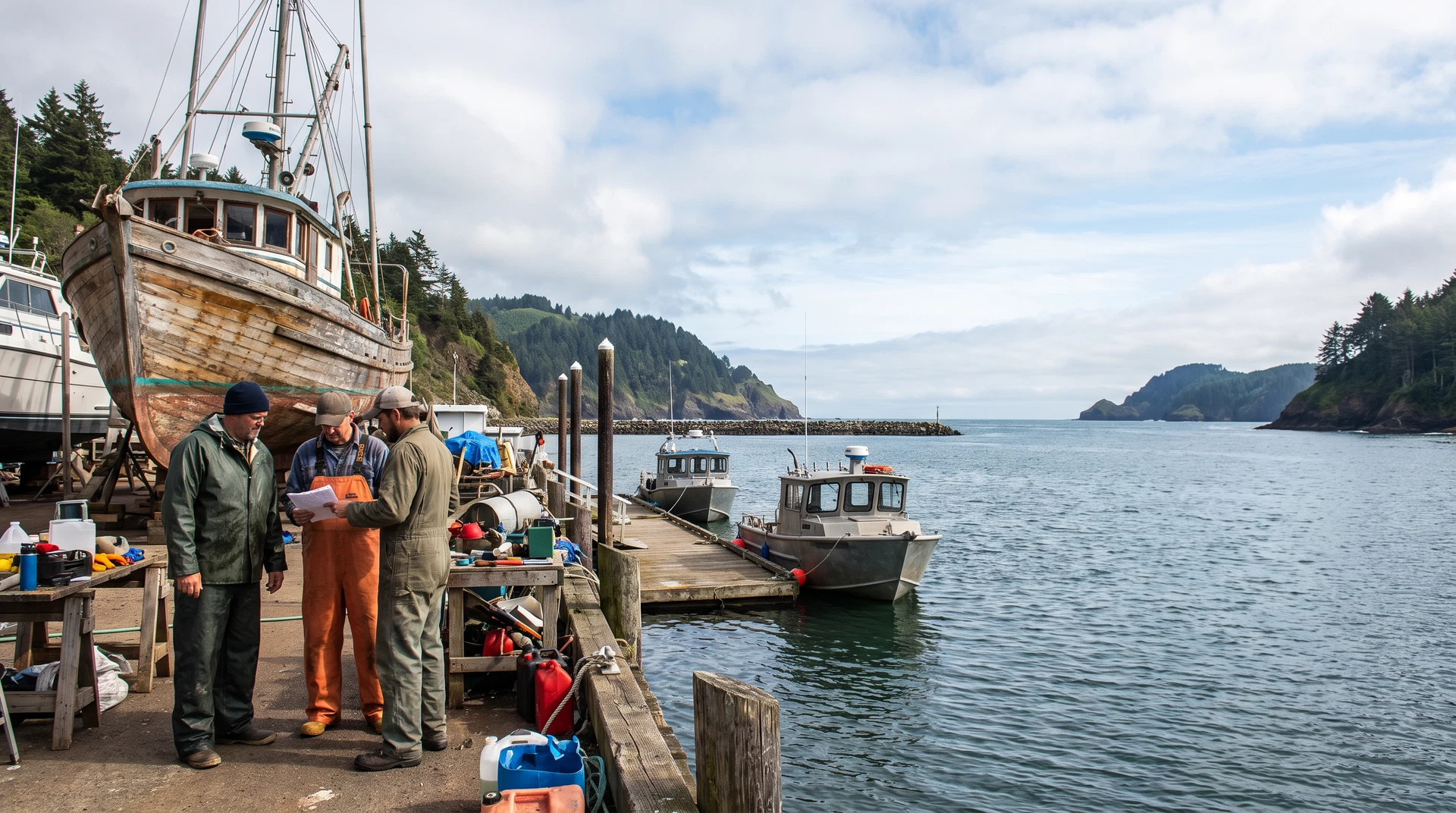

The Oregon Coast is home to some of the most active working waterfronts on the Pacific — from the commercial fishing fleets at the Port of Newport and Port of Coos Bay to the recreational marinas at Brookings, Winchester Bay, and Gold Beach. Marinas, boat yards, and marine service companies are the backbone of this coastal economy, but they also face a uniquely complex set of insurance exposures that standard commercial insurance policies were never designed to address. At Gerald Ross Agency, we have been helping Oregon Coast marine businesses navigate these specialized coverage needs since 1935. This guide covers everything you need to know.
We work with specialized marine carriers to build complete coverage packages for marinas, boat yards, and marine service companies across the Oregon Coast.
Marina Operators Legal Liability (MOLL): The Foundation of Marina Insurance
Marina Operators Legal Liability — universally known as MOLL — is the single most important specialized coverage for any Oregon Coast marina. Think of it as the marina equivalent of a valet parking operator's bailee liability coverage: when a customer entrusts their vessel to your facility for docking, storage, haul-out, or launching, you assume a legal duty of care for that vessel. If it is damaged while in your care and you are found legally liable, MOLL pays for the repair or replacement.
The risks that trigger MOLL claims on the Oregon Coast are numerous. Winter storms can drive vessels into dock pilings. A malfunctioning travel lift can drop a boat during haul-out. A fire in the dry storage yard can spread to multiple vessels. Vandalism, theft, and flooding are also covered causes of loss under most MOLL policies. Without MOLL, a single incident involving a $500,000 sportfisher or a $1.2 million sailing yacht could be financially catastrophic for a marina operator.
| Incident Type | Covered by MOLL? | Notes |
|---|---|---|
| Storm damage to docked vessels | ✅ Yes | Subject to negligence determination |
| Travel lift malfunction during haul-out | ✅ Yes | Equipment failure during marina operations |
| Fire in dry storage yard | ✅ Yes | One of the most common large MOLL claims |
| Vandalism to stored vessel | ✅ Yes | Covered under most MOLL forms |
| Fuel spill damaging vessel finishes | ⚠️ Varies | May require pollution endorsement |
| Damage by subcontractor | ❌ No | Falls on subcontractor's policy |
| Vessels stored for free | ❌ No | Free storage is excluded from MOLL |
| Damage from vessel's own defect | ❌ No | Owner's responsibility |
Oregon port authorities and lenders typically require MOLL as a condition of operating a marina. The Port of Newport, for example, requires Protection and Indemnity coverage with a minimum of $250,000 and pollution liability of at least $300,000. Most marine insurance specialists recommend limits of $1 million or more for MOLL coverage given the high value of recreational and commercial vessels on the Oregon Coast.
Ship Repairers Legal Liability: Essential for Boat Yards
If your business repairs, maintains, or services vessels — whether you operate a full boat yard or work as a mobile marine mechanic — you need Ship Repairers Legal Liability (SRLL) insurance. SRLL covers damage to customer vessels that occurs while they are in your care for repair or service, and for which you are legally liable.
The distinction between MOLL and SRLL is important: MOLL covers the storage and docking exposure, while SRLL covers the repair and service exposure. A full-service marina with an on-site boat yard typically needs both. A standalone boat yard that does not offer slip rentals needs SRLL but may not need MOLL.
Common SRLL claims on the Oregon Coast include fires in the repair shop that spread to customer vessels, crane and travel lift accidents during haul-out, faulty engine work that causes a subsequent loss at sea, and damage during sea trials. SRLL also covers the Protection and Indemnity (P&I) exposure that arises when a technician operates a customer's vessel for a test run — a critical coverage gap that many boat yard operators overlook.
Pollution Liability: The Coverage Gap That Surprises Most Marina Operators
The pollution exclusion in standard commercial general liability (CGL) policies is one of the most consequential coverage gaps for Oregon Coast marina operators. Fuel spills, oil leaks, bilge water discharge, antifouling paint runoff, and hazardous waste from boat maintenance operations are all classified as pollution events — and all are excluded from standard CGL policies.
On the Oregon Coast, a fuel spill at a marina fuel dock can quickly become an environmental disaster. The Pacific Ocean's tidal action can spread contamination across a wide area, triggering cleanup requirements under both Oregon DEQ regulations and federal EPA standards. Cleanup costs for a moderate fuel spill can easily exceed $500,000 — and that does not include third-party claims from neighboring businesses, commercial fishermen, or recreational boaters affected by the contamination.
The Port of Newport requires all marina tenants and operators to carry:
- • Protection & Indemnity: minimum $250,000 (wreck removal not excluded)
- • Pollution Liability: minimum $300,000
- • Combined P&I + Pollution: minimum $600,000
Most Oregon Coast port authorities have similar requirements. Confirm the specific requirements for your port before purchasing coverage.
Most marina operators discover their pollution exclusion only after a fuel spill. A pollution liability policy review takes less than 30 minutes and could save your business from a six-figure environmental cleanup bill.
Wharfinger's Legal Liability: Coverage for Pier and Dock Operators
A wharfinger is the operator of a commercial wharf, pier, or dock — and wharfinger's legal liability insurance is the specialized coverage designed for this exposure. While MOLL covers full-service marina operations, wharfinger's liability is tailored for pier and dock operators who provide mooring and berthing services without the full range of marina amenities.
Oregon Coast port operators, commercial fishing docks, and public boat launch facilities often need wharfinger's liability coverage. The policy covers bailee liability for vessels moored at the facility, slip-and-fall liability on docks and piers, and liability arising from dock operations including line-handling and vessel assistance. It is typically written as a stand-alone marine policy rather than as an endorsement to a CGL policy, and it requires a marine insurance specialist to place correctly.
Longshore & Harbor Workers' Compensation Act: The Federal Coverage Most Oregon Marina Employers Miss
This is the coverage gap that creates the most severe financial consequences for Oregon Coast marina and boat yard operators. The Longshore and Harbor Workers' Compensation Act (LHWCA) is a federal law that provides workers' compensation benefits to employees who work on or near navigable waters — and its benefits are dramatically higher than Oregon state workers' compensation benefits.
LHWCA applies to employees who perform maritime employment — including dock workers, boat yard technicians, marine mechanics, crane operators, and other workers whose duties are performed on or adjacent to navigable waters. If an employee covered under LHWCA is injured and the employer does not have LHWCA coverage, the employer faces unlimited personal liability for the employee's medical expenses, lost wages, and disability benefits — with no cap.
| Benefit Category | Oregon State Workers' Comp | LHWCA (Federal) |
|---|---|---|
| Wage replacement rate | 66.67% of AWW | 66.67% of AWW (higher national AWW base) |
| Maximum weekly benefit | Oregon state cap applies | No cap — based on national AWW |
| Permanent total disability | Oregon schedule | Life of disability, no limit |
| Death benefit | Oregon schedule | 50% of AWW to surviving spouse for life |
| Employer liability if uninsured | State penalties | Unlimited personal liability |
| Applies to | All Oregon employees | Maritime workers on navigable waters |
LHWCA coverage is purchased as a separate endorsement or policy and must be placed with a carrier authorized to write federal workers' compensation. Oregon Coast marina and boat yard operators should have their employee classifications reviewed by a marine insurance specialist to determine which employees require LHWCA coverage — and to ensure the premium is calculated correctly to avoid large audit adjustments.
Marine Artisan Insurance: For Mobile Mechanics and Independent Marine Service Providers
The Oregon Coast has a large community of independent marine service providers — mobile marine mechanics, fiberglass repair specialists, marine electricians, rigging technicians, detailers, and shrink-wrap installers — who work on customer vessels at marinas and boat yards throughout the coast. These marine artisans face the same liability exposures as boat yards but often operate without the proper insurance coverage.
A complete marine artisan insurance program includes three core coverages: Commercial General Liability for bodily injury and property damage to third parties; Marine Artisans Liability (also called Ship Repairers Legal Liability) for damage to customer vessels in their care; and Protection and Indemnity (P&I) if the artisan operates customer vessels for sea trials or test runs. Tools and equipment coverage and commercial auto for service vehicles round out a comprehensive program.
Many Oregon Coast marinas and port authorities now require proof of marine artisan liability insurance before allowing independent contractors to work on vessels at their facilities. Vessel owners and lenders increasingly require it as well. A marine artisan without proper coverage who damages a customer's $300,000 sportfisher faces personal financial ruin — a risk that a properly structured marine artisan policy eliminates for a few hundred dollars per year.
Commercial Property Insurance for Oregon Coast Marine Facilities
Marina buildings, boat sheds, dry storage facilities, fuel docks, travel lifts, cranes, and dock infrastructure represent enormous capital investments for Oregon Coast marine businesses. Insuring these assets correctly requires understanding the unique challenges of coastal property underwriting — including the accelerated depreciation caused by salt air corrosion, the elevated wind and storm surge risk, and the flood exclusion that applies to virtually all standard commercial property policies.
As we discussed in our guide to Oregon Coast business insurance risks, flood damage is excluded from standard commercial property policies. Oregon Coast marina operators in flood-prone areas — particularly those near river mouths and estuaries — need a separate commercial flood insurance policy through the NFIP or a private flood insurer. Floating docks and structures may require specialized inland marine or ocean marine property coverage rather than standard commercial property forms.
Building a Complete Insurance Program for Your Oregon Coast Marine Business
The complexity of marine business insurance — with its mix of specialized marine policies, standard commercial lines, and federal workers' compensation requirements — makes it essential to work with an independent agent who has genuine expertise in the marine sector. A standard commercial lines agent who does not specialize in marine insurance may be able to place your CGL and property coverage, but they are unlikely to recognize the MOLL, SRLL, LHWCA, and pollution liability gaps that create the most serious financial exposures for Oregon Coast marine businesses.
Not every marine business needs every coverage on this list — a mobile marine mechanic has very different needs than a full-service marina with a fuel dock and boat yard. The right program depends on the specific operations, the value of vessels in care, the number of employees, and the requirements of your port authority or lender. An independent marine insurance specialist can assess your exposures and build a program that provides complete protection without paying for coverage you do not need.
Frequently Asked Questions: Marina & Marine Business Insurance in Oregon
Whether you operate a full-service marina, a boat yard, or work as an independent marine service provider, Gerald Ross Agency has the marine insurance expertise to protect your business. We work with specialized marine carriers to build complete coverage programs — MOLL, SRLL, pollution liability, LHWCA, and more — at competitive rates.
Independent agency · 50+ carriers · Oregon Coast specialists since 1935


