


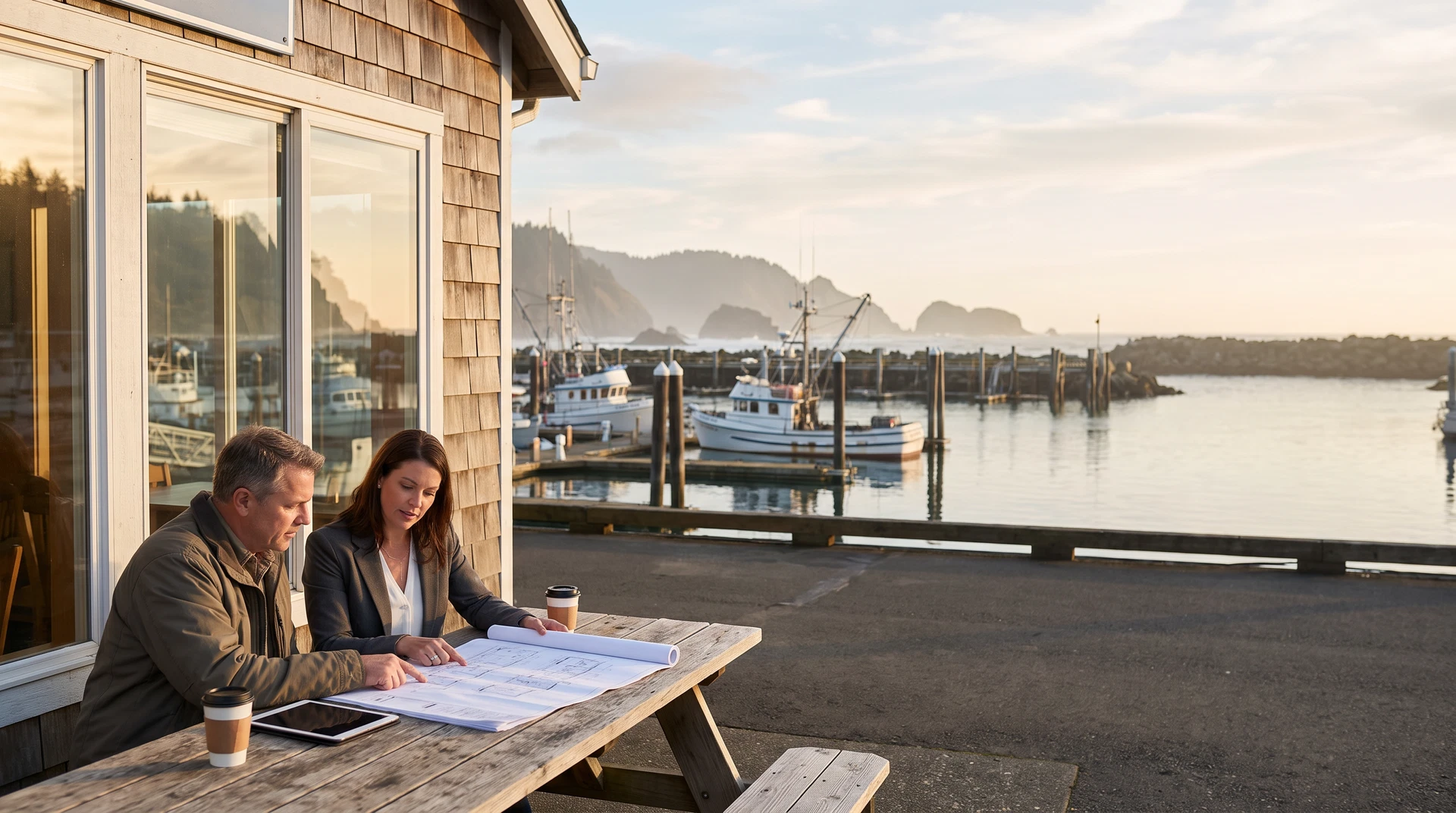

Something quiet is happening along the Oregon-California border, and it has nothing to do with the scenery. Small business owners in Crescent City, Yreka, Eureka, and Redding — communities that have always done their insurance business locally — are increasingly picking up the phone and calling an agency in Brookings, Oregon. Not because they can't find a California agent. Because they can't find a California agent who can actually get them covered. The California insurance market crisis that has dominated headlines for homeowners is hitting commercial lines just as hard, and the small businesses that are getting squeezed hardest are exactly the ones that define Northern California's economy: timber operations, fishing fleets, agricultural businesses, construction contractors, and the restaurants and retailers that serve them. This is what's happening, why it's happening, and what your options actually are.
The California Insurance Market Has Changed Permanently
More than 34 major insurance carriers have exited California or substantially reduced their commercial lines appetite since 2022. State Farm, Allstate, Farmers, AmGUARD, CSE Insurance Group, and American National are among the carriers that have pulled back. For Northern California small businesses, this means fewer options, higher premiums, and more non-renewals — even for businesses with clean loss histories. The solution isn't to accept worse coverage at higher prices. It's to work with an agent who has access to markets that California-only agents don't.
The California Commercial Insurance Market: What Actually Happened
The California insurance crisis didn't happen overnight. It built over a decade as wildfire losses escalated, litigation costs climbed, and California's regulatory framework — which requires carriers to get state approval before raising rates — made it impossible for insurers to price risk accurately. When carriers couldn't charge enough to cover their losses, they stopped writing new policies. When they couldn't exit fast enough, they stopped renewing existing ones. The result, by 2025 and 2026, is a commercial insurance market that looks nothing like it did five years ago.
For Northern California small businesses, the impact has been acute. Siskiyou, Del Norte, Humboldt, and Trinity counties are dominated by industries — timber, fishing, agriculture, construction — that carriers were already cautious about before the crisis. Add wildfire exposure (Siskiyou County has experienced some of California's most destructive wildfires), and you have a market where admitted carriers are declining risks that would have been routine placements five years ago. Business owners who have been with the same carrier for 20 years are receiving non-renewal notices. New businesses are finding that the only coverage available is through the surplus lines market at two or three times the price they expected to pay.
The businesses that are navigating this best are the ones that found an independent agent with access to markets beyond California's admitted market — and that increasingly means working with a multi-state independent agency that can reach Oregon-admitted carriers, regional specialty markets, and the national surplus lines market from a single point of contact.
The Border Region Economy: Who Needs This Most
The Oregon-California border region is economically distinctive in ways that matter for insurance. Siskiyou County's visitor economy generated $247.3 million in 2025, supporting 1,800 local jobs — but that visitor economy depends on hotels, restaurants, outfitters, and tour operators that all need commercial insurance. Del Norte County's Crescent City is home to one of California's most active commercial fishing ports, with the same complex insurance needs — hull and machinery, protection and indemnity, Jones Act workers' comp, pollution liability — that we've written about for Oregon's fishing fleet. Humboldt County's timber and agriculture economy has been a cornerstone of the Pacific Coast for 150 years, and it carries the same specialized commercial coverage needs that California's retreating admitted market is increasingly unwilling to serve.
What these communities share is that they sit at the edge of California's insurance market in every sense. Geographically remote from the major California insurance centers in Los Angeles and San Francisco. Economically dependent on industries that California's admitted carriers have become reluctant to write. And physically close to Oregon — where the insurance market is more stable, where regional carriers are still actively writing commercial lines, and where an independent agency with 90 years of Pacific Coast experience can make a real difference.
Gerald Ross Agency is based in Brookings — 6 miles north of the California border, 25 miles north of Crescent City. We've been writing commercial insurance for Pacific Coast businesses since 1935. We know the timber industry, the fishing industry, the agricultural economy, and the tourism economy of this region from the inside. And we're licensed in both Oregon and California, which means we can access markets that a California-only agent simply cannot reach.
Is Your California Business Getting Non-Renewed?
If you've received a non-renewal notice or your premiums have jumped significantly, call us before you accept a worse policy at a higher price. We have access to markets your current agent may not.
What a Multi-State Independent Agent Can Do That a California Agent Can't
The fundamental advantage of working with a multi-state independent agent is market access. An independent agent represents multiple insurance carriers — not just one. A multi-state independent agent represents carriers admitted in multiple states, plus surplus lines markets that span the entire country. When California's admitted market says no, a multi-state independent agent has more places to go.
For Northern California small businesses, this translates into several concrete advantages. First, access to Oregon-admitted carriers that may be willing to write California commercial risks, particularly for businesses in lower-risk Northern California counties. Second, access to regional specialty carriers that focus on the Pacific Coast and understand the specific industries and risks of the border region. Third, access to the national surplus lines market for hard-to-place risks — the timber operation with a complex equipment schedule, the fishing vessel with a Jones Act crew, the construction contractor with a difficult loss history. Fourth, and perhaps most importantly for businesses that operate on both sides of the border, the ability to coordinate coverage across two states from a single agent who understands both markets.
The alternative — working with a California-only captive agent who represents a single carrier that has already reduced its California appetite — is increasingly a path to inadequate coverage at inflated prices. The businesses that are finding better options are the ones that looked beyond California's borders for their insurance solution.
The Core Commercial Insurance Stack for NorCal Small Businesses
| Coverage | What It Covers | California Requirement | Market Availability |
|---|---|---|---|
| General Liability | Third-party bodily injury and property damage claims | Required by most leases and contracts | Good availability |
| Commercial Property | Building, equipment, inventory, and business personal property | Required by lenders | Tightening in wildfire zones |
| Workers' Compensation | Employee injuries and occupational illness | Mandatory for any employer | Available — rates vary by class |
| Commercial Auto | Business vehicle liability and physical damage | Mandatory for business vehicles (30/60/15 min.) | Good availability |
| Business Interruption | Lost income and fixed expenses during covered closure | Not required — but critical | Often bundled with property |
| Cyber Liability | Data breaches, ransomware, CCPA compliance costs | CCPA creates significant exposure | Growing market |
| Surplus Lines / Specialty | Hard-to-place risks: timber, fishing, cannabis, wildfire zones | Last resort for declined risks | Multi-state agent required |
Industry-Specific Challenges in the NorCal Border Region
The Northern California border region's economy is built on industries that have always required specialized commercial insurance. The California market crisis has made that specialization more important — and harder to find — than ever before.
Timber and Logging: Humboldt, Siskiyou, and Trinity counties are home to some of California's last active timber operations. Logging is one of the most hazardous industries in the United States, and commercial insurance for timber operations — equipment coverage for skidders and processors, workers' comp for high-risk classifications, general liability for timber sales — requires carriers with genuine expertise in the industry. As California's admitted market has contracted, timber operators have increasingly turned to surplus lines markets and regional Pacific Northwest carriers that understand the business. A multi-state independent agent with Pacific Coast roots is essential for this industry.
Commercial Fishing: Crescent City is one of California's most active commercial fishing ports, with a fleet that pursues Dungeness crab, salmon, albacore, and groundfish. As we've written about in our guide to Oregon Coast commercial fishing insurance, the insurance stack for a commercial fishing vessel — hull and machinery, protection and indemnity, Jones Act workers' comp, pollution liability — is genuinely complex and requires a marine insurance specialist. Most California-only agents don't have the marine markets to serve this industry properly.
Agriculture: The Scott Valley in Siskiyou County is one of California's most productive agricultural valleys, with hay, grain, and cattle operations that need farm and ranch insurance, equipment coverage, and agricultural workers' comp. The Humboldt Bay area supports dairy and livestock operations. Agricultural insurance in California has become increasingly difficult to place as carriers have pulled back from rural counties, making multi-state market access more valuable than ever.
Tourism and Hospitality: Siskiyou County's $247.3 million visitor economy is built on hotels, restaurants, outfitters, and tour operators around Mt. Shasta, Dunsmuir, and the Klamath River. These businesses need restaurant insurance, liquor liability, commercial property, and general liability — coverage categories where California's market remains reasonably competitive, but where an independent agent can still find better rates and broader coverage by shopping multiple carriers.
Construction Contractors: Northern California's construction industry — from Redding's growing commercial sector to the rural residential contractors serving Siskiyou and Del Norte counties — faces a workers' comp market that has become increasingly expensive and difficult to navigate. California's mandatory workers' comp requirement, combined with high construction class codes, means that contractors who don't have an agent actively shopping their coverage are almost certainly overpaying. A multi-state independent agent can access Oregon-admitted carriers that may write California construction risks at more competitive rates.
Serving Northern California Since 1935 — From Just 6 Miles Away
Gerald Ross Agency is based in Brookings, Oregon — 6 miles north of the California border. We're licensed in both Oregon and California, and we've been writing commercial insurance for Pacific Coast businesses for over 90 years. Call us or visit our Crescent City commercial insurance page to learn more.
The Multi-State Business Advantage
One of the most underserved segments of the Northern California border region is businesses that operate in both California and Oregon. A timber contractor who logs in both states. A trucking company with routes through both states. A construction company that takes jobs on both sides of the border. A vacation rental owner with properties in Crescent City and Brookings. These businesses face a coverage coordination challenge that two separate state-specific agents handle badly — and that a single multi-state independent agent handles well.
The specific risks of operating in two states include: workers' compensation coverage that must satisfy both California and Oregon requirements (which differ significantly in terms of benefits, rates, and classification systems); commercial auto coverage that must include appropriate interstate endorsements; and general liability policies that must cover operations in both states without gaps or overlaps. When two separate agents handle each state independently, these coordination issues frequently result in uncovered claims — the kind that only become apparent when something goes wrong.
Gerald Ross Agency handles multi-state commercial insurance as a routine part of our practice. We serve businesses from Crescent City to Yreka to Eureka to Redding, and we coordinate their coverage with their Oregon operations as a single, integrated program. It's simpler for the business owner, it eliminates coverage gaps, and it often results in better pricing because we're placing a larger, more attractive account with our carriers.
10 Signs Your Northern California Business Needs a Multi-State Independent Agent
California's Workers' Compensation Requirement: What Every NorCal Employer Must Know
California has one of the strictest workers' compensation requirements in the United States, and it applies to every employer in the state — regardless of size, industry, or how many hours an employee works. If you have one employee — full-time, part-time, seasonal, or temporary — you are required by California law to carry workers' compensation insurance. There is no minimum employee threshold. There is no grace period for new businesses.
The penalties for non-compliance are severe. The California Labor Commissioner can issue a stop-work order that shuts your business down immediately. Fines can reach $10,000 per employee at the time of the violation, with penalties up to $100,000 for willful non-compliance. Violations are criminal misdemeanors punishable by up to one year in county jail. And if an uninsured employee is injured, you lose the legal protection that workers' comp provides — the employee can file a civil lawsuit against you personally, and you are liable for every dollar of their medical care, lost wages, and pain and suffering.
For businesses near the Oregon border that have employees working in both states, the situation is more complex. Oregon has its own workers' compensation requirements, which differ from California's in terms of benefits, rates, and classification systems. A multi-state independent agent can structure a workers' comp program that satisfies both states' requirements without gaps or duplicate coverage — and can often find better rates by placing the account with carriers that have strong books of business in both states. Learn more about workers' compensation insurance and how we approach it for Pacific Coast businesses.
Frequently Asked Questions
Can a Northern California small business use an Oregon-based insurance agency?+
Why is commercial insurance harder to find in Northern California than in Oregon?+
What is surplus lines insurance and why does it matter for NorCal businesses?+
Does Gerald Ross Agency serve businesses in Crescent City, Yreka, Eureka, and Redding?+
Don't Accept a Worse Policy at a Higher Price
Northern California small businesses deserve the same access to competitive commercial insurance markets that Oregon businesses have always had. Gerald Ross Agency is licensed in both states, based 6 miles from the California border, and has been serving Pacific Coast businesses for over 90 years. If you've been non-renewed, if your premiums have jumped, or if you simply haven't had a coverage review recently — call us. We'll tell you honestly what your options are.


