


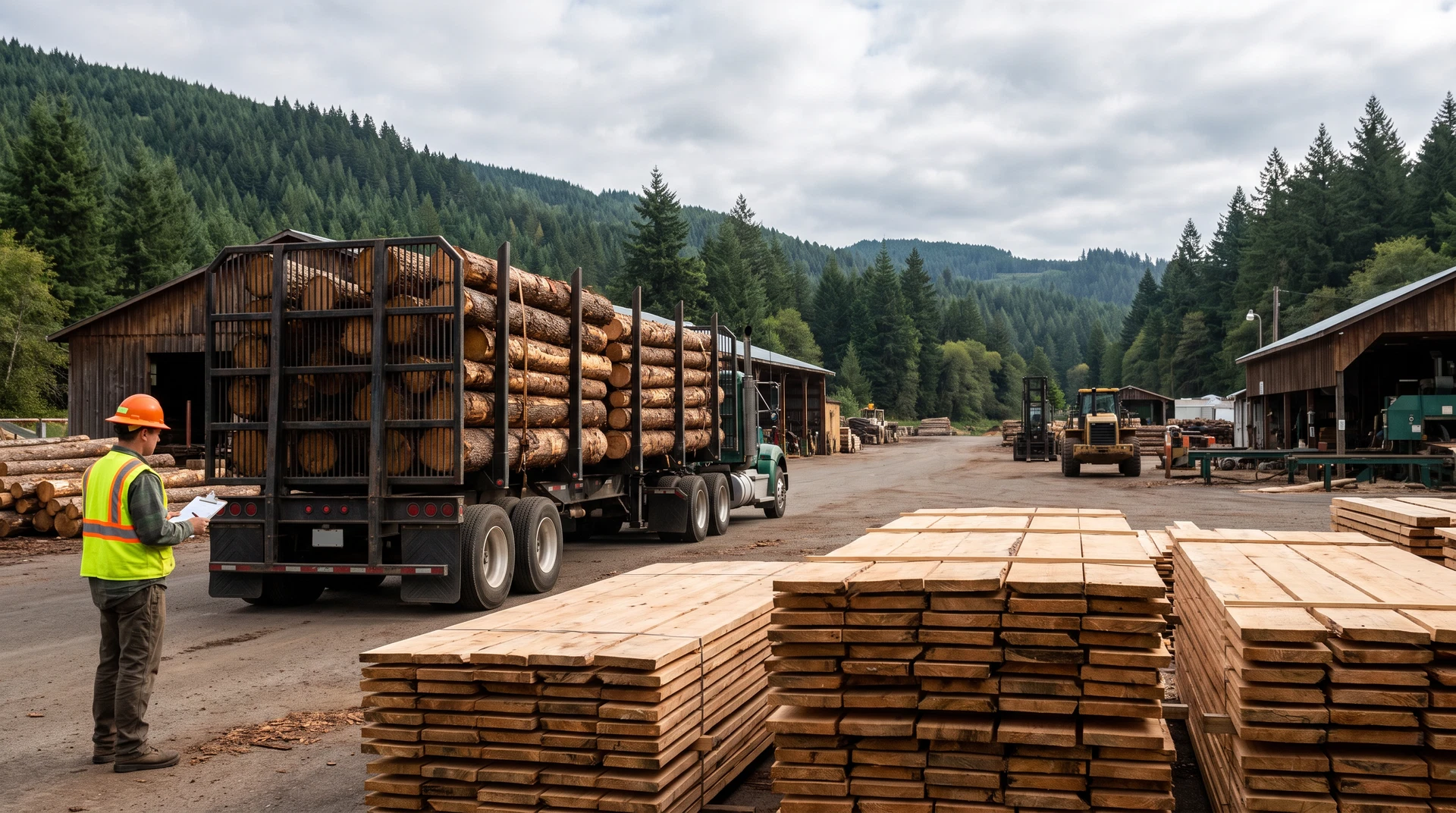

Oregon's timber industry is one of the state's most important economic engines — and one of its most hazardous. From the Douglas fir forests of the Coast Range and Cascades to the ponderosa pine stands of Southern Oregon and Eastern Oregon, logging contractors, sawmill operators, and wood products manufacturers face a unique combination of physical risks, regulatory requirements, and liability exposures that demand specialized insurance coverage. A standard commercial insurance policy built for a retail shop or office building simply does not address the realities of chainsaw injuries, log truck accidents, sawmill fires, or wildfire suppression liability. This guide covers everything Oregon timber industry businesses need to know about insurance in 2026.
Why the Oregon Timber Industry Needs Specialized Insurance
The Bureau of Labor Statistics consistently ranks logging as one of the top three most dangerous occupations in the United States, with a fatality rate more than 30 times the national average for all workers. Sawmill and wood products manufacturing operations are not far behind — wood dust fires, conveyor entanglements, and kiln explosions create hazards that most insurance carriers are reluctant to write without specialized underwriting expertise.
Oregon adds additional layers of complexity. The Oregon Department of Forestry (ODF) requires proof of insurance for many timber sale contracts and harvest permits. The Oregon Workers' Compensation Division actively audits timber employers and imposes some of the highest workers' comp classification rates in the state for logging and sawmill operations. And Oregon's wildfire season — growing longer and more severe each year — creates wildfire suppression liability exposure that can reach millions of dollars for a single logging operation that accidentally ignites a fire.
Extreme Injury Risk
Logging is the most dangerous occupation in the U.S. by fatality rate. Chainsaw injuries, falling tree strikes, skidder rollovers, and log truck accidents create frequent and severe workers' compensation claims. Oregon's WC rates for logging classifications reflect this reality.
Wildfire Suppression Liability
A logging operation that accidentally starts a wildfire in Oregon's forests can be held liable for millions of dollars in suppression costs incurred by ODF, the USFS, and neighboring landowners. Standard GL policies exclude this exposure — Loggers Broad Form is essential.
Sawmill Fire Hazard
Wood dust is classified as a combustible dust by OSHA, and sawmills carry one of the highest fire risk profiles of any manufacturing operation. A single fire can destroy the mill building, all equipment, and months of lumber inventory — often totaling millions of dollars in losses.
Log Truck Liability
Log trucks are among the most hazardous commercial vehicles on Oregon roads. Overloaded trucks, unsecured loads, and steep mountain roads create serious accident exposure. A log truck accident involving fatalities or serious injuries can generate liability claims well above standard auto policy limits.
High-Value Equipment
Feller-bunchers, skidders, forwarders, yarders, and band saws represent hundreds of thousands to millions of dollars in equipment value. Equipment breakdowns, theft on remote job sites, and damage from falling trees create significant inland marine and equipment breakdown exposures.
Environmental & Pollution Liability
Fuel spills from logging equipment, hydraulic fluid leaks, and sediment runoff into Oregon's protected waterways create pollution liability exposure. Oregon's Department of Environmental Quality (DEQ) and the Army Corps of Engineers enforce strict cleanup requirements that general liability policies typically exclude.
Essential Insurance for Oregon Logging Contractors
A complete insurance program for an Oregon logging contractor goes well beyond a basic general liability policy. Here is what a comprehensive logging contractor insurance portfolio looks like in 2026:
1. General Liability with Loggers Broad Form Endorsement
Standard general liability insurance covers bodily injury and property damage claims arising from your operations — but for logging contractors, the standard form leaves critical gaps. The Loggers Broad Form endorsement extends your general liability policy to cover:
- Property damage to timberlands you are working on (including standing timber damaged by your operations)
- Damage arising from the loading and unloading of logs
- Fire suppression costs incurred by others as a result of your logging operations
- Accidental trespass onto adjacent timber land
- Blasting and explosion liability (for operations using explosives for stump removal)
Without the Loggers Broad Form endorsement, an Oregon logging contractor who accidentally starts a wildfire could face millions of dollars in suppression costs with no insurance coverage. This endorsement is not optional — it is the foundation of any logging contractor's insurance program.
2. Workers' Compensation Insurance
Oregon law requires workers' compensation insurance for all employees — no exceptions. For logging contractors, workers' comp is not just a legal requirement; it is one of the most significant insurance costs in the business. Oregon's workers' comp classification rates for logging operations reflect the industry's injury frequency and severity:
| Classification | Typical Rate (per $100 payroll) | Notes |
|---|---|---|
| Logging — Felling & Bucking | $20–$35 | Highest-risk classification in Oregon |
| Logging — Skidding & Yarding | $18–$28 | Heavy equipment operators |
| Log Truck Drivers | $12–$20 | Includes loading/unloading exposure |
| Sawmill — Production Workers | $10–$18 | Saw operators, green chain workers |
| Sawmill — Maintenance & Repair | $8–$14 | Mechanics, electricians |
| Wood Products — Manufacturing | $6–$12 | Varies by operation type |
Misclassifying logging employees as independent contractors to avoid workers' comp is one of the most common — and costly — mistakes in the Oregon timber industry. The Workers' Compensation Division actively audits logging and sawmill employers, and violations result in back premiums, penalties, and personal liability for the business owner. The Associated Oregon Loggers (AOL) offers a workers' comp program through SAIF that many Oregon logging contractors use as a competitive alternative to the private market.
3. Commercial Auto Insurance for Log Trucks & Logging Vehicles
Every vehicle used in logging operations — log trucks, chip vans, lowboys, pickups, water trucks, and equipment trailers — must be covered under a commercial auto insurance policy. Personal auto policies explicitly exclude business use, and a log truck accident involving a personal auto policy would result in a denied claim.
Log trucks are among the most expensive commercial vehicles to insure in Oregon. A single log truck accident involving fatalities or serious injuries can generate liability claims of $1 million or more. Most timber sale contracts and ODF permits require minimum liability limits of $1 million per occurrence for log trucks. Many Oregon logging contractors carry $2 million per occurrence with a commercial umbrella stacked on top for additional protection.
4. Logging Equipment Insurance (Inland Marine)
Logging equipment — feller-bunchers, skidders, forwarders, yarders, processors, and loaders — represents the largest capital investment most logging contractors make. This equipment is not covered by commercial auto or general liability policies. An inland marine (logging equipment) policy covers:
- Physical damage from accidents, rollovers, and falling trees
- Fire and theft on remote job sites
- Flood damage during stream crossings or wet-weather operations
- Vandalism and mysterious disappearance
- Breakdown and mechanical failure (with an equipment breakdown endorsement)
Remote Oregon job sites — often miles from the nearest town on unpaved forest roads — are prime targets for equipment theft. A stolen feller-buncher or skidder can cost $200,000–$800,000 to replace, and the downtime during replacement can cost far more in lost production. Inland marine coverage is not optional for any logging contractor with significant equipment investment.
Get a Logging & Timber Industry Insurance Quote
Gerald Ross Agency has served Oregon's timber industry since 1935. We shop 50+ carriers to build the right program for your logging, sawmill, or wood products operation — workers' comp, loggers broad form, commercial auto, equipment, and more.
Essential Insurance for Oregon Sawmills
Sawmill operations face a distinct set of insurance challenges compared to logging contractors. The combination of high fire risk, expensive specialized equipment, large lumber inventory, and significant payroll creates a complex insurance program that requires carriers with specific sawmill underwriting expertise.
5. Commercial Property Insurance — Fire Is the Primary Threat
Wood dust is classified as a combustible dust by OSHA, and sawmills carry one of the highest fire risk profiles of any manufacturing operation in Oregon. A single fire can destroy the mill building, all processing equipment, and months of lumber inventory — often totaling millions of dollars in losses. Commercial property insurance for a sawmill should cover:
- The mill building and all outbuildings (dry kilns, log decks, lumber sheds)
- Processing equipment — band saws, edgers, planers, conveyors, and debarkers
- Lumber inventory and log decks (often the largest single asset on the property)
- Office contents, computers, and business records
- Outdoor property including log storage areas and equipment yards
Many standard commercial property carriers will not write sawmill risks due to the fire hazard. Gerald Ross Agency works with specialty carriers that understand sawmill operations and can provide the property limits and coverage terms your operation requires. Proper wood dust management, sprinkler systems, and documented safety programs can significantly reduce your property insurance premiums.
6. Equipment Breakdown Insurance
Sawmill production depends on specialized, high-value equipment that is often custom-built or difficult to replace quickly. Equipment breakdown insurance (also called boiler and machinery coverage) covers repair or replacement costs when equipment fails due to mechanical or electrical failure — a cause of loss that commercial property policies explicitly exclude. For Oregon sawmills, this coverage is particularly important for:
- Band saws and head rigs — the heart of any sawmill operation
- Dry kilns and kiln control systems
- Conveyors, sorters, and green chain systems
- Electrical switchgear and motor control centers
- Boilers and pressure vessels used in kiln drying
7. Business Interruption Insurance
If a fire, equipment breakdown, or other covered event temporarily shuts down your sawmill, business interruption insurance replaces lost income and covers ongoing fixed expenses — payroll, loan payments, lease obligations, and utilities — while you rebuild or repair. For Oregon sawmills, business interruption coverage is particularly valuable because:
Sawmill reconstruction can take 12–24 months. Specialized equipment like band saws and kiln systems often has lead times of 6–18 months. During that period, your fixed costs continue even as revenue stops. Without business interruption coverage, a major fire or equipment loss can permanently close a sawmill that would otherwise have been financially viable. Business interruption coverage should be set at a minimum of 12 months of gross profit — and 24 months is increasingly common for larger operations.
Insurance for Oregon Wood Products Manufacturers
Oregon's wood products manufacturing sector includes pallet manufacturers, architectural millwork shops, hardwood flooring manufacturers, cabinet shops, furniture manufacturers, and engineered wood product producers. Each of these operations has a distinct insurance profile — but all share the common thread of fire risk, workers' compensation exposure, and product liability concerns.
Product Liability Insurance
Wood products manufacturers face product liability exposure if a product they manufacture causes injury or property damage after it leaves their facility. A cabinet that collapses, a pallet that fails under load, or a hardwood floor that delaminates prematurely can all generate product liability claims. Product liability coverage is included in most commercial general liability policies but should be confirmed with your agent — particularly if you manufacture structural components or products used in load-bearing applications.
Pollution Liability Insurance
Wood products manufacturing operations that use adhesives, stains, finishes, preservatives, or fire retardants face pollution liability exposure. A chemical spill, a VOC release, or a wastewater discharge into a protected Oregon waterway can result in DEQ cleanup orders and significant fines. Pollution liability insurance covers cleanup costs, third-party bodily injury and property damage claims, and regulatory defense costs that general liability policies exclude.
Inland Marine — Finished Goods in Transit
Wood products manufacturers who deliver finished goods to customers, job sites, or distribution centers need inland marine coverage for products in transit. Commercial property policies cover inventory at your facility — but once a load of lumber, cabinets, or millwork leaves your dock on a delivery truck, it is no longer covered by your property policy. Inland marine fills this gap.
Commercial Umbrella Insurance
Given the severity of potential losses in the timber and wood products industry — a major fire, a log truck fatality, a wildfire suppression claim — a commercial umbrella policy providing $1–$5 million in excess liability coverage above your primary policies is strongly recommended. Umbrella coverage is one of the most cost-effective ways to protect a timber industry business from catastrophic losses.
2026 Oregon Timber Industry Insurance Cost Guide
Insurance costs in the Oregon timber industry vary significantly based on payroll, fleet size, equipment value, revenue, and claims history. The table below provides 2026 benchmark ranges for typical operations:
| Coverage | Logging Contractor | Sawmill | Wood Products Mfr. |
|---|---|---|---|
| General Liability (Loggers BF) | $3,000–$12,000/yr | $4,000–$15,000/yr | $2,500–$10,000/yr |
| Workers' Compensation | $15–$35/$100 payroll | $10–$18/$100 payroll | $6–$12/$100 payroll |
| Commercial Auto (per truck) | $4,000–$15,000/yr | $3,000–$10,000/yr | $2,000–$8,000/yr |
| Logging Equipment (Inland Marine) | $5,000–$20,000/yr | N/A | N/A |
| Commercial Property | N/A | $8,000–$40,000/yr | $4,000–$20,000/yr |
| Equipment Breakdown | N/A | $1,500–$6,000/yr | $1,000–$4,000/yr |
| Business Interruption | N/A | $3,000–$12,000/yr | $2,000–$8,000/yr |
| Commercial Umbrella ($1M) | $1,500–$4,000/yr | $2,000–$5,000/yr | $1,500–$3,500/yr |
Protect Your Oregon Timber Business
From sole-proprietor logging contractors to regional sawmills and wood products manufacturers, Gerald Ross Agency builds insurance programs that match the unique demands of Oregon's timber industry. Serving Southern Oregon, the Willamette Valley, and the Oregon Coast since 1935.
Risk Management Tips for Oregon Timber Industry Businesses
Good risk management does more than prevent accidents — it directly reduces your insurance premiums. Oregon timber industry businesses with strong safety programs, documented training, and low claims histories consistently pay significantly less for workers' compensation and general liability coverage than operations with poor safety records. Here are the most impactful risk management steps for Oregon timber businesses:
Implement a Written Safety Program
Oregon OSHA requires written safety programs for logging and sawmill operations. A well-documented program covering chainsaw safety, falling procedures, equipment operation, and emergency response reduces injury frequency and demonstrates to insurers that your operation is well-managed.
Conduct Regular Equipment Inspections
Logging equipment failures are a leading cause of serious injuries and fatalities. Daily pre-operation inspections, documented maintenance records, and prompt repair of identified defects reduce both injury risk and equipment breakdown claims.
Manage Wood Dust at Your Sawmill
OSHA's combustible dust standard requires regular dust collection, housekeeping, and equipment maintenance at sawmills. Proper dust management reduces fire risk, which directly reduces your property insurance premiums and the likelihood of a catastrophic fire loss.
Maintain Proper Fuel Storage Practices
Fuel spills from logging equipment are one of the most common pollution liability claims in Oregon's timber industry. Proper fuel storage containers, secondary containment, and spill response kits reduce both the frequency and severity of pollution incidents.
Review Your Certificates of Insurance Annually
Timber sale contracts, ODF permits, and timber company agreements all require specific insurance coverages and limits. Review your certificates of insurance annually — or before signing any new contract — to ensure your coverage meets the requirements. A lapsed certificate can result in a work stoppage on an active timber sale.
How Gerald Ross Agency Helps Oregon Timber Industry Businesses
Gerald Ross Agency has been serving Oregon's timber and wood products industry since 1935 — nearly a century of experience placing insurance for logging contractors, sawmill operators, and wood products manufacturers across Southern Oregon, the Willamette Valley, and the Oregon Coast. As an independent agency, we are not tied to a single carrier. We shop 50+ top-rated insurance companies to find the right combination of workers' comp, loggers broad form liability, commercial auto, equipment, property, and business interruption coverage for your specific operation.
We understand the Oregon timber industry. We know which carriers write logging and sawmill risks — and which ones don't. We know the ODF permit requirements, the Associated Oregon Loggers workers' comp program, and the specialty markets for high-value logging equipment. And we know how to build an insurance program that keeps your operation running, your crew protected, and your contracts compliant.
Whether you are a sole-proprietor logging contractor working timber sales in the Siskiyous, a family-owned sawmill in the Willamette Valley, or a regional wood products manufacturer supplying the Pacific Northwest construction market, Gerald Ross Agency has the market access and timber industry expertise to build the right insurance program for your business. Learn more about our agency or get a free quote today.
Frequently Asked Questions
What insurance do Oregon logging contractors need?
What is Loggers Broad Form coverage and why is it important?
How much does logging insurance cost in Oregon?
What insurance does a sawmill need in Oregon?
Is workers' compensation required for Oregon logging and sawmill workers?
Does my general liability policy cover wildfire suppression costs?
How does Gerald Ross Agency help Oregon timber industry businesses?
Related Resources
Ready to Protect Your Oregon Timber Business?
Get a comprehensive timber industry insurance review from Gerald Ross Agency. We have served Oregon's logging, sawmill, and wood products industry since 1935 and know exactly what coverage you need to stay protected, stay compliant, and keep operating.


