


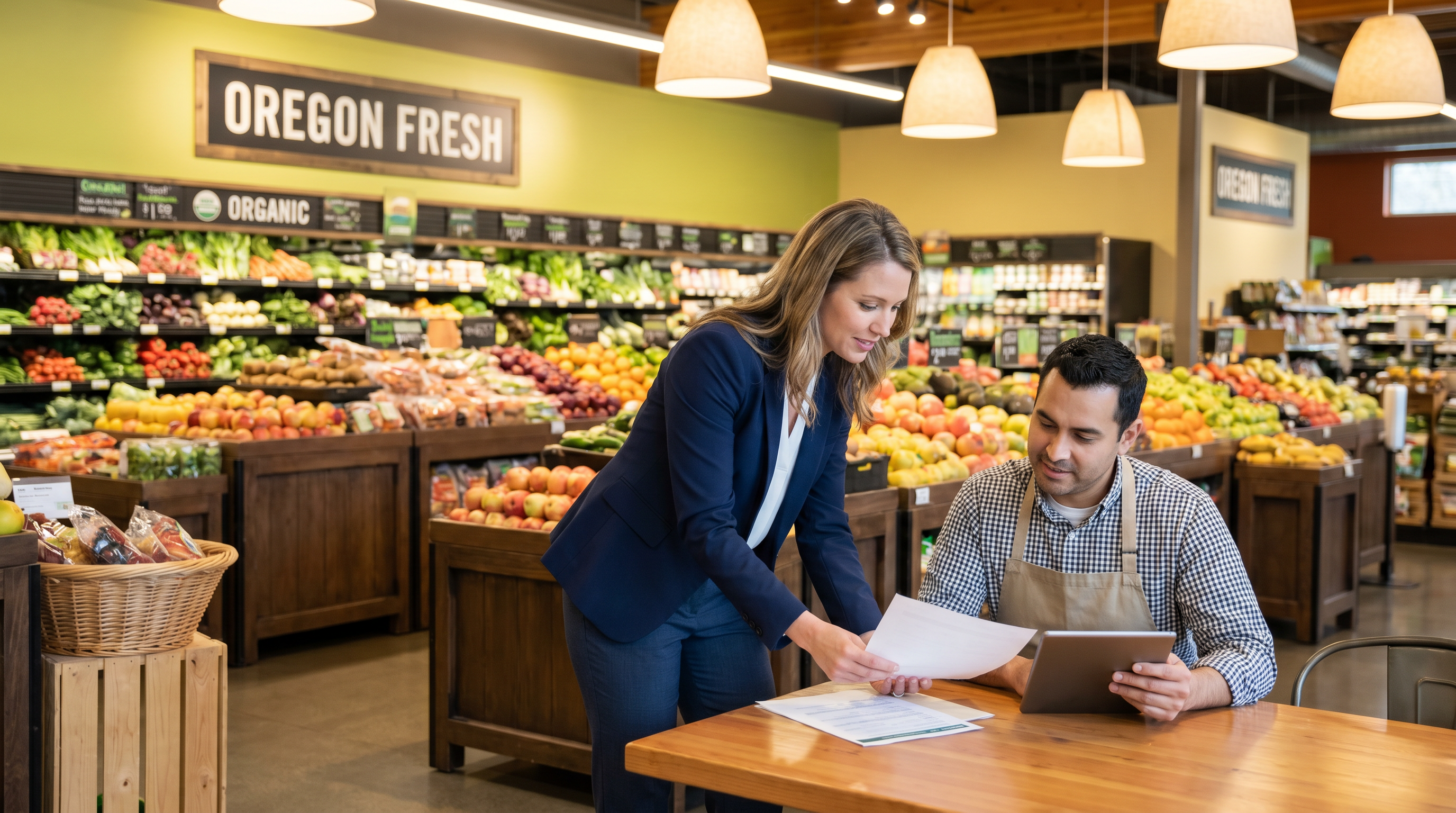

Oregon's independent grocery stores are the heart of their communities — from the natural food co-ops in Ashland and Corvallis to the family-owned markets in Brookings, Gold Beach, and Coos Bay that serve as the only full-service grocery within miles. But running a grocery store in Oregon comes with a set of insurance exposures that most store owners don't fully understand until a claim hits. Product liability from a foodborne illness outbreak, tens of thousands of dollars in spoiled inventory from a refrigeration failure, a serious slip-and-fall on a wet produce floor — any one of these can threaten the financial stability of a business that took decades to build. This guide explains every coverage Oregon grocery store owners need — and how Gerald Ross Agency's commercial insurance specialists can help you get properly protected.
The Most Common Coverage Gap for Oregon Grocery Stores
Standard commercial property policies do not cover food spoilage from refrigeration failure or power outages. A single compressor failure in a walk-in cooler can result in $20,000–$80,000 in spoiled inventory — and without a food spoilage endorsement, that loss is entirely uninsured. This is the most common and most costly coverage gap we see in grocery store policies.
Why Grocery Store Insurance Is More Complex Than Most Retailers
Grocery stores occupy a unique position in the commercial insurance landscape. Unlike most retail businesses, grocery stores combine the exposures of a high-traffic retail environment with the product liability risks of a food manufacturer, the equipment-dependent operations of a cold storage facility, and the employment intensity of a full-service business. A standard commercial property and general liability policy — the kind that works fine for a clothing boutique or hardware store — simply does not address the full range of risks that a grocery store faces.
Oregon's independent grocery stores face additional complexity from the state's regulatory environment. Workers' compensation is required for virtually all employers, Oregon OLCC licensing requirements apply if you sell beer, wine, or spirits, and Oregon's food safety regulations create specific documentation and training obligations that can affect your insurance coverage in the event of a claim. Understanding the food industry insurance landscape is the first step to getting your store properly protected.
The 7 Essential Coverages for Oregon Grocery Stores
General Liability
Covers third-party bodily injury and property damage claims — including slip-and-fall accidents on wet floors, customer injuries from shopping carts, and advertising injury claims. The foundation of any grocery store insurance program.
Product Liability
Covers claims from food products you sell that cause illness, injury, or property damage. Even if you didn't manufacture the product, you can be named in a lawsuit as the retailer. Essential for any store selling prepared foods or local products.
Food Spoilage & Refrigeration Breakdown
Covers perishable inventory lost due to refrigeration equipment failure, power outages, or mechanical breakdown. A critical endorsement that standard commercial property policies do not include by default.
Commercial Property
Covers your building, fixtures, shelving, refrigeration equipment, POS systems, and inventory against fire, vandalism, windstorm, and other covered perils. Oregon Coast stores need additional attention to wind and flood exposure.
Workers' Compensation
Required by Oregon law for any business with employees. Grocery stores have above-average workers' comp claims due to lifting injuries, slip-and-falls, and repetitive motion injuries. Failure to carry it can result in significant penalties.
Cyber Liability & POS Security
Grocery store POS systems process thousands of card transactions daily — making them a primary target for data theft and card skimming. Cyber liability covers breach response costs, customer notification, and regulatory fines.
Business Interruption
Covers lost income and continuing expenses if your store is forced to close temporarily due to a covered loss — such as a kitchen fire, flood, or major equipment failure. Can be the difference between surviving a closure and permanently closing.
Is Your Grocery Store Properly Covered?
Gerald Ross Agency reviews your current policy for free and identifies any coverage gaps — including the food spoilage endorsement most stores are missing.
Food Spoilage Insurance: The Coverage Gap That Costs Oregon Grocers the Most
Of all the coverage gaps we see in grocery store insurance programs, food spoilage is the most common and the most costly. Standard commercial property policies are designed to cover physical damage to your building and equipment — not the value of perishable inventory that spoils when that equipment fails. Without a specific food spoilage endorsement, a refrigeration compressor failure, a power outage from a coastal storm, or a mechanical breakdown in your walk-in freezer can result in a loss that is entirely uninsured.
The numbers are significant. A mid-size independent grocery store might carry $30,000–$100,000 in refrigerated and frozen inventory at any given time. A single walk-in cooler failure over a weekend — when the store is closed and the failure goes undetected for 24–48 hours — can result in the total loss of everything in that unit. For Oregon Coast grocery stores that serve as the primary food source for their communities, the business interruption impact of a major refrigeration failure can be equally severe.
Gerald Ross Agency ensures that every grocery store client has adequate food spoilage coverage — with limits that reflect their actual inventory levels, not a generic estimate. We also review your policy for equipment breakdown coverage, which covers the cost of repairing or replacing failed refrigeration equipment itself — a separate gap that many store owners discover only after a claim.
Independent Agency vs. Direct Carrier: What's the Difference for Grocery Stores?
| Coverage Feature | Gerald Ross Agency (Independent) | Direct / Captive Carrier |
|---|---|---|
| Access to food-retail specialist carriers | ✓ | ✗ |
| Food spoilage endorsement placement | ✓ | Limited |
| Product liability for prepared foods | ✓ | Limited |
| Shops 50+ carriers for best rate | ✓ | ✗ |
| Claims advocacy on your behalf | ✓ | ✗ |
| Liquor liability for OLCC licensees | ✓ | Limited |
Product Liability: Why Every Oregon Grocery Store Needs It
Product liability is the coverage that protects your business when a food product you sell causes illness, injury, or property damage to a customer. As the retailer, you can be named in a lawsuit even if you had no role in manufacturing or preparing the product — the legal theory of strict liability means that everyone in the distribution chain, from manufacturer to retailer, can be held responsible for a defective or contaminated product.
This exposure is particularly acute for Oregon grocery stores that sell prepared foods from their deli or bakery departments, bulk items where cross-contamination is a risk, or products from local producers and farmers who may not carry their own product liability insurance. If a customer gets sick from your prepared chicken salad, or has an allergic reaction to a bulk item that was mislabeled, your store is the most likely target for a lawsuit — and without adequate product liability coverage, the legal defense costs alone can be devastating.
Product liability insurance is typically included in a general liability policy, but coverage limits and exclusions vary significantly between carriers. Gerald Ross Agency reviews your product liability coverage carefully — particularly if you sell prepared foods, local products, or bulk items — to ensure your limits are adequate and your policy doesn't contain exclusions that would leave you exposed.
Workers' Compensation for Oregon Grocery Stores: What You Need to Know
Oregon law requires workers' compensation insurance for virtually all employers with one or more employees. For grocery stores, this is not optional — and the penalties for non-compliance are severe. Oregon's Workers' Compensation Division can assess fines, order your store closed, and hold you personally liable for employee injury claims if you are operating without coverage.
Grocery stores have above-average workers' compensation claims rates for several reasons. The work is physically demanding — employees lift heavy cases, work on wet floors, and perform repetitive motions scanning and stocking shelves for hours at a time. Back injuries, slip-and-fall accidents, and repetitive motion injuries (carpal tunnel, shoulder injuries) are the most common claims. Oregon workers' compensation rates are experience-rated, meaning your claims history directly affects your premium — making loss prevention and early return-to-work programs important cost management tools.
Oregon Coast Grocery Store? We Know Your Market.
Gerald Ross Agency has served Oregon Coast businesses since 1935. We understand the coastal weather exposure, the seasonal revenue patterns, and the unique risks that come with serving as your community's primary food source.
Get a Quote for Your StoreCyber Liability for Grocery Stores: A Growing Risk You Can't Ignore
Grocery store point-of-sale systems process thousands of credit and debit card transactions every day — making them a primary target for card skimming devices, data theft, and ransomware attacks. A data breach at a grocery store can expose thousands of customers' payment card information, triggering mandatory notification requirements, regulatory investigations, and significant legal liability.
Cyber liability insurance covers the costs of responding to a data breach — including forensic investigation, customer notification, credit monitoring services, regulatory fines, and legal defense. It also covers business interruption losses if your POS system is taken offline by a ransomware attack. For grocery stores that have adopted online ordering, loyalty programs, or digital payment systems, cyber liability is no longer optional coverage — it is an essential part of your risk management program.
Special Considerations for Oregon Coast Grocery Stores
Grocery stores along the Oregon Coast face a set of risks that inland stores don't encounter. Coastal storms can knock out power for days at a time — turning a refrigeration failure into a catastrophic inventory loss. Tsunami inundation zones affect many coastal communities, and standard commercial property policies specifically exclude flood damage. Wind-driven rain can cause building damage that standard policies may dispute if the damage is characterized as "flooding" rather than wind damage.
Oregon Coast grocery stores that serve as essential community infrastructure — often the only full-service food retailer within 20–30 miles — also face unique business interruption exposure. A temporary closure from a major storm or equipment failure doesn't just affect your revenue; it affects your entire community's access to food. Business interruption coverage with adequate limits and a short waiting period is particularly important for these stores.
Gerald Ross Agency has served Brookings, Gold Beach, Coos Bay, Florence, and communities throughout the Oregon Coast since 1935. We understand the coastal insurance market and can help you find coverage that addresses the specific risks of operating a grocery store in a coastal environment.
Frequently Asked Questions: Grocery Store Insurance in Oregon
What insurance does a grocery store need in Oregon?
A typical Oregon grocery store needs: general liability insurance, product liability insurance, commercial property insurance, food spoilage and refrigeration breakdown coverage, workers' compensation (required for any employee), cyber liability insurance for POS systems, liquor liability (if selling beer/wine/spirits), and business interruption insurance. A Business Owners Policy (BOP) can bundle several of these coverages at a lower combined cost.
Does commercial property insurance cover food spoilage?
Standard commercial property policies typically do not cover food spoilage from refrigeration equipment failure or power outages unless you specifically add a food spoilage endorsement. This is one of the most common and most costly coverage gaps for grocery store owners. Gerald Ross Agency ensures your policy includes adequate food spoilage coverage for your actual inventory levels.
How much does grocery store insurance cost in Oregon?
Grocery store insurance costs vary based on store size, annual revenue, number of employees, type of products sold, and claims history. A small independent grocery store might pay $8,000–$18,000 per year for a complete program; larger operations with prepared food departments and high annual revenue may pay significantly more. Gerald Ross Agency shops 50+ carriers to find the best rate for your specific operation.
Do I need liquor liability if my grocery store sells beer and wine?
Yes. If your grocery store holds an Oregon OLCC license to sell beer, wine, or spirits, you need liquor liability coverage. Standard general liability policies typically exclude or limit liquor liability. Oregon OLCC may also require proof of liquor liability insurance as a condition of your license.
Is flood insurance included in my grocery store commercial property policy?
No. Standard commercial property policies specifically exclude flood damage. Oregon Coast grocery stores face real flood risk from coastal storms, river flooding, and tsunami inundation zones. Gerald Ross Agency can help you obtain commercial flood insurance through the National Flood Insurance Program (NFIP) or private flood markets — essential coverage for any coastal Oregon business.
Ready to Get Your Grocery Store Properly Covered?
Gerald Ross Agency has served Oregon businesses since 1935. We shop 50+ carriers to find the right coverage at the right price — and we work for you, not for any insurance company.


