


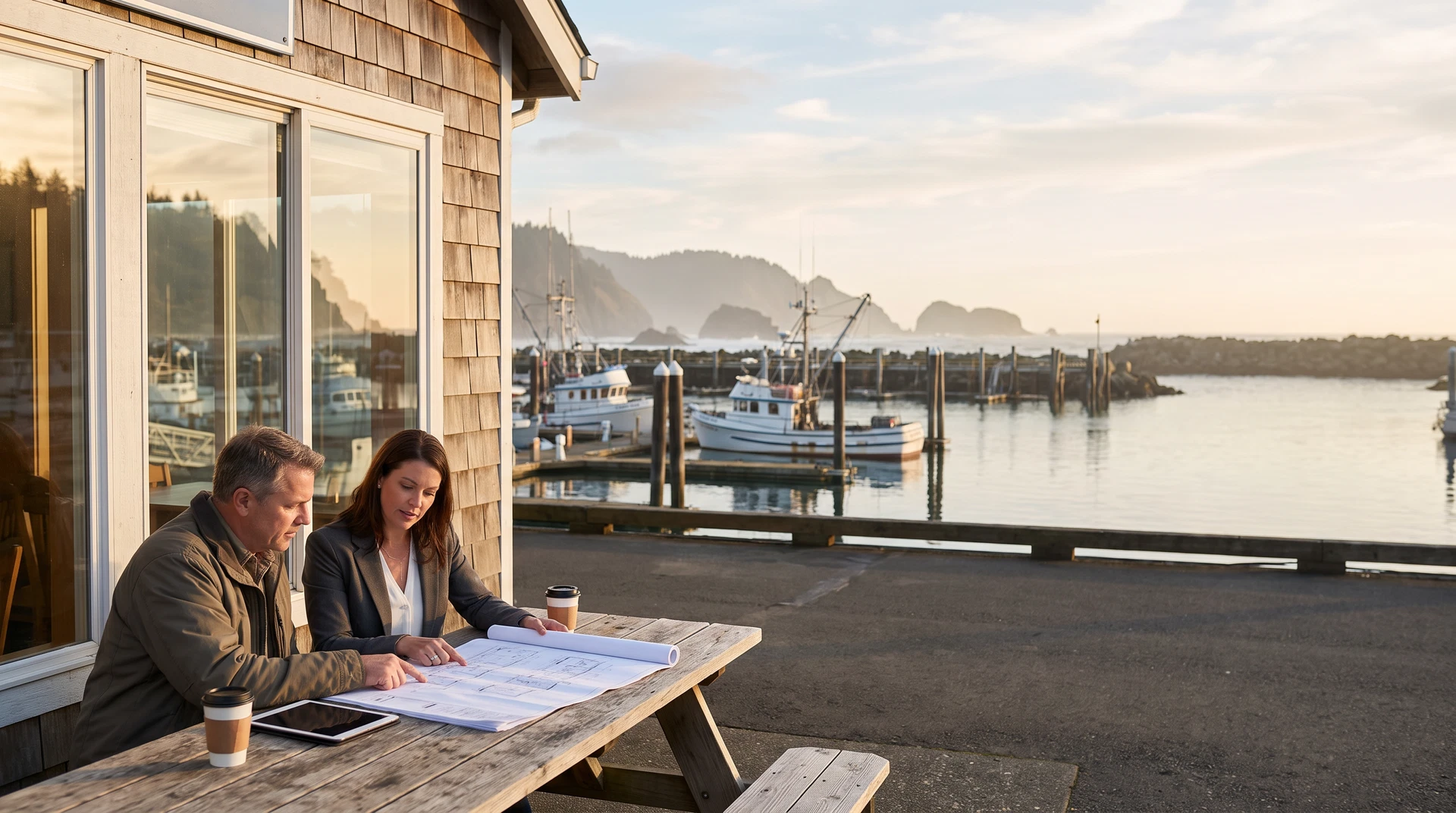

Running a business on the Oregon Coast is one of the most rewarding things a person can do — and one of the most complex when it comes to managing risk. The same qualities that make the coast so appealing to visitors and residents alike — the dramatic Pacific Ocean setting, the seasonal tourism economy, the remote beauty — create a set of insurance exposures that most standard commercial insurance policies were never designed to address. After decades of serving businesses from Astoria to Brookings, the team at Gerald Ross Agency has seen the same coverage gaps cause devastating financial losses for business owners who thought they were fully protected. Here are the six risks that catch Oregon Coast business owners off guard most often.
Salt Air Corrosion
Accelerates building and equipment deterioration — and is excluded from most standard property policies.
Tourism Liability
High foot traffic, wet surfaces, alcohol service, and adventure activities create elevated injury claim exposure.
Employee Housing
Providing housing for seasonal workers creates landlord liability and employment practices exposure most owners overlook.
Flood Exclusions
Flood damage is excluded from virtually every standard commercial property policy — and the Oregon Coast floods.
Seasonal Staffing Gaps
Rapid summer hiring creates workers' comp audit surprises and coverage gaps that can leave businesses exposed.
Cyber Risks
Peak tourist season means peak credit card transaction volume — and peak exposure to data breaches and POS attacks.
1. Salt Air Corrosion: The Silent Property Destroyer
If you operate a business within a mile of the Pacific Ocean, salt air is actively attacking your property right now. Salt-laden marine air accelerates the corrosion of metal roofing, HVAC systems, electrical panels, plumbing fixtures, railing systems, and signage at a rate that can be two to ten times faster than the same materials would deteriorate inland. Studies of coastal roofing systems have found that metal roofs near the ocean can deteriorate up to 60 percent faster than identical roofs installed in non-coastal environments.
The insurance problem is that standard commercial property policies exclude damage caused by gradual deterioration, corrosion, and wear and tear. When a coastal business owner files a claim for a corroded roof, failed HVAC system, or deteriorated electrical panel, the insurer almost always denies it on the grounds that the damage was gradual and foreseeable rather than sudden and accidental. This is not a loophole — it is a fundamental feature of how property insurance is designed.
The solution is not a different policy exclusion — it is a different approach to property valuation and maintenance documentation. Coastal businesses need property policies with replacement cost valuations that account for the premium cost of marine-grade materials, and they need to document routine maintenance to establish that damage was sudden rather than gradual when a claim does arise. Working with an independent agent who understands coastal commercial property insurance underwriting is essential.
Is Your Oregon Coast Property Properly Valued?
Many coastal businesses are underinsured because their policy values don't account for the higher replacement cost of marine-grade materials. A free coverage review from Gerald Ross Agency can identify gaps before a loss occurs.
2. Tourism Liability: When Visitors Become Claimants
The Oregon Coast welcomes millions of visitors each year, and every one of them is a potential liability claimant. Wet decks and sandy floors create slip-and-fall hazards that are dramatically more common in coastal businesses than in inland retail or restaurant environments. Beach access points, outdoor dining areas, whale-watching platforms, and kayak launch sites all create premises liability exposure that standard general liability policies may not adequately address.
Tourism-related businesses face several specific liability categories that deserve attention. Liquor liability is a major exposure for coastal bars, restaurants, and tasting rooms — Oregon's dram shop laws can hold a business liable for injuries caused by an intoxicated patron after they leave the premises. Adventure activity liability is critical for kayak rental shops, whale-watching tour operators, fishing charter companies, and ATV rental businesses — standard general liability policies often exclude or severely limit coverage for guided activities and equipment rentals.
The high volume of tourist foot traffic also creates parking lot liability exposure that many business owners underestimate. Accidents in business parking lots — vehicle-pedestrian collisions, slip and falls on wet asphalt, and altercations between visitors — can generate significant claims. A commercial umbrella policy providing $1 million to $5 million in excess liability coverage is strongly recommended for any Oregon Coast business with significant tourist traffic.
3. Employee Housing: The Liability Most Employers Never See Coming
The Oregon Coast's tight housing market has pushed many employers — particularly hotels, resorts, canneries, and agricultural operations — to provide housing for seasonal workers. This is often a practical necessity in communities where affordable rentals are scarce during tourist season. But the moment an employer provides or controls housing for employees, a new and significant liability exposure is created that most standard business insurance policies do not cover.
As a housing provider, the employer takes on landlord liability for injuries that occur on the housing property — slip and falls, fires, carbon monoxide incidents, and structural failures. This exposure requires a separate habitational or landlord liability policy. Oregon law under ORS 659A.253 also gives employees in employer-provided housing specific legal rights, including the right to receive visitors and the right not to have housing used as a tool of employment coercion. Violations of these rights can generate employment practices liability claims.
Workers who are injured in employer-provided housing may also have workers' compensation claims if the injury is deemed work-related — a question that Oregon courts have answered inconsistently, creating additional uncertainty for employers. Workers' compensation insurance with adequate employers' liability limits and a separate EPLI policy are both important protections for any Oregon Coast employer providing worker housing.
4. Flood Exclusions: The Coverage Gap That Surprises Everyone
This is perhaps the most dangerous coverage gap on this list, because it affects the most businesses and causes the most financial devastation when discovered after a loss. Flood damage is explicitly excluded from virtually every standard commercial property policy and business owner's policy. The exclusion is not buried in fine print — it is typically a clear, prominent exclusion — but many business owners either do not read their policies carefully or assume that "water damage" coverage includes flooding. It does not.
The Oregon Coast is not just at risk from Pacific storm surges. Many coastal communities sit at the mouths of rivers and estuaries that flood regularly during winter storm events. Coos Bay, Florence, Tillamook, and Lincoln City all have significant flood-prone commercial areas. The Tillamook area, in particular, has experienced multiple major flood events that caused millions of dollars in uninsured business losses because property owners did not carry separate flood insurance.
Commercial flood insurance is available through the National Flood Insurance Program (NFIP) and through private flood insurers. NFIP commercial policies cover up to $500,000 for the building and $500,000 for business contents. Private flood insurance can provide higher limits and may also cover business interruption losses — which NFIP policies do not. If your business is in a Special Flood Hazard Area (SFHA), your lender likely requires flood insurance. But even businesses outside the SFHA should consider coverage, because more than 20 percent of flood insurance claims come from properties outside high-risk flood zones. Learn more about Oregon flood insurance options in our dedicated guide.
| Coverage Type | Covers Flood? | Notes |
|---|---|---|
| Standard Commercial Property | No | Flood explicitly excluded in all standard forms |
| Business Owner's Policy (BOP) | No | Same exclusion as standard commercial property |
| NFIP Commercial Flood | Yes | Up to $500K building / $500K contents; no BI coverage |
| Private Commercial Flood | Yes | Higher limits available; may include business interruption |
| Business Interruption Insurance | No* | Covers BI losses from covered perils only — flood is excluded unless flood is a covered peril |
5. Seasonal Staffing: Workers' Comp Audit Surprises and Coverage Gaps
The Oregon Coast's tourism economy creates dramatic seasonal staffing swings. A hotel that employs 8 people in January may employ 45 people in July. A seafood restaurant that runs a skeleton crew through winter may add 20 seasonal servers and kitchen staff for summer. This volatility creates two distinct insurance problems that many business owners do not discover until it is too late.
The first problem is workers' compensation audit surprises. Oregon workers' comp policies are written at the beginning of the year based on estimated payroll. When the actual payroll — including all seasonal workers — is audited at year-end, businesses that significantly underestimated their summer payroll can face large additional premium bills. A business that estimated $200,000 in annual payroll but actually paid $380,000 due to a strong tourist season could face a retroactive premium bill of $10,000 to $20,000 or more, depending on the classification rates.
The second problem is coverage gaps during rapid hiring. Oregon law requires workers' compensation coverage for all employees from their first day of work — including seasonal and part-time workers. Businesses that hire quickly during peak season and delay adding new workers to their payroll records can find themselves uninsured for workers' comp claims during the gap. Pay-as-you-go workers' comp programs, which calculate premiums based on actual payroll each pay period, eliminate audit surprises and ensure coverage is always current. Ask your Gerald Ross Agency advisor about pay-as-you-go options for your seasonal operation.
Seasonal Business? Ask About Pay-As-You-Go Workers' Comp
Pay-as-you-go workers' comp calculates premiums on actual payroll each pay period — eliminating year-end audit surprises and ensuring your seasonal workers are always covered. Gerald Ross Agency can help you find the right program for your Oregon Coast business.
6. Cyber Risks: Peak Season Means Peak Exposure
Cyber risk may seem like a concern for large corporations, but Oregon Coast small businesses are increasingly attractive targets precisely because they are small. Hotels, restaurants, retail shops, and tour operators process enormous volumes of credit card transactions during peak tourist season — often with point-of-sale systems that have not been updated or audited for security vulnerabilities. Cybercriminals know that small businesses are less likely to have dedicated IT security staff and more likely to be running outdated software.
The most common cyber threats for Oregon Coast businesses include point-of-sale skimming attacks that capture credit card data from payment terminals, phishing attacks targeting employees during the busy season when staff are less vigilant, ransomware attacks that encrypt business systems and demand payment to restore access, and reservation system breaches at hotels and vacation rental operations that expose guest personal information.
Oregon's Consumer Information Protection Act (OCIPA) requires businesses that experience a data breach to notify affected Oregon residents and, in some cases, the Oregon Attorney General. Breach notification, credit monitoring services, and regulatory defense costs can easily reach $50,000 to $200,000 for a small business breach — costs that a cyber liability insurance policy is specifically designed to cover. Cyber insurance also covers business interruption losses when a ransomware attack or system outage prevents a business from processing transactions during peak season.
What Oregon Coast Business Owners Should Do Right Now
The good news is that all six of these risks are insurable — they just require working with an agent who understands the Oregon Coast market and knows which carriers and policy forms address coastal exposures properly. Here is a practical checklist for Oregon Coast business owners:
Review your commercial property policy for the corrosion/deterioration exclusion and confirm your building is valued at coastal replacement cost
Confirm your general liability policy covers your specific tourism activities — including any equipment rentals, guided tours, or alcohol service
If you provide employee housing, verify you have a separate habitational liability policy and EPLI coverage
Check whether your business is in or near a FEMA Special Flood Hazard Area and obtain a commercial flood insurance quote
Ask your agent about pay-as-you-go workers' comp if your staffing levels vary significantly by season
Get a cyber liability insurance quote — policies for small businesses typically start at $500–$1,500 per year
Review your commercial umbrella limits — $1 million is often not enough for a high-traffic coastal business
Related Coverage for Oregon Coast Businesses
Frequently Asked Questions
Does standard commercial property insurance cover salt air corrosion damage on the Oregon Coast?
No. Standard commercial property insurance policies exclude damage caused by gradual deterioration, corrosion, and wear and tear — which is exactly how salt air damage is classified. Oregon Coast business owners need to work with a specialist who understands coastal property underwriting and can secure policies with appropriate replacement cost valuations that account for the accelerated deterioration coastal environments cause.
Is flood damage covered by my Oregon Coast business insurance policy?
Almost certainly not. Flood damage is explicitly excluded from virtually every standard commercial property and business owner's policy. Oregon Coast businesses in flood-prone areas need a separate commercial flood insurance policy through the National Flood Insurance Program (NFIP) or a private flood insurer. Many business owners discover this exclusion only after a flood loss.
What tourism liability risks do Oregon Coast businesses face?
Oregon Coast businesses serving tourists face elevated slip-and-fall liability from wet decks and sandy floors, liquor liability from beach bars and restaurants, adventure activity liability for kayak rentals and whale-watching tours, and parking lot liability from high-volume foot traffic. A commercial umbrella policy is strongly recommended for any high-traffic coastal business.
Do I need special insurance if I provide housing for my seasonal employees?
Yes. If you own or control housing for seasonal employees, you have landlord liability exposure that your standard business insurance policy does not cover. You need a separate landlord or habitational liability policy. Oregon law also gives employees in employer-provided housing specific rights, and violations can create employment practices liability claims.
What workers' compensation issues arise from seasonal staffing on the Oregon Coast?
Oregon law requires workers' compensation coverage for all employees, including seasonal and part-time workers, from their first day of work. Businesses that ramp up staffing quickly for summer season often underreport payroll at policy inception and face large audit premiums at year-end. Pay-as-you-go workers' comp programs can eliminate audit surprises.
Why do Oregon Coast businesses need cyber insurance?
Oregon Coast businesses process large volumes of credit card transactions during peak tourist season, making them attractive targets for point-of-sale attacks and data breaches. Oregon's Consumer Information Protection Act requires breach notification and can impose significant compliance costs. Cyber liability insurance covers these costs and business interruption losses from a cyber event.
How can Gerald Ross Agency help Oregon Coast businesses with these risks?
Gerald Ross Agency has served Oregon Coast businesses since 1935 from our Coos Bay headquarters. As an independent agency, we work with 50+ carriers to build customized coverage packages that address the specific risks coastal businesses face — including coastal property underwriting, flood insurance, tourism liability, seasonal workers' comp, employee housing liability, and cyber coverage.
Protect Your Oregon Coast Business the Right Way
Gerald Ross Agency has served Oregon Coast businesses from Astoria to Brookings since 1935. We know the risks that come with doing business on the coast — and we know which carriers and policies actually cover them. Let us review your current coverage and identify any gaps before a loss occurs.


