
Every spring and summer, thousands of Oregonians and Northern Californians buy boats — and almost none of them think seriously about insurance until after the purchase agreement is signed. By then, the decisions that matter most have already been made: whether to get a marine survey, what type of coverage to request, and what questions to ask before the ink dries. This guide is the checklist you should run through before you sign anything — covering marine surveys, agreed value vs. actual cash value, navigation territory limits, trailer coverage, and the five questions every buyer on the Oregon and Northern California coast must ask their insurance agent.
Buying a Boat on the Oregon or NorCal Coast? Get Your Coverage Right From Day One.
Gerald Ross Agency specializes in marine insurance for Oregon Coast and Northern California boat owners — from Newport to Crescent City. We'll help you find the right coverage before you leave the dock.
The Oregon and Northern California Boating Landscape
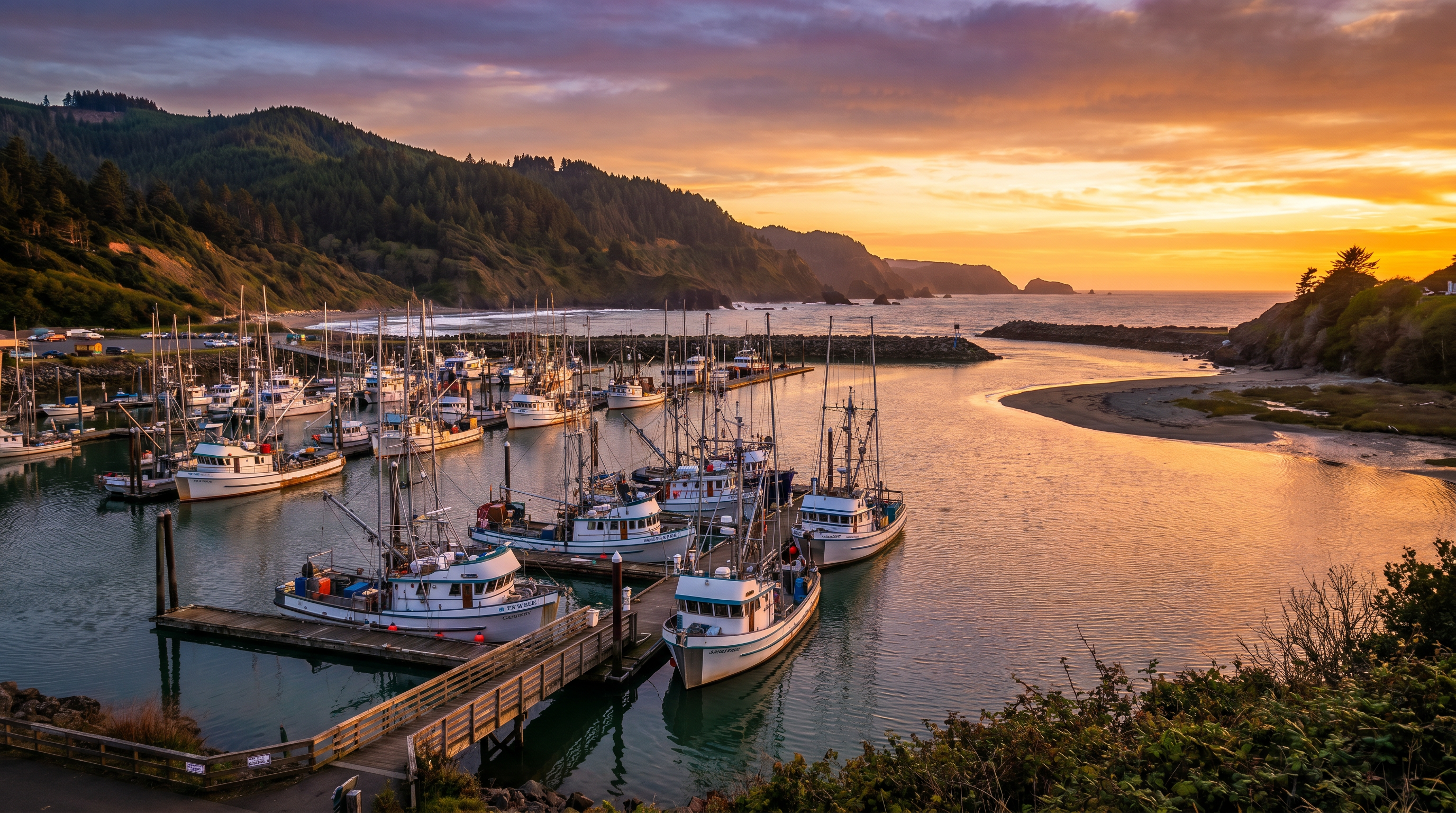
The Oregon Coast stretches 363 miles from Astoria at the Columbia River mouth to Brookings at the California border, with major boating hubs at Newport, Coos Bay, Gold Beach, and the unique Port Orford — where boats are stored on land and launched by crane because there is no protected harbor. Southern Oregon's Rogue River draws drift boat and jet boat enthusiasts from across the Pacific Northwest. Cross the border into Northern California and you reach Crescent City's harbor, Humboldt Bay — the second-largest bay in California and home to Eureka's active commercial and recreational fleet — and the coastal waters of Mendocino County.
Each of these locations has its own character, its own hazards, and its own insurance considerations. The bar crossings at Coos Bay, the Rogue River mouth at Gold Beach, and the notoriously rough entrance to Humboldt Bay are among the most challenging in the Pacific Northwest. The insurance market knows this — and the coverage you need for a boat operating in these waters is meaningfully different from what you would buy for a lake boat in the Willamette Valley.
Step One: Get a Marine Survey — Before You Commit
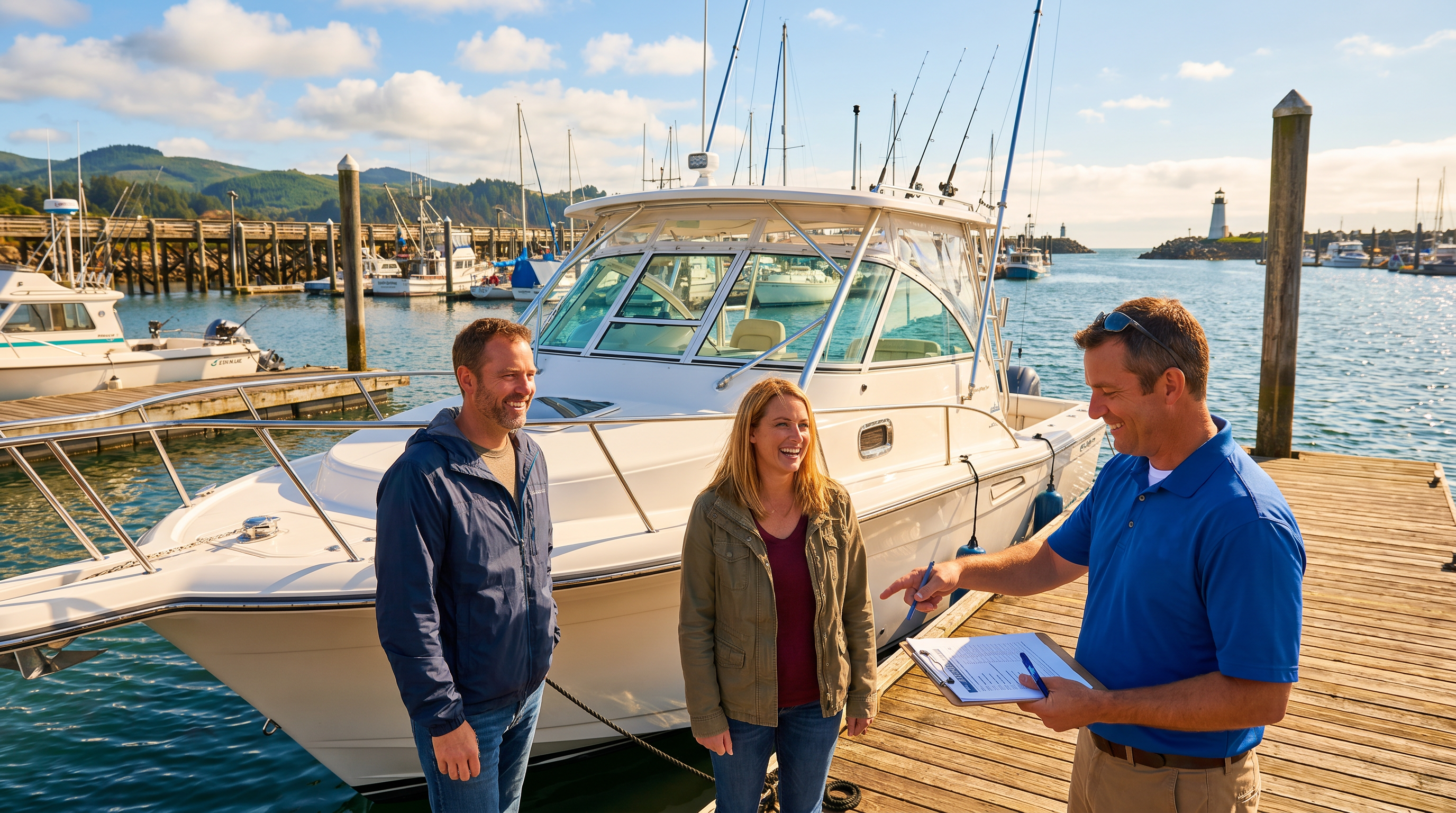
A marine survey is a professional inspection of a vessel's condition, safety, and market value conducted by a certified marine surveyor — typically certified by the Society of Accredited Marine Surveyors (SAMS) or the National Association of Marine Surveyors (NAMS). Unlike a car inspection, there is no standardized checklist or Carfax equivalent for boats. The marine survey is the only independent professional assessment you will get of what you are actually buying.
Most insurers require a survey for used boats over 10 years old or valued above $25,000. Even when it is not required, the cost — roughly $20 to $25 per foot of boat length, or $400 to $750 for a typical 30-foot vessel — is modest compared to the cost of buying a boat with hidden structural damage, a compromised hull, or electrical problems that create fire risk. The survey report also serves a second critical function: it establishes the agreed value for your insurance policy, which determines how much you receive in the event of a total loss.
On survey day, the surveyor will inspect the hull, deck, engine, safety equipment, navigation electronics, propellers, and trailer. For vessels operating in Oregon and Northern California coastal waters, pay particular attention to the surveyor's assessment of through-hull fittings, bilge pump systems, and structural integrity — the Pacific Coast is not forgiving of deferred maintenance.
Step Two: Understand Agreed Value vs. Actual Cash Value
This is the single most important coverage decision you will make, and most first-time boat buyers do not understand the difference until after a loss.
With an agreed value policy, you and your insurer agree upfront on the boat's value — typically based on the marine survey. If the boat is a total loss, you receive that agreed amount with no depreciation deducted. With an actual cash value (ACV) policy, the insurer pays the current market value at the time of loss, minus depreciation. A 10-year-old sport fishing boat that cost $80,000 new might have an ACV of $35,000 — and that is all you would receive, regardless of what you paid or what you owe on your loan.
For any boat valued above $10,000, agreed value coverage is strongly recommended. The premium difference is typically modest — often 10 to 15 percent more than an ACV policy — and the protection in a total loss scenario is dramatically better. As boats age, some insurers shift to ACV-only policies; ask specifically whether your policy is agreed value and get it confirmed in writing before you bind coverage.
| Coverage Type | How It Pays | Best For | Watch Out For |
|---|---|---|---|
| Agreed Value | Full agreed amount, no depreciation | Boats over $10,000; newer vessels | Premium is slightly higher |
| Actual Cash Value | Market value minus depreciation at time of loss | Older boats with low market value | Significant shortfall on newer or financed boats |
| Liability Only | Covers damage/injury to others only | Very old boats with minimal hull value | No coverage for your own boat damage |
| Full Marine Package | Hull + liability + medical + towing + personal effects | Most Oregon/NorCal coastal boats | Verify navigation territory limits carefully |
Step Three: Know Your Navigation Territory Limits
Every marine insurance policy has a navigation territory — a defined geographic area within which your coverage applies. Operating outside that territory voids your coverage entirely. This is one of the most commonly misunderstood aspects of boat insurance, and it matters enormously for Oregon and Northern California boat owners.
Most standard Pacific Coast policies cover inland waters plus coastal waters within a defined distance from shore — typically 25 to 200 miles depending on the policy tier. For Oregon Coast boat owners who want to take their vessel south to Humboldt Bay, Crescent City Harbor, or the Mendocino coast, verify explicitly that your policy covers California coastal waters. Most do, but some policies are written with Oregon-only territory limits that would leave you uninsured the moment you cross the state line.
Alaska trips require special attention. The Inside Passage and Southeast Alaska waters are among the most spectacular boating destinations in the world, and many Oregon Coast boat owners make the journey. However, most standard Pacific Coast policies do not cover Alaska. You will need an extended territory endorsement — and you should arrange it well before your departure date, as underwriters may require additional information about your vessel's seaworthiness and your experience for offshore passage.
For Northern California boat owners in Humboldt County and Del Norte County, the navigation territory question runs in the other direction: verify that your California-issued policy covers Oregon coastal waters if you plan to run north to Brookings, Gold Beach, or Coos Bay. The Pacific Coast is one continuous body of water, but insurance policies are not always written that way.
Step Four: Understand Trailer Coverage — It Is Not Automatic
Most boat owners assume their boat and trailer are covered together under a single policy. The reality is more complicated. Your boat policy typically covers the trailer when it is attached to the vessel and listed on the policy. Your auto policy typically covers the trailer only when it is physically attached to your vehicle and being towed. The gap — the trailer sitting in your driveway, stored at a marina, or parked at a launch ramp — is often uncovered by both policies.
For boats stored on trailers at home between seasons — which describes most Oregon Coast recreational boats from November through March — a separate trailer endorsement on your boat policy or a standalone trailer policy is the correct solution. The premium is modest, and the protection is real. Ask your agent specifically: "Is my trailer covered when it is detached from both my boat and my vehicle?"
Not Sure If Your Boat Coverage Has These Gaps?
Gerald Ross Agency reviews existing marine policies for Oregon and Northern California boat owners at no charge. We'll identify gaps in navigation territory, trailer coverage, and agreed value — before they cost you.
Step Five: Check for Prior Claims on the Vessel
Just as a home has a CLUE report tracking prior insurance claims, a documented vessel (one registered with the U.S. Coast Guard) has a documented ownership and lien history. Before you purchase a used boat, ask the seller for any prior survey reports and any known insurance claims. A boat that has been in a collision, run aground, or sunk and been salvaged may have structural issues that are not visible on the surface but will affect both your insurability and the agreed value an insurer is willing to offer.
If the boat has an existing lien — a loan that has not been paid off — the lender must be listed as a loss payee on your insurance policy. This is a standard requirement, but it needs to be arranged before you bind coverage. Your agent can walk you through the process of adding a lienholder to a marine policy; it is straightforward but must be done correctly to protect both you and the lender.
The Nine Coverages Every Oregon and NorCal Coastal Boat Policy Should Include
A complete marine insurance policy for Pacific Coast boating is more than just hull coverage. The following nine coverages represent the full protection picture for a boat operating in Oregon and Northern California coastal waters.
Physical damage to your boat — collision, sinking, fire, theft, vandalism. The core of any marine policy.
Bodily injury and property damage to others. Oregon marinas typically require $300,000 minimum; $500,000 is better for larger vessels.
Covers injuries to you and your passengers regardless of fault. Separate from liability coverage.
Protects you if you are hit by a boater who has no insurance — more common than you might think.
On-water roadside assistance. Essential on the Oregon Coast where the nearest marina may be 30+ miles away.
Critical in Oregon and California given strict environmental regulations. Covers cleanup costs if your vessel spills fuel.
Covers fishing gear, electronics, clothing, and other personal property aboard. Verify the sub-limit is adequate.
Covers the trailer when detached from both vessel and vehicle. Often requires a separate endorsement.
Covers the cost of removing your vessel if it sinks and creates a navigation hazard. Federal law makes this your responsibility.
Oregon and Northern California: What Makes Coastal Marine Insurance Different
The Pacific Coast between Astoria and Eureka is one of the most demanding boating environments in North America. Bar crossings — the transition from river or bay to open ocean — are notoriously hazardous at Coos Bay, the Rogue River mouth at Gold Beach, and the entrance to Humboldt Bay. The U.S. Coast Guard Sector North Bend covers the Oregon Coast and Northern California, and bar crossing conditions are monitored and sometimes restricted. Your insurance policy needs to reflect the realities of this environment.
Humboldt Bay deserves special mention. It is the second-largest bay in California, home to a significant commercial fishing fleet out of Eureka and a growing recreational boating community in Arcata and Eureka. The bay entrance is one of the most dangerous bar crossings on the West Coast — the Coast Guard has recorded numerous capsizings and fatalities at the entrance over the decades. Insurers who write Humboldt Bay policies understand this risk; make sure your agent does too.
Oregon's Depoe Bay — billed as the world's smallest navigable harbor — and Port Orford's unique dolly-launch system are two examples of the local knowledge that matters when placing marine coverage in this region. An independent agent with deep roots in the Oregon Coast and Northern California marine market understands these nuances in a way that an online quote tool simply cannot.
Oregon State Marine Board and California DMV: Registration Requirements
In Oregon, all motorized vessels must be registered with the Oregon State Marine Board within 30 days of purchase. The registration fee is approximately $100 for a standard motorized vessel. Required safety equipment under Oregon law includes properly sized life jackets for all passengers, a throwable flotation device for boats 16 feet and longer, fire extinguishers appropriate to the vessel size, and navigation lights. Oregon does not require boat insurance by law, but marina slip agreements almost universally do.
In California, motorized vessels are registered with the California Department of Motor Vehicles rather than a separate marine board — a common source of confusion for Oregon boat owners who take their vessels south. California also does not require boat insurance by law, but Humboldt Bay marinas and the Crescent City Harbor District require liability coverage as a condition of slip rental. If you are purchasing a boat in California for use in Northern California waters, verify the registration process with the California DMV before you close the sale.
The Five Questions to Ask Your Insurance Agent Before You Sign
These are the five questions that separate a well-protected Oregon and Northern California boat owner from one who discovers their coverage gaps at the worst possible moment.
1. Does this boat require a marine survey for insurance, and who pays for it?
Most insurers require a survey for used boats over 10 years old or valued above $25,000. The buyer pays. Budget $400–$750 for a typical coastal vessel. The survey report establishes your agreed value and identifies any conditions the insurer may require you to correct before binding coverage.
2. Is this an agreed value or actual cash value policy?
Get this confirmed in writing. Agreed value means no depreciation on a total loss. ACV means you receive the depreciated market value, which can be significantly less than what you paid or what you owe. For any boat over $10,000, push for agreed value.
3. What are the navigation territory limits — specifically, does this policy cover California waters? Alaska?
Verify explicitly that your policy covers the waters you intend to use. Oregon-to-California trips are common; Alaska trips require an extended territory endorsement. Get the territory limits in writing, not just a verbal assurance.
4. Is my trailer covered when it is detached from both the boat and my vehicle?
If the answer is no, ask about a trailer endorsement. The gap between auto coverage (attached and towing) and boat coverage (attached to vessel) is where most trailer losses fall — and it is easily closed with the right endorsement.
5. Does this policy include wreck removal coverage, and what is the limit?
Federal maritime law makes you responsible for removing your vessel if it sinks and creates a navigation hazard. Removal costs can run $50,000 to $500,000. Verify the wreck removal limit in your policy is adequate for the size and location of your vessel.
Seasonal Lay-Up and Winter Storage: Don't Forget the Discount
Many Oregon and Northern California marine policies offer a seasonal lay-up discount for the winter months — typically November through March on the Oregon Coast. During the lay-up period, your premium is reduced because the boat is not in active use. However, you must notify your insurer when the boat goes into lay-up and again when it returns to active use. Operating the boat during the lay-up period without notifying your insurer can void your coverage.
Ask your agent about lay-up discounts when you are shopping for coverage. On a $50,000 boat, the annual savings can be $200 to $400 — meaningful over the life of the policy. More importantly, understanding the lay-up terms ensures you do not accidentally create a coverage gap by taking the boat out for a late-season trip without reinstating full coverage first.
Why an Independent Agent Makes the Difference on the Oregon and NorCal Coast
The marine insurance market for Pacific Coast boating is not a commodity. The carriers who write coastal Oregon and Northern California risks understand bar crossings, Pacific swell, and the specific hazards of Humboldt Bay and the Rogue River mouth. The carriers who do not understand these waters will either decline your application or write a policy with exclusions that leave you exposed when you need coverage most.
Gerald Ross Agency is an independent insurance agency serving the Oregon Coast, Southern Oregon, and Northern California. We have carrier relationships across the marine insurance market — from standard admitted carriers to specialty marine programs and surplus lines markets — and we understand the specific waters our clients navigate. Whether you are buying your first boat at the Newport marina, upgrading to a larger sport fishing vessel at Coos Bay, or insuring a commercial fishing operation out of Eureka, we can help you find the right coverage before you leave the dock.
Explore our marine insurance overview, learn about fishing charter and commercial boat insurance, and review our guide to insurance for the new Oregon Coast economy. Then call us — we are here to help you get on the water with confidence.
Frequently Asked Questions
Is boat insurance required in Oregon?▼
What is a marine survey and do I need one?▼
What is the difference between agreed value and actual cash value boat insurance?▼
Can I take my Oregon-insured boat to California or Alaska?▼
Does my auto insurance cover my boat trailer?▼
What is wreck removal coverage and why does it matter?▼
What are the Oregon State Marine Board registration requirements for a new boat purchase?▼
Ready to Get on the Water? Let's Get Your Coverage Right First.
Gerald Ross Agency specializes in marine insurance for Oregon Coast and Northern California boat owners — from Astoria to Eureka. We know these waters, we know these risks, and we have the carrier relationships to find you the right coverage before you sign. Call us today.