


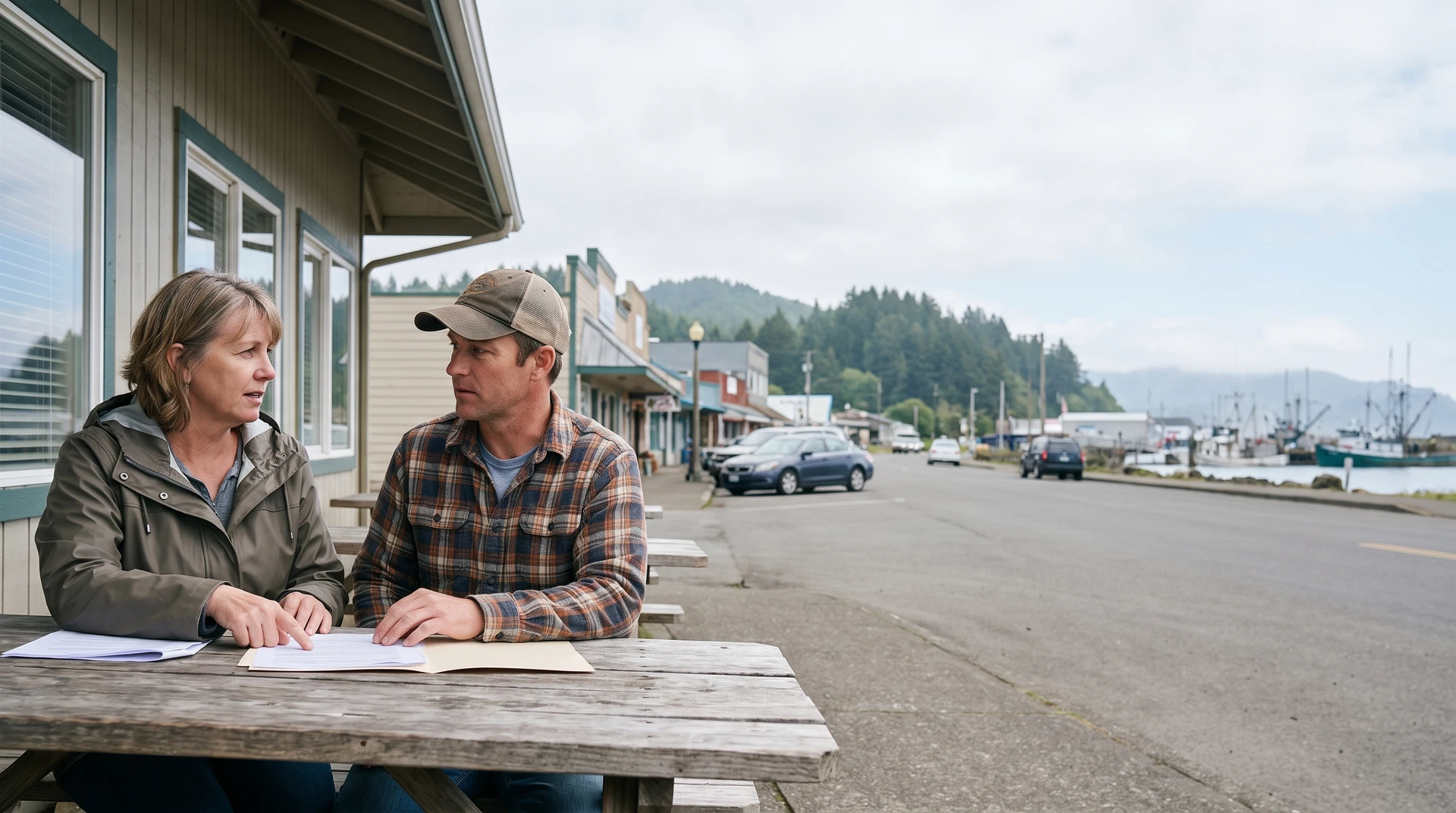

Walk the waterfront in Brookings, Gold Beach, Bandon, or Newport today and you will see an economy that looks nothing like it did twenty years ago. The fishing boats are still there — but so is the Airbnb host renting her cottage to weekend visitors, the ceramicist selling handmade mugs at the Saturday market, the software developer working from a converted garage with an ocean view, the charter captain offering whale-watching tours in the shoulder season, and the jam maker selling directly to tourists from her front porch under Oregon's expanded Cottage Food Law. The Oregon Coast is in the middle of a genuine economic transformation — and the insurance industry has not kept up. Most of these new-economy workers are operating with dangerous coverage gaps, often without knowing it.
Running a Business on the Oregon Coast? Let's Review Your Coverage.
Whether you are an Airbnb host, a cottage food producer, a charter captain, an artisan vendor, or a remote worker, Gerald Ross Agency can identify your coverage gaps and build a policy that actually matches how you live and work. Independent, local, and experienced since 1935.
The New Oregon Coast Economy: What Changed and Why It Matters for Insurance
The Oregon Coast has always attracted entrepreneurs. The Oregon Coast Small Business Development Center in Newport describes the region as one that draws "a special kind of entrepreneur" — people drawn by the natural beauty, the tourism economy, and the fishing and natural resource industries. But the post-pandemic decade has accelerated a shift that was already underway. Remote work technology untethered knowledge workers from urban centers. Short-term rental platforms turned coastal vacation homes into income-producing assets. Oregon's expanded Cottage Food Law opened direct-to-consumer food sales to home producers. And a growing cultural appetite for handmade, locally sourced goods created a market for coastal artisans that simply did not exist at scale a generation ago.
The result is an economy of layered uses. A single property on the Oregon Coast might be a primary residence, an occasional Airbnb rental, a home office for a remote consulting practice, and the production site for a small-batch jam business — all at the same time. Each of those uses creates a distinct insurance exposure. And a standard homeowners policy, written for a single purpose, covers almost none of them.
This is not a hypothetical problem. It is the coverage gap that shows up when a guest slips on the deck of an Airbnb and the homeowners carrier denies the claim because the property was being used for a business purpose. It is the food producer whose kitchen equipment is destroyed in a fire and whose homeowners policy pays nothing because the equipment was used commercially. It is the artisan whose $8,000 kiln is stolen from the back of her truck on the way to a market and whose personal auto policy covers nothing because the vehicle was being used for business. These are real claims, and they are being denied every day.
Vacation Rental Hosts: The Coverage Gap Most Airbnb Hosts Don't Know About
The Oregon Coast is one of the most active short-term rental markets in the Pacific Northwest. Platforms like Airbnb and VRBO have made it possible for homeowners in Brookings, Gold Beach, Bandon, Coos Bay, and Newport to generate meaningful income from their properties — but most hosts are operating with a fundamental coverage misunderstanding. Standard homeowners policies contain explicit exclusions for "business pursuits" and "rental activity." The moment a paying guest enters your home, your homeowners policy may deny any claim arising from that stay — including a guest injury, a fire started by a guest, or theft of your personal property.
Airbnb's AirCover program and VRBO's host protection provide some coverage, but both have significant limitations. AirCover, for example, does not cover cash and securities, jewelry, fine art, collectibles, or damage caused by pets. It also requires hosts to exhaust all other insurance options before making a claim — meaning it is designed as a backstop, not a primary policy. Neither platform's protection covers loss of rental income if a covered loss makes your property temporarily uninhabitable, which is often the most financially damaging consequence of a major claim.
The correct solution depends on how frequently you rent. Occasional renters (fewer than 30 days per year) may be able to add a short-term rental endorsement to their existing homeowners policy. More active hosts need a dedicated vacation rental policy or a landlord policy structured for STR use. These policies provide property coverage, guest liability, loss of rental income, and in some cases, bed bug and damage-by-tenant coverage that standard homeowners policies never include. Our guide to seasonal vacation home insurance on the Oregon Coast covers this in detail, and our Airbnb and VRBO insurance guide walks through the specific coverage structures available to hosts.
Cottage Food Producers and Direct-to-Consumer Food Businesses
Oregon's Cottage Food Law has expanded significantly in recent years, allowing home-based food producers to sell a wide range of products — jams, baked goods, pickles, dried herbs, candies, and more — directly to consumers at farmers markets, farm stands, and online. The 2026 expansion of HB 4153 broadened the categories of allowable products and raised the annual sales cap, creating a genuine pathway for small-scale food entrepreneurs on the Oregon Coast. What the law does not provide is any insurance protection.
A cottage food producer faces three distinct insurance exposures. The first is product liability — the risk that a customer becomes ill, has an allergic reaction, or is harmed by a labeling error. A single product liability claim can easily exceed $100,000 in medical costs and legal fees. The second is general liability — the risk that a customer is injured at your home, your market booth, or your farm stand. The third is business property coverage — the risk that your commercial kitchen equipment, inventory, or packaging supplies are damaged or destroyed. Standard homeowners policies exclude all three of these exposures when the activity is commercial in nature.
The solution for most cottage food producers is a combination of a home-business endorsement on their homeowners policy (to cover business property and premises liability) and a separate product liability policy. For producers who sell at multiple markets or ship products, a standalone Business Owner's Policy (BOP) that includes product liability is often more cost-effective. Our guide to insurance for direct-to-consumer food producers in Oregon covers the full range of options, and our commercial insurance team can build a policy tailored to your specific products and sales channels.
Selling Food, Art, or Services from Your Oregon Coast Home?
Your homeowners policy almost certainly does not cover your business activities. Gerald Ross Agency can review your current coverage and identify exactly what is and is not protected — at no cost to you.
Marine Businesses: Charter Fishing, Whale Watching, Kayak Tours, and Boat Rentals
The Oregon Coast's marine tourism economy has diversified dramatically. Beyond the traditional commercial fishing fleet, coastal harbors now support charter fishing operations, whale-watching tours, kayak and paddleboard rentals, sunset dinner cruises, and eco-tourism boat trips. Each of these businesses operates in a regulatory and insurance environment that is fundamentally different from recreational boating — and the consequences of getting it wrong are severe.
The Oregon State Marine Board requires charter operators and outfitter-guides to be "adequately insured and bonded" as a condition of their license. But the specific coverage required goes well beyond what most operators initially expect. A personal boat policy covers recreational use only — the moment you charge a passenger for a trip, you are operating commercially, and your personal policy will deny any claim. Commercial marine insurance for charter and tour operators typically includes Hull and Machinery (H&M) coverage for the vessel itself, Protection and Indemnity (P&I) insurance for passenger liability and third-party property damage, Jones Act coverage for crew members (which functions as maritime workers' compensation), and in some cases, pollution liability and cargo coverage.
For kayak and paddleboard rental operators, the coverage structure is different but equally important. Equipment rental businesses face significant liability exposure when customers use your equipment without adequate supervision — a capsized kayak in rough Oregon Coast surf can result in serious injury or death, and the resulting liability claim can be catastrophic without proper coverage. Our detailed guide to fishing charter insurance on the Oregon Coast and our marine insurance page cover the full range of commercial marine coverage options available through Gerald Ross Agency.
Artisans and Crafters: The Coverage Gaps at Every Market Booth
The Oregon Coast artisan economy — jewelry makers, potters, woodworkers, fiber artists, painters, glassblowers, and metalworkers — has grown significantly as coastal towns have become destinations for visitors seeking locally made goods. Saturday markets in Brookings, Gold Beach, Bandon, and Newport regularly feature dozens of artisan vendors, and many of them are operating without the coverage their market requires, let alone the coverage their business actually needs.
Most Oregon Coast farmers markets and craft fairs require vendors to carry a certificate of general liability insurance — typically $1 million per occurrence — naming the event organizer as an additional insured. A homeowners policy does not satisfy this requirement. Even if a homeowners policy did not exclude business activities, it would not extend to off-premises vendor activity. Artisans need a separate business policy that covers their inventory, tools, display equipment, and liability both at their home studio and at market locations.
Inland marine coverage is also critical for artisans who transport equipment and inventory to markets. A $6,000 kiln, a $3,000 loom, or a $4,000 set of woodworking tools in the back of a vehicle is not covered by a personal auto policy if the vehicle is being used for business purposes. Inland marine coverage — sometimes called "floater" coverage — protects business property in transit and at temporary locations, filling a gap that neither homeowners nor auto policies address. Our commercial insurance team regularly works with Oregon Coast artisans to build affordable coverage packages that satisfy market requirements and protect their tools and inventory.
Remote Workers: The Home Office Coverage Gaps Most Employees Don't Know About
The remote work revolution brought thousands of knowledge workers to Oregon Coast towns. The appeal is obvious: high-speed internet, lower cost of living than Portland or the Bay Area, and an ocean view from the home office. But the insurance implications of working from home — whether as a company employee or as a self-employed freelancer — are widely misunderstood, and the gaps can be financially devastating.
For employees working remotely for an out-of-state employer, the workers' compensation picture is complicated. Oregon law does cover remote work injuries if the injury occurs "in the course and scope of employment," but proving that a home injury occurred during work activity — rather than during a personal break — is a practical challenge. Employers are required to carry workers' compensation for Oregon employees regardless of where they work, but many remote workers have never confirmed that their employer's policy actually covers their home state. Self-employed remote workers and independent contractors are not covered by any employer's policy and should carry their own coverage.
The business equipment gap is equally significant. A standard homeowners policy typically caps coverage for business personal property — computers, cameras, specialized equipment, professional tools — at $2,500. A remote worker with a $3,500 laptop, a $1,200 external monitor, a $2,000 camera for video calls, and $1,500 in other professional equipment is already over that limit before accounting for any specialized industry tools. A home-business endorsement or a separate Business Owner's Policy raises those limits and adds professional liability (errors and omissions) coverage — which is critical for consultants, designers, writers, developers, and other knowledge workers whose professional advice or work product can be the subject of a claim.
Cyber liability is the third remote worker coverage gap. Remote workers are prime targets for phishing attacks, ransomware, and data breaches — and a successful attack on a remote worker's home network can expose their employer's systems, client data, and proprietary information. Cyber liability insurance covers the costs of a breach response, legal defense, and regulatory fines. It is increasingly required by employers for remote workers and is available as an endorsement or standalone policy through Gerald Ross Agency.
The Mixed-Use Property Problem: When One Building Has Five Insurance Needs
The most complex insurance challenge in the new Oregon Coast economy is the mixed-use property — a single building that serves multiple purposes simultaneously. Consider a realistic scenario: a homeowner in Gold Beach uses her property as her primary residence, rents it on Airbnb for 60 nights per year, operates a home-based jam business from the kitchen, runs a freelance graphic design practice from the home office, and hosts occasional pottery classes in the garage. Each of those activities creates a distinct insurance exposure. A standard homeowners policy is written for exactly one of them.
The solution for mixed-use properties is a layered coverage approach. The foundation is a homeowners policy — but it must be structured to accommodate the other uses, which may require a specialty carrier or a non-admitted (surplus lines) carrier willing to write the risk. On top of that foundation, the property owner needs a short-term rental endorsement or separate STR policy for the Airbnb activity, a home-business endorsement or BOP for the jam business and design practice, and potentially a separate commercial general liability policy for the pottery classes (which involve third-party visitors on the premises). Each layer addresses a specific exposure that the others do not.
This is precisely the kind of complex, multi-layered coverage situation where an independent agent adds the most value. A captive agent — one who works for a single carrier — can only offer what that carrier writes. An independent agent like Gerald Ross Agency works with dozens of carriers across admitted and surplus lines markets and can build a coverage structure that actually matches the full reality of how a property is used. Learn more about our approach on our about page and see why independent agents still beat the algorithm for complex coastal risks.
Coverage Summary: New Oregon Coast Economy Segments
| Business Type | Key Coverage Gaps | Recommended Solution |
|---|---|---|
| Vacation Rental Host (Airbnb/VRBO) | Guest injury, property damage by guests, loss of rental income | Dedicated STR policy or homeowners + STR endorsement |
| Cottage Food Producer | Product liability, customer injury at home/market, business equipment | Home-business endorsement + product liability policy |
| Charter/Marine Tourism Operator | Passenger liability, vessel damage, crew injuries (Jones Act) | Commercial marine policy: H&M + P&I + Jones Act |
| Artisan/Crafter Vendor | Market liability certificate, inventory in transit, tools/equipment | Business policy with inland marine + general liability |
| Remote Worker (Employee) | Business equipment above homeowners sublimit, workers' comp clarity | Home-business endorsement + confirm employer WC coverage |
| Remote Worker (Self-Employed) | Professional liability (E&O), cyber liability, business equipment | BOP with E&O endorsement + cyber liability policy |
| Mixed-Use Property | Multiple simultaneous exposures not covered by any single policy | Layered coverage: homeowners + STR + home-business + BOP |
Why Gerald Ross Agency Is Built for the New Oregon Coast Economy
Gerald Ross Agency has been serving the Oregon Coast, Southern Oregon, and Northern California since 1935. We have watched the coastal economy evolve through every cycle — from the timber and fishing booms of the mid-twentieth century to the tourism-driven economy of the 1990s to the diversified, mixed-use, remote-work-enabled economy of today. What has not changed is the fundamental challenge: the insurance industry moves slowly, and the people building new kinds of businesses on the Oregon Coast need an agent who can navigate the gap between what carriers offer and what their clients actually need.
As an independent agency, we work with dozens of carriers across admitted and surplus lines markets. We write commercial insurance for businesses of every size, marine insurance for vessels and coastal operators, homeowners insurance for primary residences and vacation properties, and specialty coverage for the kinds of mixed-use, multi-purpose properties that define the new Oregon Coast economy. We also write farm and ranch insurance for the agritourism and direct-sales operations that are increasingly common in coastal and valley communities — see our guide to agritourism insurance in Oregon for more.
If you are part of the new Oregon Coast economy — or if you are not sure whether your current coverage actually matches how you live and work — the most valuable thing you can do is sit down with an independent agent for a no-obligation coverage review. We will ask the right questions, identify the gaps, and build a coverage structure that protects everything you have built.
Frequently Asked Questions
Does my homeowners policy cover my Airbnb or vacation rental on the Oregon Coast?▼
What insurance does a cottage food producer in Oregon need?▼
What is the difference between a personal boat policy and commercial marine insurance?▼
Do I need separate insurance if I sell my art or crafts at Oregon Coast markets?▼
Does my employer's workers' compensation cover me if I'm injured working from home in Oregon?▼
What is a mixed-use property insurance problem?▼
Can Gerald Ross Agency help with all of these coverage types?▼
The Oregon Coast Is Changing. Make Sure Your Coverage Keeps Up.
Whether you are renting your home on Airbnb, selling jam at the Saturday market, running charter fishing trips, working remotely, or doing all of the above — Gerald Ross Agency has the carrier relationships and the local expertise to build coverage that actually fits your life. Independent, experienced, and based right here on the Oregon Coast since 1935.


