


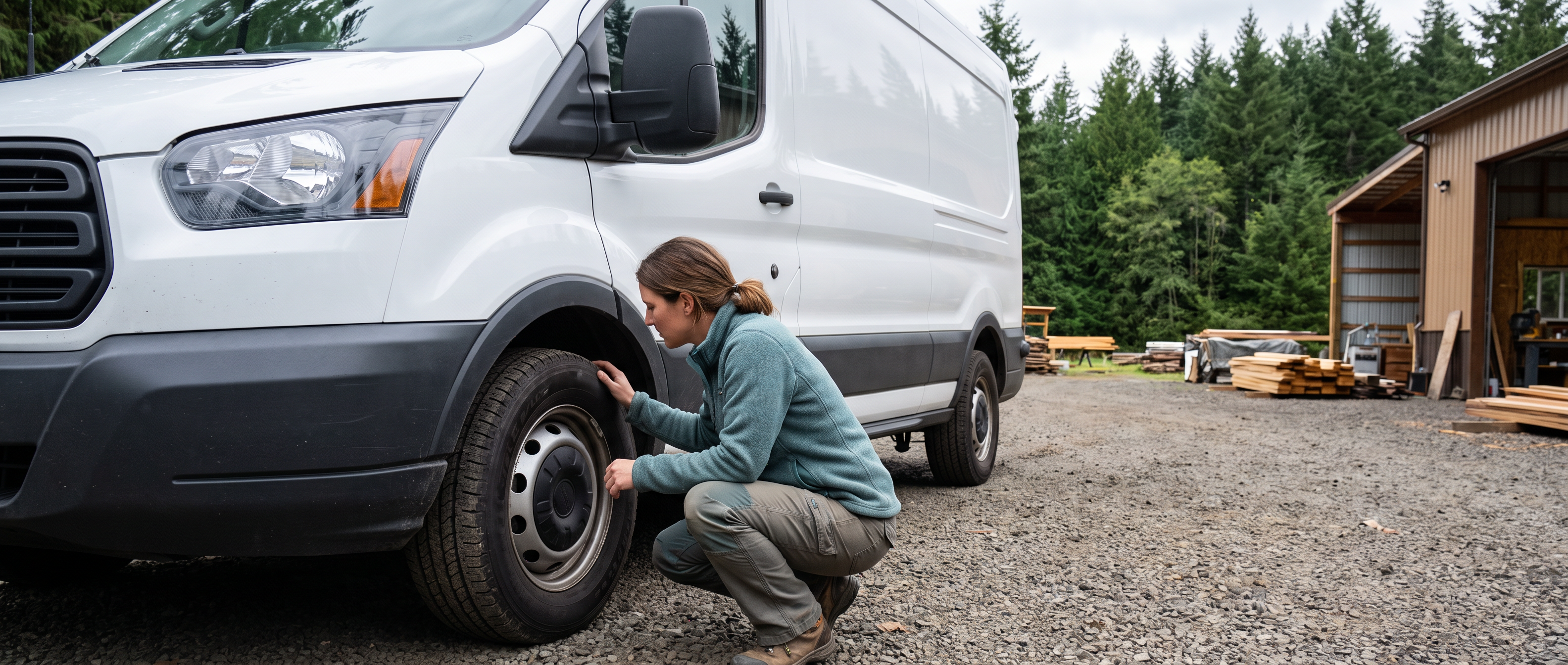

The deal is agreed, the paperwork is nearly finished and the keys are waiting. Before a business vehicle leaves the lot, make sure the insurance conversation has caught up with the transaction. A purchased work truck, a long-term leased van and a temporary rental can create different ownership, liability and physical-damage questions.[1] [3]
For Oregon and Northern California businesses, the useful checklist is not simply “send the insurance card.” It is who owns the vehicle, who is insured, how it will be used, which protection applies and precisely when that protection begins. This guide organizes those questions for an owner adding a first van, replacing a pickup, leasing specialized equipment or renting transport during a busy week.
Before-you-drive rule
A quote, a contract and bound coverage are different things
Do not assume that a signed purchase agreement, a dealer's deadline, a rental receipt or an unanswered message establishes insurance. Obtain authorized confirmation of the vehicle, coverages and effective date and time. Newly acquired vehicle provisions and rental protections are policy-specific—not a universal grace period.[2] [3] [4]
Start with the transaction and the actual owner
Begin your commercial auto insurance review before collecting the vehicle. Is this an outright purchase, financed purchase, long-term lease, short rental, borrowed vehicle or replacement? Those descriptions help the agent identify the relevant policy provisions. The fact that every option gets an employee to a jobsite does not make the insurance treatment identical.
Identify the legal owner and the business that will operate it. An individual, sole proprietorship, corporation and LLC can present different named-insured and ownership questions. Provide the exact names on the title application, finance documents and agreement. Oregon's title application separates owner/lessee, security-interest holder and lessor; explain those roles to the agent rather than assuming they are interchangeable.[8] A familiar business nickname or DBA is not a reason to omit the underlying legal entity.
Explain who is signing and paying for a rental or lease, too. A rental in an employee's name for company business should not be treated as automatically equivalent to a rental in the company's name. Ask how the issued policy handles that arrangement. Do not make last-minute title or entity changes solely to fit an insurance form without appropriate legal and financial guidance.
Three checkpoints before the vehicle goes to work
Before committing
Identify the owner, transaction, vehicle and proposed use. Share the lender, lease or rental agreement and obtain the insurance requirements.
Before taking the keys
Confirm the VIN, drivers, selected coverages, deductibles and actual effective date and time. Keep the written confirmation accessible.
Before putting it to work
Disclose upfits, cargo, routes and parking. Reconcile old-vehicle overlap and finish the applicable title, registration and policy updates.
Buying a vehicle: send the exact VIN and proposed use
Give the agent the vehicle identification number, year, make, model, body type and purchase details. A quote for one van is not confirmation for a different van substituted at the dealership. Compare the VIN on the vehicle, agreement and insurance confirmation, and resolve any discrepancy before relying on the documents.
Describe the work: transporting employees, visiting customers, making deliveries, carrying tools or hauling materials. Include operating territory, expected mileage, overnight parking and any trailer. A passenger car used for occasional visits and a loaded service vehicle making daily stops should not be reduced to the same vague phrase, “business use.”
For contractors and tradespeople, our commercial versus personal auto guide explains related questions. Ownership is one input, but activity matters as well. A vehicle titled personally does not establish that every commercial activity is permitted under a personal policy; disclose the real use instead of relying on its appearance.
Newly acquired coverage: do not borrow someone else's deadline
Some policies contain provisions for vehicles acquired during the policy term. Their scope can depend on the existing coverage, the vehicle's role and timely reporting. Distinguish liability from comprehensive and collision, and an additional vehicle from a replacement. A statement that a new vehicle is “covered” is incomplete unless it identifies which coverage applies.
Progressive's public Any Auto description illustrates this distinction: it describes liability for certain vehicles purchased during the policy period, while expressly saying that Any Auto does not itself include comprehensive or collision.[2] That example is not proof that your policy contains the option or that it addresses damage to your new van.
Ask the insurer to explain your actual newly acquired provision and reporting duties. Do not repeat a personal-policy seven-day, fourteen-day or thirty-day rule as a universal commercial deadline. Ask what must be reported, who must receive it and whether approval or an endorsement is required. Keep confirmation with your policy rather than saving only a screenshot of the request.
Buying or leasing a business vehicle?
Bring the VIN, ownership details, intended use and contract requirements to Gerald Ross Agency before the pickup date.
Request a business vehicle insurance reviewReplacing a work vehicle: review the overlap, not just the trade
Replacing an existing vehicle can involve a period when the business still has both. The new van may arrive before the old one sells; the old pickup may stay available as backup; or a trade-in handover may occur later than the policy request. Explain the actual sequence, not only the intended final fleet size.
Ask how the policy defines a replacement and what happens if the old vehicle remains owned or in use. Do not delete it merely because a buyer has expressed interest. Identify the appropriate deletion date with the insurer after reviewing possession, ownership and remaining use. Registration and sale reporting require their own steps.[5] [6]
Compare the replacement's value, capacity and work assignment. Switching from a pickup to a refrigerated van or heavier truck can change equipment, cargo and operational questions. Carrying forward the old deductible and limit by habit may overlook the new transaction's requirements. Tell the agent about each material change before the vehicle starts working.
Financed vehicles: liability is not protection for your own investment
Liability protection addresses covered injury or damage to others. Comprehensive and collision address different causes of damage to the insured vehicle.[1] A lender may require these physical-damage coverages and specify acceptable deductibles. Review the finance agreement, requested creditor status and the policy rather than assuming a proof-of-liability card meets the contract.
Ask about settlement basis and any difference between a loss payment and the outstanding balance. The Hartford lists lease or loan gap as specialized coverage; that is not a reason to assume every financed vehicle has it.[4] Eligibility, exclusions and what balance components are addressed need separate review. Gap protection is not a mechanical warranty or a replacement for comprehensive and collision.
For liability limits beyond the underlying auto policy, a commercial umbrella review should confirm the required underlying coverage and operations. An umbrella does not repair the van, pay every finance balance or automatically satisfy a lessor's physical-damage condition.
Leasing: read the lessor's requirements before signing
A lease can request liability limits, comprehensive and collision, deductible caps and particular protections for the lessor. Send the relevant contract pages to the agent early. A long-term lease of a regularly operated vehicle deserves an explicit discussion about scheduling and policy treatment; do not assume general hired-auto wording satisfies every provision.[1] [3]
Different insurance statuses serve different purposes. Additional-insured treatment concerns liability interests; loss-payee or other creditor wording concerns specified physical-damage interests. The exact endorsement matters. A certificate is evidence of the stated coverage, not permission to treat every contract clause as insured or to assume the policy has been expanded.
Review indemnity, recovery-right waivers, maintenance obligations, permitted drivers and return-condition requirements separately. Ask the insurer about coverage implications and use qualified legal advice for interpreting contractual liability. Ordinary wear, end-of-lease charges and mechanical deterioration should not be presented as automatically covered collision claims.
Renting: ask who is protected and for which loss
A business can face liability from an employee driving a rental even when it owns no vehicles. Travelers explains that commercial auto policies do not automatically cover vehicles a company does not own and describes hired/non-owned protection as liability coverage.[3] Ask whether the actual rental arrangement and driver fit your forms.
Then ask the separate question: what pays for damage to the rental itself? The Hartford identifies hired/non-owned physical damage as specialized protection that may have limits, conditions and exclusions.[4] Check the deductible, vehicle eligibility, territory, duration and contractual charges. The words “hired auto” alone do not prove first-party protection for the rented vehicle.
Do not rely on a credit-card brochure or personal-auto assumption without checking the actual benefit terms and policy. Business purpose, rental in an employee's name, a cargo van, a large truck, multiple drivers or extended duration can require specific questions. You need the applicable contract, not a general assurance that a card “covers rentals.”
Review any rental-company damage waiver alongside your insurance. Enterprise explicitly says its US Damage Waiver is not insurance and is subject to conduct that can invalidate it under the rental agreement.[7] That is a particular provider's description, not a guarantee for every rental. Ask about damage, theft, loss of use, administrative charges, diminished value, towing and prohibited conduct. Neither arrangement should be described as paying every charge. Get the answer before deciding what to accept or decline.
A rented truck is not the same as rented equipment
Explain what is being rented: a road-going cargo van, a pickup, a box truck, a trailer or a machine carried on another vehicle. The rented and borrowed equipment insurance guide covers related equipment questions, but equipment protection is not interchangeable with road-vehicle liability.
Tell the agent about towing, the trailer, loading and unloading, and any goods or machines carried. Check rental restrictions on weight, towing, roads, geography and permitted activity. A truck suitable for the load mechanically still needs an insurance and contract review. Do not assume that buying rental damage protection authorizes every use.
Renting temporarily or reviewing a lease?
Separate business liability, damage to the vehicle and the agreement's requirements before relying on a single coverage label.
Discuss your vehicle arrangementDrivers, garaging and routes need an update too
Disclose the people who will actually drive, their duties and any occasional or backup use. A new vehicle may be assigned to a different employee, taken home or used by an owner outside working hours. Ask about driver eligibility, exclusions and the treatment of personal use. Permission from the company is not proof that every driver meets the policy's conditions.
Travelers recommends driver vetting, valid licenses, safety standards and attention to employee driving exposure.[3] Keep a practical company plan for distracted driving, reporting vehicle problems and responding after an accident. Those steps support operations and safety; they do not guarantee a claim outcome or replace the issued coverage.
Provide the actual overnight location and routes. A business address is not necessarily where the vehicle sleeps, and occasional trips into another state deserve disclosure. Home garaging, deliveries, higher mileage or a change in service territory should be discussed rather than left out because the original quote used a simpler description.
Upfits, tools and cargo are not one coverage category
Supply details of service bodies, shelving, liftgates, refrigeration, permanently installed electronics or other modifications. The Hartford identifies certain installed-equipment protection as specialized coverage.[4] Ask how an upfit is scheduled and valued, whether its installation period matters and what documentation is needed. A base-vehicle invoice may not capture the completed working vehicle.
Portable tools, materials and customer goods deserve a separate cargo and inland marine insurance discussion. Do not describe comprehensive vehicle coverage as protecting everything inside. Ownership, location, transit, theft conditions and limits can differ for equipment and stock.
Retailers adding deliveries should review the whole workflow. Our online orders and local delivery guide explores related questions about goods, pickup and returns. Tell the agent if employees use personal cars during overflow, because that arrangement creates a separate non-owned vehicle discussion.[3]
Rental reimbursement and downtime: check the exact trigger
Paying to rent a replacement while your vehicle is repaired and insuring that replacement against damage are different issues. The Hartford lists rental reimbursement and hired physical damage separately.[4] Ask what event activates reimbursement, which vehicles qualify, how long benefits last and which expense limits apply.
A mechanical breakdown, scheduled service, a delayed new-vehicle delivery and a covered collision should not be assumed to produce the same benefit. Explain the downtime situation before making a rental decision. Any proposed lost-income protection needs its own policy review; vehicle physical damage is not a blanket promise to replace revenue while the business waits.
Heavier vehicles and transportation operations can need additional review of filings, operating authority, cargo and contracts. The trucking and transportation insurance guide provides a broader starting point. A policy issued for a light service van does not establish the requirements for a trucking operation.
Oregon and Northern California: insurance and DMV work are separate
Do not confuse proof of insurance with a completed title or registration process. Oregon DMV lists ownership documents, title applications, applicable releases, odometer requirements, inspections and other situation-dependent items.[5] Gather the documents relevant to your vehicle and keep copies before sending originals. A purchase invoice alone should not be treated as the entire DMV file.
California DMV's commercial registration guidance addresses vehicle design, use and weight, with categories and exceptions.[6] The insurance label “commercial auto” does not by itself determine DMV classification. Verify the process for the actual vehicle, including any weight declarations, inspections or other applicable requirements; heavier or specialized operations may need additional agency guidance.
For a vehicle crossing state lines, explain where it will be owned, registered, garaged and operated. Consult the appropriate DMV and qualified advisers when the transaction involves multiple entities or jurisdictions. The existing buying and transferring a vehicle checklist offers related family-vehicle context, not a substitute for business-specific registration or tax advice.
Inspection and handover: preserve the starting condition
Before accepting a purchased or rented vehicle, record its condition when it is safe and permitted: overall photographs, visible damage, odometer, included accessories and relevant delivery paperwork. For a used vehicle, arrange an appropriate independent mechanical inspection. Insurance is not a substitute for discovering defects or a warranty that the vehicle is fit for work.
For a rental, follow the company's check-out and return procedures, note existing damage through its required channel and retain the final receipt. Keep records of any extension or vehicle substitution. Do not rely on photographs alone to override contract reporting rules, but use clear records to support an accurate account of what happened.
If plans change after the insurance review—different VIN, another driver, longer rental, new trailer or revised pickup time—raise the change before proceeding. Confirm the final arrangement rather than assuming the earlier answer follows every substitution. The best checklist is a current one that matches the keys actually in your hand.
Eight items to bring to the before-you-drive review
- 1
Legal owner and named insured, including entity names, any DBA, and who signs the purchase, lease or rental agreement.
- 2
VIN, year, make, model, vehicle/body type, purchase information and photographs of the exact vehicle.
- 3
Acquisition, delivery and first-use dates; requested coverage start time and any overlap with an existing vehicle.
- 4
Driver names, license details, actual driving duties, take-home or personal use, routes and overnight garaging.
- 5
Liability limits, comprehensive/collision or hired physical damage, deductibles, valuation and policy restrictions.
- 6
Finance, lease or rental requirements, relevant contract pages, requested endorsements and certificate instructions.
- 7
Upfit invoices, permanently installed equipment values, tools, cargo, trailer use and work performed at other locations.
- 8
Written coverage confirmation, policy updates, transfer documents, DMV submissions and rental return-condition evidence.
Frequently asked questions
Is a newly purchased business vehicle automatically insured?
Not under every policy or for every coverage. Newly acquired vehicle provisions can distinguish additional vehicles from replacements, liability from physical damage, and different reporting requirements. Progressive's Any Auto description illustrates liability protection that does not itself include comprehensive or collision. Ask your insurer to confirm the actual vehicle, coverages, limits, deductibles and effective date and time before driving. Do not apply a personal-auto grace period to a commercial policy.
Does a leased business vehicle need different insurance from a purchased vehicle?
A lease can impose specific liability limits, physical damage, deductible and lessor-status requirements. Share the actual contract with your agent before signing. Additional insured, loss payee and other requested statuses do different jobs and may require endorsements. A certificate does not expand the policy. Confirm how the vehicle and long-term lease are treated rather than assuming basic hired-auto liability satisfies every obligation.
Does hired and non-owned auto liability pay for damage to a rental van?
Do not assume it does. Liability for injuries or damage to other people is different from physical damage to the rented vehicle. The Hartford identifies hired/non-owned physical damage as specialized coverage that may have limits and conditions. Review that protection, any rental-company damage waiver and the rental agreement's charges separately. Do not assume a personal policy or credit-card benefit applies to a commercial van or business rental.
Can I delete the old vehicle as soon as I buy its replacement?
First confirm whether you still own, retain possession of or use the old vehicle. Temporary overlap can mean both vehicles remain exposed. Ask the insurer which newly acquired or replacement provision applies and when deletion is appropriate. Coordinate the sale or trade documents and any required DMV notices; a scheduled future sale is not the same as a completed transfer.
Are tools and custom equipment covered by the vehicle's stated value?
Not necessarily. Permanently installed equipment, a specialized body, removable tools and customer property can be treated differently. Provide invoices and photographs for shelving, liftgates, refrigeration and other upfits, and ask how the policy values them. Review portable tools or cargo under the appropriate separate coverage. A vehicle's purchase price does not prove every item carried in it is insured.
Does submitting a quote request allow me to drive the vehicle away?
No. A quote request, payment receipt, dealer deadline or unanswered message is not confirmation that the requested coverage is bound. Ask for the authorized coverage confirmation and effective date and time, together with the correct VIN, named insured and coverage selections. Resolve any insurer conditions before relying on protection.
Sources and further reading
These insurer and official DMV resources informed the guide. Product descriptions illustrate questions and possible coverages, not the terms of your issued policy or an agency appointment with a referenced insurer. Use the actual contracts and current official instructions for your transaction.
- [1] Progressive Commercial: Commercial auto coverage: liability, physical damage and hired/non-owned options
- [2] Progressive Commercial: Any Auto coverage: newly purchased vehicle liability and important limits
- [3] Travelers: Hired and non-owned auto coverages
- [4] The Hartford: Specialized commercial auto coverages
- [5] Oregon DMV: Titling and registering your vehicle
- [6] California DMV: Commercial vehicle registration
- [7] Enterprise: US rental insurance and protection options
- [8] Oregon DMV: Title and registration application: owner, lessee and vehicle address
Make the insurance review part of the vehicle decision
Gerald Ross Agency can help Oregon and Northern California businesses organize the coverage questions before a vehicle is bought, leased, rented or replaced. Bring the VIN, your plans and the agreement so the discussion fits the transaction.
Request a commercial auto insurance quoteImportant: General educational information, not legal, tax, mechanical or individualized coverage advice. Eligibility, coverage, reporting duties and claim outcomes depend on underwriting, issued forms, endorsements, exclusions, limits, deductibles and the facts. DMV classification and contractual obligations require their own review. A quote request does not bind coverage. No checklist, certificate or recommendation guarantees compliance, reimbursement or uninterrupted operations.


