


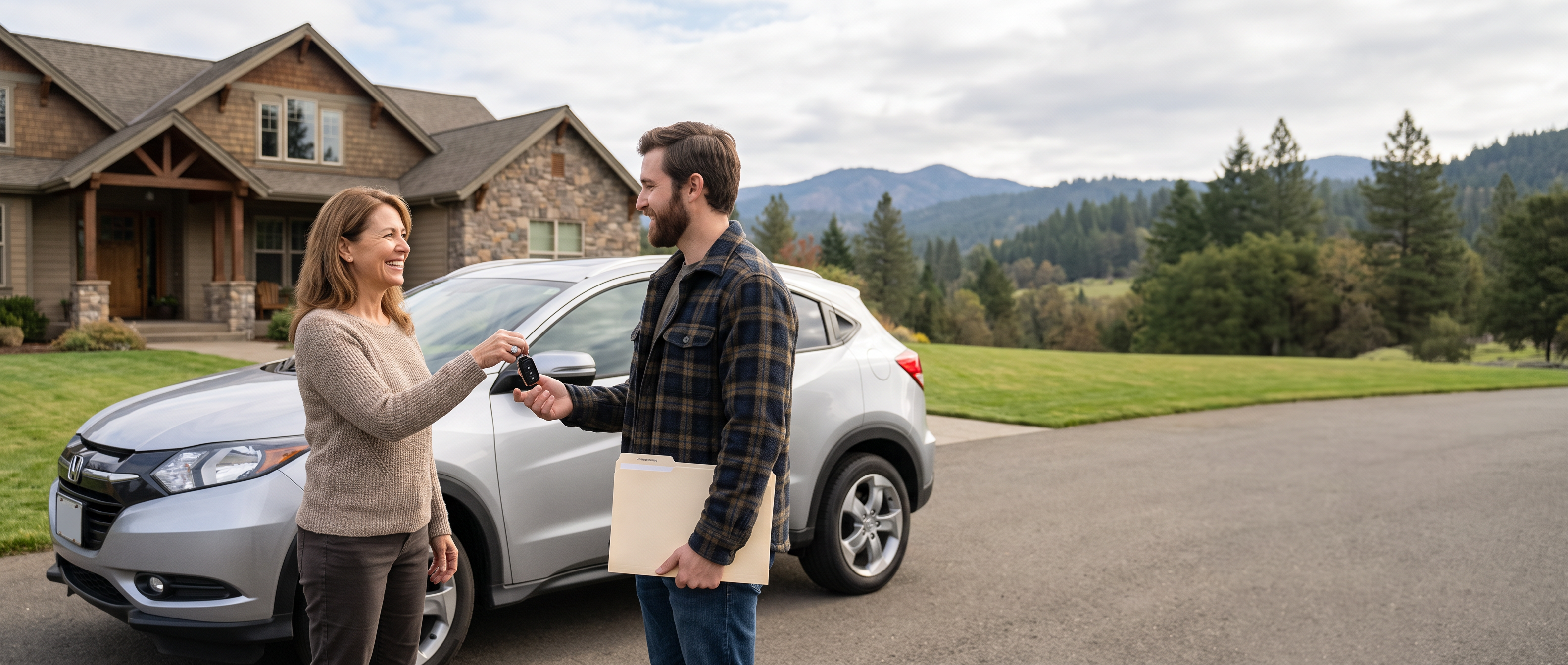

A car can change hands in a matter of minutes. The insurance, title, registration and lender questions often do not. When an Oregon or Northern California family buys, sells, gifts or inherits a vehicle, the practical goal is to make the ownership record, actual drivers, garaging address and issued insurance policy tell the same accurate story. A clear checklist helps the family ask better questions. It does not replace DMV instructions, lender requirements, estate advice or the terms of an issued policy.
The central rule
A title transfer and an insurance change are connected, but neither one automatically completes the other
DMV records address ownership and registration. An auto policy addresses the people, vehicles, coverages, limits, exclusions and conditions in that policy. A lender or estate may have another set of requirements. Treat each lane as a separate step and reconcile the facts before assuming the transition is complete.
Start with four questions before the keys change hands
Before a purchase, family gift, private sale or inherited-car decision, slow down long enough to identify who will own the vehicle, who will drive it regularly, where it will be kept, and whether a loan, lease or estate has a continuing interest. Those answers can affect the title application, DMV documents, loss-payee or lienholder information, household-driver questions and the auto policy. An auto insurance review gives the family a way to raise those policy questions before the handoff rather than after an unexpected loss or registration issue.
Do not use a verbal family understanding as the only record. Write down the intended ownership date, possession date, intended garaging address, current odometer information, title status, names on any loan and the people expected to use the car. If facts change after a move, college enrollment, divorce, marriage, death or a new driver joining the household, update the list and ask the DMV and insurer what their separate records need to show.
A family transition map
Four lanes to keep aligned when a family vehicle changes hands
Working through these lanes separately can prevent a title detail from being mistaken for an insurance answer, or an insurance call from being mistaken for a completed ownership transfer.
Ownership & possession
Who is on the title, who has the keys, when possession changes, where the car is garaged, and whether a lender or lessor remains involved.
Insurance & drivers
Named insureds, household members, regular drivers, liability limits, physical damage, deductibles, lender requirements, policy timing and carrier instructions.
DMV & records
Title, release or bill of sale, odometer information, lien release, required notices, registration, proof of death or estate papers when applicable.
Family & estate facts
Gift terms, co-owners, survivor rights, probate or trust authority, college or adult-child living arrangements, and estate-professional guidance.
Buying a vehicle: ask the insurance question before relying on the drive home
Oregon Division of Financial Regulation says it is best to notify the insurer immediately after buying a new vehicle. Its consumer FAQ notes that a policy may typically allow 14 days to report a newly acquired vehicle, but that can drop to four days when physical-damage coverage is not already carried on another insured car. Policies vary, so a buyer should ask the insurer or agent for the actual timing and coverage answer before relying on a general rule.[1]
The purchase price, financing, collision and comprehensive choices, deductible, vehicle value, intended use, household drivers and garaging address can all matter to the policy conversation. A personal auto insurance cost review can help organize questions about deductibles and coverage choices. It cannot promise a price, approve coverage, determine a vehicle’s value or replace an insurer’s underwriting decision.
Oregon DMV says buyers generally have 30 days from the date of sale to submit a title application before a late fee applies. Its instructions identify the title or ownership document, lien releases, releases or bills of sale from prior owners, any required odometer disclosure, and other situation-specific documents.[2] The DMV process is separate from the insurance call. Complete both, and keep copies of what was submitted.
Buying a vehicle this week?
Bring the vehicle year, make, model, VIN, purchase date, loan or lease information, drivers and garaging address to an auto-insurance conversation before assuming existing coverage applies.
Request a personal auto reviewSelling a vehicle: document the handoff and confirm what remains
For a seller, an endorsed title, a bill of sale or a transfer notice may be important evidence, but the action required depends on the state and facts. California DMV says an ownership or lienholder change must be reported within 10 days and says sellers must submit a Notice of Transfer and Release of Liability within five days. The notice can help establish responsibility after the transfer date, but California DMV also says it does not itself transfer ownership; the buyer must complete the transfer requirements.[4] [5]
Before removing a vehicle from insurance, confirm the effective handoff date and time with the insurer. Ask how the policy should treat a vehicle no longer owned, what documentation the carrier wants, and whether another vehicle, driver or household arrangement must be updated. Do not assume a DMV notice, a buyer’s promise, a screenshot, a key handoff or a cancelled payment alone establishes the policy result.
A seller should retain the relevant title release, sale record, odometer information when required, buyer details, transfer confirmation and communication with the insurer. A vehicle that remains available to a household member, is kept at the family residence, is still financed or is not yet fully transferred can create questions that deserve a policy-specific answer.
Gifting a car: make the family arrangement concrete
A gift can feel simpler than a sale, but the insurance question often becomes more layered. Is the recipient an adult child living at home, a student temporarily away, a relative at a different address, or a co-owner? Is the vehicle being retitled, and who will insure and drive it? If there is a loan, who is responsible to the lender? The answers can change the conversation with the DMV and insurer.
California DMV identifies a distinct family, estate, inheritance and gift path that can involve the title plus a Statement of Facts or affidavit, along with the relevant fee.[4] Oregon DMV’s title materials similarly direct applicants to use the documents that fit the ownership record and transaction. Do not assume a family relationship removes the need for signatures, a lien release, a title application, a record of the transfer or insurer notification.
When the person receiving the car is moving into a new apartment, a renters insurance review may also be timely because their personal property and address are changing. If the household’s home, drivers and vehicles are being reorganized together, a home insurance conversation can help make sure the broader household facts are current. Each policy remains separate and subject to its own terms.
Inheriting a car: separate estate authority, title work and insurance
An inherited vehicle can involve a survivor, multiple heirs, a trust, probate, a lienholder, a personal representative or a buyer. Oregon DMV’s Title and Registration Handbook describes different records for survivorship, probate and non-probated estates. In certain non-probated situations, it describes an Inheritance Affidavit, Form 516, signed by all heirs and showing who receives the vehicle.[3] California DMV also lists a deceased-owner path that can involve a death certificate and an Affidavit for Transfer without Probate, subject to its rules and value limits.[4]
That does not mean a family should pick forms based on a summary article. Estate documents, title wording, state law, lender interests and the vehicle’s facts can change the path. Use the current DMV instructions and obtain legal or estate guidance when it is needed. Before anyone drives, sells, stores or transfers the car, call the insurer to discuss the actual circumstances and ask what policy evidence or change is required.
An inherited-car decision frequently sits alongside other family property questions. Our guide to estate, trust and inherited-home insurance reviews explains why a change in authority, occupancy or ownership can require more than one insurance conversation. The home guide is not a substitute for DMV or estate advice about a vehicle.
The handoff question
Confirm who has authority to sign, who has possession and what the insurer needs to know
A title signed by the wrong party, a vehicle left on an old policy, or a loan that still shows a different owner can create a problem later. Treat these as distinct facts to verify, not details to reconstruct after a claim, ticket, registration notice or lender request.
Household changes can make the car question larger than one vehicle
A family car transfer can overlap with a blended household, divorce, adult child move, college address, marriage, new driver or change in financial responsibility. In those moments, the title may be just one part of a broader review. Our blended families, divorce and new households guide explains how policy roles can change when a household changes. Our guide for parents, college students and adult children covers related auto, renters, home and umbrella review questions.
If an ownership transition changes the household’s assets, drivers or liability exposure, an umbrella insurance review may be worth adding to the discussion. An umbrella policy does not resolve title work or automatically apply to every person or vehicle. It is a separate policy-level question involving the underlying auto coverage, insureds, limits, exclusions and actual facts.
Sorting out a family vehicle, title and household change at the same time?
Bring the actual ownership arrangement, vehicle details, drivers, address, policy documents and lender information to the conversation. Gerald Ross Agency can help identify insurance questions while DMV and estate professionals address title and legal requirements.
Talk through the policy changesBuild a transition file before the transaction is forgotten
A concise, dated file is useful because several people may be involved: the buyer or recipient, current owner, insurer, lender, dealer, DMV, personal representative, trustee or family member. Keep it factual. It should show what happened, who has the vehicle, what was submitted and what remains to be confirmed. It should not be treated as legal proof or insurance confirmation unless the relevant authority or carrier provides that confirmation.
Before the handoff and after it
Eight records to organize for a family vehicle transition
This is a practical organization checklist, not a substitute for DMV instructions, lender terms, estate advice or issued-policy requirements.
Vehicle identification number, current title status, plate and registration information, key count, possession date and the address where the car will be garaged.
Names of every titled owner, buyer, recipient, heir, regular driver, household member, lienholder and party authorized to sign or act for an estate or trust.
The dated bill of sale, title release, odometer disclosure when required, lien-release documentation, transfer confirmation and the applicable Oregon or California DMV forms.
Current declarations pages and the exact questions for the insurer: who is an insured, which vehicle is being added or removed, when the change takes effect and what physical-damage coverage is requested.
Loan, lease and payoff information, including whether a lender needs to remain listed and whether a gap between vehicle value and loan balance raises a policy-specific coverage question.
For inherited cars, proof of death, probate, trust, heir or estate documents as directed by the DMV and qualified estate professionals; do not assume another family member can sign or transfer the vehicle.
Photos and a condition record at handoff, existing damage notes, service records, spare keys, accessories and a written record of where the vehicle is stored after transfer.
A calendar for the state DMV deadline, insurer follow-up, registration, lender confirmation and any required notice, with copies retained in a secure location.
Frequently asked questions
Does my existing auto policy automatically cover a car I just bought?
Do not assume it does without checking your issued policy. Oregon DFR says it is best to notify an insurer immediately after purchase and notes that newly acquired vehicle reporting provisions can vary, including when physical-damage coverage is not already in place. The insurer, policy terms, vehicle, financing and requested coverage determine the actual answer.
Should a seller cancel insurance as soon as the keys are handed over?
A seller should first confirm the handoff date and time, possession, title paperwork, registration requirements and the insurer's direction. A transfer report or release may not itself complete the ownership transfer, and insurance cancellation timing is policy-specific. Do not rely on a general checklist as a coverage determination.
Does gifting a car to an adult child remove the parent from the insurance picture?
Not necessarily. Ownership, garaging address, household membership, regular drivers, title status, financing and the issued policy can all matter. The family should ask the insurer how the actual arrangement should be listed and separately follow the applicable DMV transfer process.
What changes when a vehicle is inherited?
Inheritance can involve title status, survivorship, estate administration, heir documentation, lienholder releases, registration, possession and insurance questions. Oregon DMV describes different records for probate, survivorship and certain non-probated estates. California DMV also has separate inheritance paths. Confirm the applicable DMV, estate and insurer requirements before driving, selling or transferring the vehicle.
Can a title transfer or notice of transfer prove that insurance is in place?
No. DMV title records and insurance-policy records answer different questions. A title document or notice may be important for ownership and registration, but it does not establish liability, collision, comprehensive, loan or lease protection, driver eligibility, policy limits or a claim outcome.
Sources and further reading
Government sources below informed this general education article. They are starting points, not a determination of an individual title, estate, loan, registration, policy, coverage or claim. Procedures and forms can change. Confirm the current requirements with the appropriate Oregon or California DMV, lender, insurer and qualified professionals for the actual facts.
- [1] Oregon Division of Financial Regulation: Car Insurance FAQs
- [2] Oregon Driver and Motor Vehicle Services: Titling and Registering Your Vehicle
- [3] Oregon Driver and Motor Vehicle Services: Title and Registration Handbook: Operation of Law and Trusts
- [4] California Department of Motor Vehicles: Title Transfers and Changes
- [5] California Department of Motor Vehicles: Notice of Transfer and Release of Liability
Let the insurance review match the car and family arrangement you have today
Before the next purchase, sale, gift or inherited-car decision, bring the vehicle, household, title and lender facts to Gerald Ross Agency for a policy-specific auto review.
Request a personalized auto quoteImportant: General educational information only; not legal, estate, probate, trust, tax, title, DMV, financing, lender, registration, insurance-coverage, claims, underwriting or regulatory advice. Nothing here promises coverage, eligibility, renewal, acceptance, a defense, payment, title transfer, registration result, lender approval or claim outcome. Ownership, drivers, garaging, household membership, policy terms, endorsements, limits, exclusions, deductibles, liens, DMV procedures, estate authority, documents and applicable law can change the analysis. A title, bill of sale, release, transfer notice, policy declaration, online confirmation, source summary or this article does not by itself establish ownership, authority, insurance coverage or liability. Confirm current requirements with the appropriate authorities and qualified professionals.


