


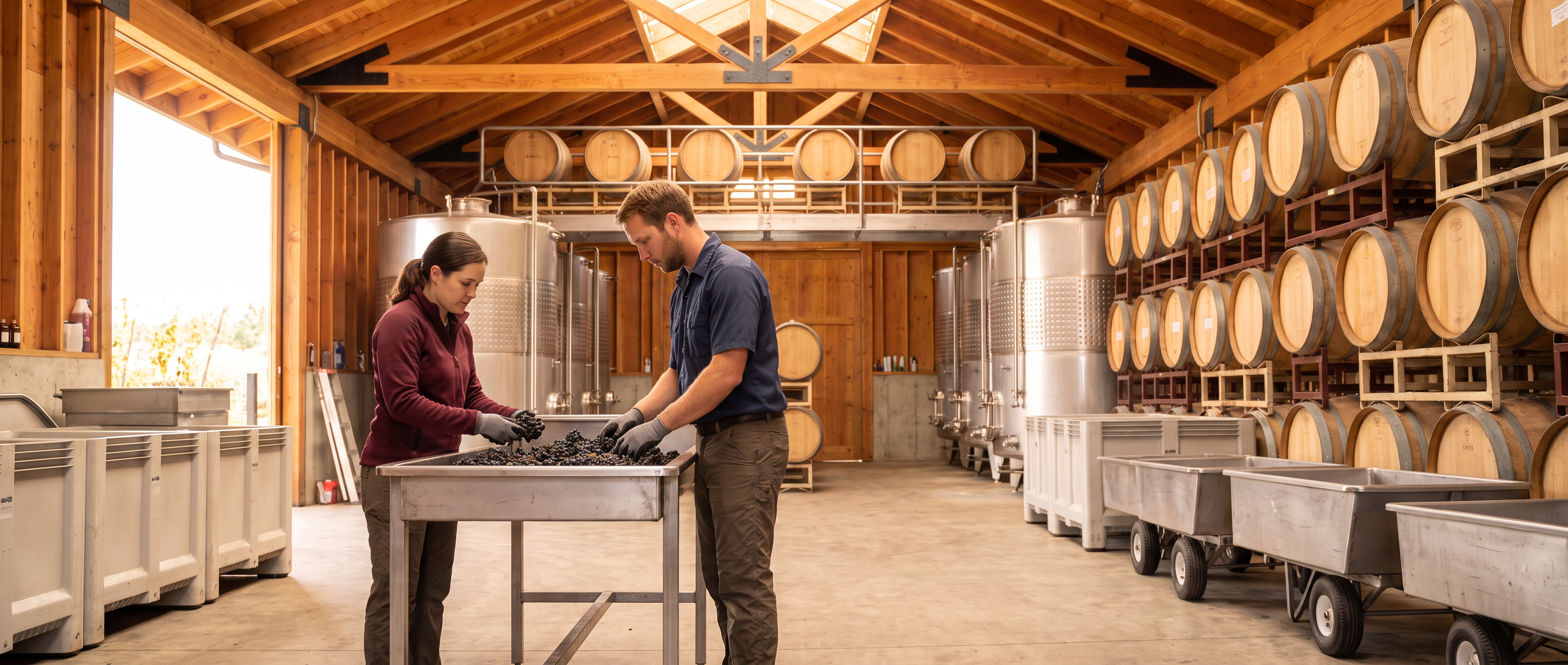

A winery’s workforce can change quickly when grapes are ready. Year-round cellar employees may be joined by harvest crews, temporary bottling help and extra tasting-room staff. Workers’ compensation planning needs to follow the people doing the work—not just the winery’s usual headcount. Seasonal employment does not automatically remove the need for coverage.[1] [3]
For Oregon and Northern California wineries, a useful review begins before the first shift. Identify the employer, the work location, the employee’s actual duties and the policy arrangement. Then connect the insurance discussion with payroll records, training, injury reporting and recovery planning. A short harvest assignment can still involve meaningful physical work.
Start before the crew arrives
Seasonal is a staffing description—not an automatic exemption
Direct employees, staffing-agency workers, labor contractors, owners and informal helpers can require different questions. Do not treat a short assignment, family relationship, contractor label or certificate as a complete answer about coverage.[1] [3] [4]
What workers’ compensation does—and what it does not replace
A workers’ compensation insurance review concerns covered work-related injuries and illnesses under the applicable state system. California DWC identifies benefits including medical care and several forms of disability or other assistance, depending on the claim.[3] Coverage and benefit administration are not the same as a promise that every reported injury will be accepted.
Keep the insurance in place alongside—not instead of—safe operating procedures. A policy does not make a confined space safe, train a forklift operator or replace required heat protections. It also does not settle whether a person is legally an employee. Those obligations need attention even when an insurer has issued a policy.
Workers’ compensation is one part of a winery insurance program. Wine stock, buildings, production equipment, customer injuries and employee injuries are different exposures. Organizing them separately makes it easier to ask the right policy questions without expecting one coverage to solve every problem.
Oregon and California: start with the actual employment arrangement
Oregon’s Workers’ Compensation Division says employers generally need coverage when they have one or more subject workers. California’s DWC says employers with one or more employees generally must provide workers’ compensation benefits.[1] [3] These are starting rules, not a determination that every owner, helper or contractor at every winery has the same status.
Explain the winery’s legal organization and the way people are hired, paid and supervised. A small family winery, a separate vineyard company and a production business using outside crews can involve different arrangements. Specific exceptions or elections should be verified rather than inferred from the operation’s size or the length of the harvest season.
Put this review before the work starts. If the winery has had no employees and now plans to hire someone, do not assume a general business policy includes workers’ compensation. If employees are moving between entities or locations, ask how the insured employer and applicable state are identified. The agent and insurer need accurate operating information.
Describe the whole winery workforce
Harvest and vineyard crews
Disclose seasonal additions, field tasks, supervisors, work locations and the company that employs each crew.
Cellar and production staff
Describe crush, cleaning, equipment, case handling and other actual duties—not just the job title cellar worker.
Tasting room and support roles
Include hospitality, office, packing and delivery work, especially when employees move between roles.
Directly hired harvest crews: plan for the peak, not just the average
A payroll estimate based only on the permanent team can miss the busiest part of the year. Give the insurer the expected harvest hiring window, approximate headcount, work locations and actual jobs. Picking, sorting, receiving grapes and assisting at crush should be described as distinct tasks even if the insurer ultimately treats them within the same classification.
Do not assume part-time or short-term workers are outside the coverage obligation. The employer rules focus on the actual worker relationship and applicable exceptions, not simply the number of weeks worked.[1] [3] Include people hired through informal recommendations and those paid through a different payroll process in the review.
If the winery also grows grapes, connect the workforce discussion with its farm insurance review. Explain whether employees work in the vineyard, cellar or both. Farm property insurance and employee injury coverage need separate attention; the existence of a vineyard policy does not itself answer the workers’ compensation question.
Review your workforce before the next busy season
Bring your year-round staffing, harvest plans and existing coverage to Gerald Ross Agency. Discuss the actual work and payroll before relying on last year’s arrangement.
Request a winery workers’ compensation reviewTemporary staffing and worker leasing are not interchangeable
Oregon WCD distinguishes temporary staffing from worker leasing. Its guide explains that temporary placements require appropriate documentation before work begins, while worker-leasing arrangements involve an agreement with a licensed leasing company.[1] A company regularly needing extra workers should not automatically assume every recurring arrangement qualifies as temporary staffing.
Ask the provider who employs the workers, who pays them, which policy applies and what work the arrangement allows. Obtain applicable coverage information and clarify the assignment’s dates, locations and duties. A purchasing invoice or a brief email describing “harvest help” is not a complete insurance file.
In California, Cal/OSHA describes a typical staffing arrangement as dual employment: the agency pays the worker and administers workers’ compensation, while the host supervises the work.[8] That guidance does not make every contractor arrangement identical. It does make clear that using outside staffing is not a reason for a winery to ignore site-specific hazards and training.
Harvest labor contractors: identify responsibility before relying on a certificate
When another business supplies a crew, document the employer’s identity and the actual relationship. Ask for applicable proof of workers’ compensation coverage before work begins and have the insurance arrangement reviewed. Oregon WCD warns that a prime contractor may become responsible when subcontractors lack required coverage.[1] Avoid assuming a labor contract transfers every possible responsibility.
Explain who directs the daily work and whether the winery’s supervisors assign tasks or operate alongside the outside crew. Distinguish providing a specific contracted service from supplying people for the winery to manage. These facts can matter to employment and insurance analysis even when the provider has a legitimate business name.
A certificate is useful documentation, but it does not resolve every status or coverage issue. Check effective dates, the named employer and the work described, then ask the insurer about relevant terms. If a provider changes or a crew moves to another location, revisit the file rather than assuming an earlier document answers the new assignment.
A 1099 or contractor agreement does not settle employee status
Oregon WCD says a contractor agreement and Form 1099 do not by themselves establish independence. California DIR likewise explains that labels, agreements and tax reporting do not determine the relationship.[1] [4] California identifies employment tests and exceptions; a winery should not select a label first and treat the legal analysis as finished.
The practical insurance step is to provide the facts. Describe supervision, payment, the work being performed and how the outside business operates. Have status questions reviewed by appropriate legal or employment advisers when needed. An insurance quotation is not a legal ruling about classification.
Keep payroll and staffing records consistent with the arrangement actually used. If an individual begins working more like an employee, raise the change promptly. Do not assume that the independence of one service provider establishes the status of every harvest worker, delivery driver or person helping in the cellar.
Owners, relatives and informal helpers need individual review
Owner inclusion or exclusion is not universal. SAIF explains that some owners and officers are automatically covered while others require an endorsement; California DWC also advises reviewing inclusion based on business organization and policy treatment.[2] [3] A working owner should know what the policy says rather than assuming personal health insurance answers a work-injury question.
Oregon WCD states that family members generally must be covered unless a specific exemption applies. It also warns that remuneration does not have to be cash.[1] A relative receiving something of value in exchange for harvest work should not be dismissed from the review simply because no ordinary paycheck is issued.
Similarly, do not declare every unpaid helper or volunteer covered—or excluded—based on the name. California DIR notes that volunteer or intern questions involve standards separate from its employee-versus-contractor test.[4] Review the real arrangement before inviting someone to help with crush, machinery, bottling or other winery work.
Payroll and classifications: describe duties instead of guessing codes
SAIF directs policyholders to report actual subject payroll, and its guidance explains that payroll can include more than base wages. California DWC lists payroll, industry classification, injury history and underwriting adjustments among premium factors.[2] [3] A seasonal payroll estimate deserves the same care as the permanent team’s records.
Describe field work, crush, cellar cleaning, bottling, case packing, forklift duties, tasting-room service and office work. These are disclosure examples, not a list of verified separate classification codes. Ask the insurer which classification applies and whether mixed duties can be separated under its rules.
Do not divide payroll solely to obtain a lower estimated premium or because a job title sounds administrative. Keep the records the insurer requests and explain employees who change duties. Actual wages, locations and work assignments help support an accurate review and reduce surprises when the insurer examines the policy-period records.
Who employs each harvest worker?
Organize staffing agreements, payroll information and policy documents before the crew starts. Identify questions that need insurer or employment-adviser review.
Discuss your winery staffing and coverage questionsCellar work: tanks and fermentation demand more than a routine checklist
Oregon OSHA’s winery-vessel alert addresses workers entering tanks or putting their heads inside while cleaning, emptying or checking fermentation. Oxygen displacement and hazardous gases can create a deadly atmosphere, including concerns involving carbon dioxide.[5] The alert warns that smell is unreliable and fans alone may not make a tank safe.
The alert describes winery tanks as generally permit-required confined spaces and calls for evaluation, hazard identification, written protective procedures and worker training.[5] Keep the need to evaluate the actual space in mind. This blog is not a tank-entry instruction, atmospheric testing protocol or rescue plan.
Tell the insurer about cellar operations, but also engage qualified safety resources for the work. A seasonal employee should not enter a vessel simply because an experienced worker says the job is quick. Insurance is not a substitute for the protective program and task-specific preparation the situation requires.
Case handling, washdown and machinery: train for the assigned job
Different winery tasks create different practical hazards. Handling cases, moving equipment, washdown and cleaning chemicals deserve review alongside powered machinery. Do not treat a worker’s previous agricultural experience as proof that the person understands this winery’s equipment, procedures and work areas.
Cal/OSHA’s temporary-worker guidance emphasizes site-specific training and appropriate protective equipment, even when a staffing agency provides general training.[8] Explain hazards to each assigned worker and confirm what the staffing provider has already covered. Changes in duties need more than a new verbal instruction.
Plan how supervisors identify problems and stop unsafe work. Keep task assignments aligned with training and authorization. These are prevention questions, not claims about the winery’s injury rate or a guarantee that training eliminates losses. The insurance discussion and the operating safety program should reinforce each other without being confused.
Heat prevention follows the workplace—not just the calendar
Outdoor harvest work can involve weather-related heat exposure. Oregon OSHA’s heat guidance addresses water, shade, training, acclimatization and emergency planning, with additional high-heat protections and defined exceptions.[6] Oregon uses heat index in its rules; this should not be copied into another state’s requirements as if the standards were identical.
California has separate indoor and outdoor heat standards. Cal/OSHA notes that employers with both workplace types may have obligations under both.[7] A cellar should not automatically be called exempt because it is indoors, nor should every warm indoor task be assigned Oregon’s outdoor requirements without checking applicability.
Review the current standards with qualified safety advisers and use an appropriate plan for actual conditions. New seasonal employees may need acclimatization and training before demanding work. Clarify who recognizes symptoms, arranges help and communicates with the crew. This guide does not provide numerical thresholds or a universal rest-break schedule.
Driving and hospitality introduce separate insurance questions
Explain employee driving, whether it involves deliveries, errands or moving between operating locations. A commercial auto insurance review concerns vehicle-related exposures that workers’ compensation alone does not resolve. Employee injury and liability to other people are different coverage questions, even when one accident involves both.
Tasting-room work also needs its own description. A tasting-room employee moving cases, serving guests and helping with events may not spend every shift doing the same task. Disclose the actual mix rather than presenting everyone as a purely clerical or hospitality worker for payroll purposes.
Separate customer injuries from employee injuries. General liability insurance is part of the discussion about covered third-party claims, not a substitute for required employee injury coverage. Clear descriptions of the people and operations help the agent identify which policies deserve review.
Employers liability, umbrella and employment disputes are different topics
Ask about the employers liability portion of the workers’ compensation program and any intended relationship to an upper liability layer. Our commercial umbrella and excess liability guide explains why an underlying policy schedule and actual forms matter. An umbrella is not a replacement for statutory workers’ compensation benefits.
Likewise, disputes involving hiring, discrimination or other employment practices are not automatically the same as a covered physical work injury. Discuss those exposures separately and ask about appropriate employment practices coverage. Do not assume a policy with employers liability in its name handles every employee-related allegation.
Keep legal and HR obligations separate from the coverage review. Insurance does not determine whether payroll practices, contractor classifications or hiring decisions comply with law. The agent can help organize insurance questions; appropriate professional advisers should address the winery’s legal and employment circumstances.
Work across Oregon and Northern California: verify before the assignment
A business can have a vineyard in one state, a production location in another and employees who travel during harvest. Explain where workers are hired, where they normally work and where the temporary assignment will occur. Oregon WCD’s guidance makes recognition of out-of-state arrangements conditional.[1]
Do not assume an Oregon policy automatically satisfies every California requirement or that a brief assignment always qualifies for reciprocal treatment. Confirm the applicable policy arrangements with the insurer and destination state before work begins. Permanent locations and locally hired teams require particular attention.
Update the review when assignments change. Adding a new vineyard, using a different labor provider or extending a project can change the facts the insurer originally considered. Keep the coverage discussion tied to current operations rather than treating an earlier cross-border job as permission for every later one.
If a worker is injured: care, reporting and documentation come first
Arrange appropriate medical attention and follow the state and carrier’s claim-reporting process promptly. SAIF advises using Oregon’s Form 801 when a worker seeks medical care for a work injury or requests a claim, without delaying because the employer questions validity.[9] California DWC describes providing the claim form and forwarding required materials to the claims administrator.[3]
Record the incident accurately, preserve relevant information and communicate through authorized claim channels. An internal incident note is not a substitute for a required claim form. Do not pressure a worker to avoid reporting, decide claim validity yourself or promise a benefit outcome on the insurer’s behalf.
Workers’ compensation reporting and OSHA reporting or recordkeeping are separate obligations. SAIF flags the need to consider those additional requirements, while Cal/OSHA describes duties in temporary-worker arrangements.[9] [8] Notifying the insurer alone should not be treated as proof that every required report has been made.
Return to work must fit medical restrictions and available duties
Keep in contact with the injured worker and coordinate with the carrier and medical guidance. California DWC says assigned work must comply with the treating doctor’s restrictions. SAIF also advises checking medical release for light duty.[3] [9] A busy crush season does not override an employee’s restrictions.
Administrative or inventory paperwork may be possibilities only when medically appropriate and genuinely available. Do not automatically describe bottling, tasting-room work or cellar cleaning as light duty. Consider the actual lifting, standing, movement and other demands of a proposed assignment.
Document the discussion and use qualified guidance when duties or restrictions are unclear. A return-to-work plan should be realistic for the worker and winery. It is not a promise of claim savings, a required outcome for every injury or a reason to assign work a doctor has not approved.
Connect employee coverage with the rest of the winery program
Our vineyard, winery and tasting-room insurance guide helps organize the broader operation. Staffing plans should be discussed alongside changes in production, events, deliveries and property use so the insurer receives a coherent picture of the business.
Damaged grapes, barrels or bottles require a separate wine inventory insurance review. A workplace accident can involve both an injured employee and damaged stock, but workers’ compensation is not the property policy for the wine. Identify which policies and claim contacts address each part.
Review the workforce at renewal and whenever operations materially change. Bring realistic seasonal payroll, provider agreements and actual duties rather than a copied headcount from a quiet month. Accurate information and a clearly assigned reporting process make the insurance discussion more useful before the next harvest arrives.
Eight items to bring to your winery workforce review
- 1
Legal entity names, ownership structure, operating locations and every state where employees will work.
- 2
Current workers’ compensation policy, endorsements, payroll reports and the insurer’s classification instructions.
- 3
Year-round staffing plus expected harvest dates, seasonal headcount, payroll and changes in operations.
- 4
Actual duties by worker or group, including field work, crush, cellar cleaning, bottling, tasting-room service and driving.
- 5
Staffing, worker-leasing and harvest-labor contracts, employer identities and applicable proof of coverage.
- 6
Owner, officer, family-member and informal-helper arrangements requiring inclusion, exclusion or status review.
- 7
Training, equipment and hazard-control information for heat, confined spaces, machinery and material handling.
- 8
The injury-reporting contact, carrier procedures and medically appropriate return-to-work options that actually exist.
Frequently asked questions
Do wineries need workers’ compensation for seasonal harvest employees?
Seasonal or short-term employment is not itself a blanket exemption. Oregon employers generally need coverage for subject workers, and California generally requires employers with one or more employees to provide workers’ compensation benefits. Review the actual employment arrangement, applicable exceptions and state requirements before the crew starts work.
Does a staffing agency’s insurance eliminate the winery’s responsibilities?
Do not assume that it does. Identify who employs and pays the workers, verify applicable coverage and review the staffing or labor arrangement with the insurer. Oregon distinguishes temporary staffing from worker leasing. California safety guidance identifies responsibilities for both staffing agencies and host employers, including the host’s site-specific training obligations.
Can a winery treat a harvest worker as an independent contractor because it issues a 1099?
A 1099, a signed contractor agreement or a short assignment does not by itself establish independent contractor status. Oregon and California apply legal criteria that consider the actual relationship; applicable tests and exceptions need a fact-specific review. Have employment status reviewed separately from the insurance quotation.
Are owners, relatives and volunteers automatically excluded from coverage?
No universal rule applies to all these arrangements. Owner inclusion or exclusion depends on business organization, applicable rules and policy treatment. Oregon generally requires family members to be covered unless a specific exception applies, and noncash compensation can matter. Review informal helpers, volunteers and working owners individually rather than relying on the label.
Can vineyard, cellar and tasting-room payroll simply be assigned different class codes?
Do not choose classifications from job titles alone. Describe actual operations, mixed duties, locations and seasonal payroll to the insurer. Ask which classifications apply and which payroll records are required. The insurer must confirm whether and how any payroll separation is permitted; this guide does not assign winery class codes or rates.
Does workers’ compensation replace winery safety programs or cover damaged wine?
No. Workers’ compensation addresses covered work-related injuries and illnesses under the applicable system. It does not replace hazard controls, required training or separate reporting duties, and it is not property insurance for wine or equipment. Confined spaces, machinery, heat and lifting need their own safety planning; damaged inventory needs a separate coverage review.
Sources and further reading
These Oregon and California regulator, workplace-safety and SAIF resources informed the guide. State guidance and policy terms can change. A referenced resource is not proof of coverage for a particular winery, an agency appointment with an insurer or a substitute for individualized legal and safety advice.
- [1] Oregon Workers’ Compensation Division: Why do I need workers’ compensation insurance? Employer guide
- [2] SAIF: How to fill out your payroll report
- [3] California Division of Workers’ Compensation: Workers’ compensation FAQs for employers
- [4] California Department of Industrial Relations: Independent contractor questions and employment-status tests
- [5] Oregon OSHA: Confined spaces: winery vessels hazard alert
- [6] Oregon OSHA: Key requirements of heat illness prevention rules
- [7] Cal/OSHA: Heat illness prevention guidance and resources
- [8] Cal/OSHA: Protecting temporary agency employees: information for employers
- [9] SAIF: Reporting a workplace injury
Build the coverage discussion around your actual winery team
Gerald Ross Agency can help Oregon and Northern California wineries organize workers’ compensation questions for year-round employees, harvest staffing and changing operations. Bring the policy and workforce details so the review starts with the people doing the work.
Request a winery workers’ compensation quoteImportant: General educational information, not legal, medical, safety-program or individualized coverage advice. Employment status, exemptions, classifications, benefits and insurer obligations depend on applicable law, policy terms and the facts. No description guarantees claim acceptance, premium savings, compliance or coverage availability. A quote request does not bind or change insurance.


