

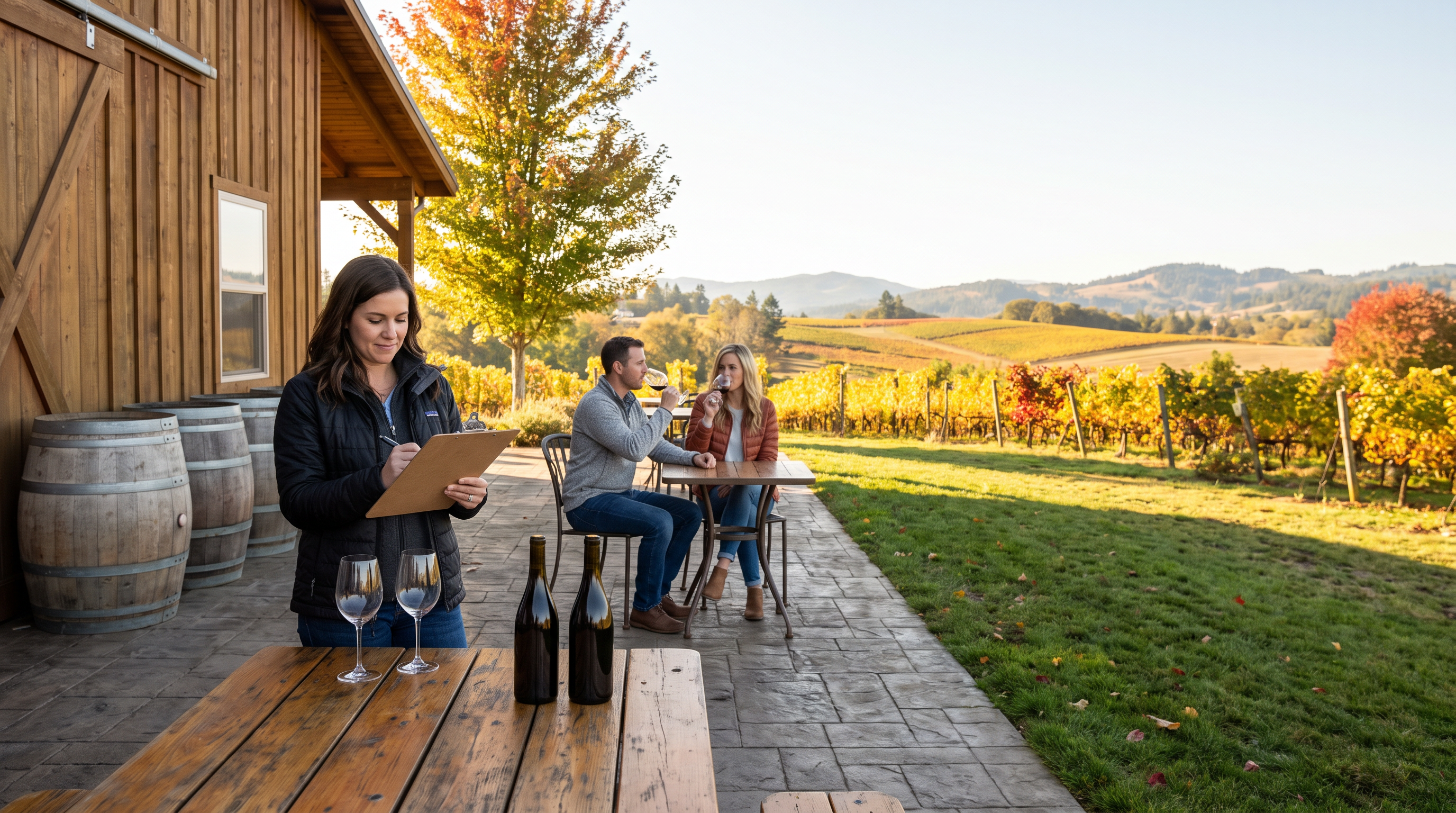

A vineyard may be an agricultural operation. A winery or cidery may be a production facility. A tasting room may be retail and hospitality. A wine club may be an e-commerce business. An estate event can add a temporary venue. When one brand spans all of those activities, the best insurance conversation starts by describing the actual operation rather than relying on one label.
The practical starting point
A wine-country business changes when its operations change
Adding a tasting counter, food pairing, wine club, cider release, special event, delivery option, barrel room, harvest contractor or new location can introduce new property, guest, alcohol-service, product, vehicle, labor, data and contract questions. A policy review should follow those changes before the next busy season—not after a claim, licensing issue or cancellation.
Why a vineyard, winery, cidery and tasting room should not be treated as the same risk
Some operators grow fruit and sell it to another producer. Others buy grapes or apples, press or ferment product, age it, bottle it, welcome guests, offer food, ship clubs, host events or manage multiple locations. A broad farm and ranch insurance conversation is a useful starting point, but it should name every part of the operation that moves beyond the growing site.
A dedicated winery insurance review can help structure those questions in a practical order: What is grown, produced, stored, sold or served? Which building, vineyard, patio, production area, warehouse or off-site location is involved? Who owns the fruit, product, property and equipment at each step? Who are the employees, guests, vendors, landlords, distributors and event partners? And what does the contract actually require?
Map the actual operation
Four operating zones that can change the insurance questions
These prompts help organize a conversation with the right insurance, legal, alcohol-service, safety, food and tax professionals. They do not determine a claim result or create coverage.
The growing site
Vineyard acreage, trellises, irrigation, agricultural equipment, weather exposure, contracts, seasonal labor, fruit ownership and any leased or managed land.
The production floor
Crush, fermentation, cider pressing, tanks, barrels, bottling, refrigeration, power, maintenance, cleanup, contractors, wine in process and finished stock.
The guest experience
Tasting counters, outdoor patios, food pairings, retail shelves, alcohol-service practices, reservation volume, minors, vendors, signage, parking and special-event space.
The sales path
Wine club or cider club orders, online checkout, age verification, customer data, pickup, direct delivery, carrier handoffs, distributor shipments and event transport.
Start with the growing site, the property and the product in process
A vineyard can have vines, trellises, irrigation, equipment, tools, buildings, access roads, leased acreage and weather-driven work cycles. A winery or cidery adds fruit receiving, pressing, crush pads, tanks, refrigeration, barrel storage, bottling, utilities, packaging and finished stock. Some businesses also work under custom-crush, alternating-proprietor, vineyard-management or storage arrangements. Those details can change both who is responsible for property and what the policy needs to describe.
Commercial property is only part of the discussion. A business owners policy review should lead to precise questions about buildings, business personal property, stock, income, extra expense, valuation, locations, off-premises property, utilities and any specialty endorsements. A wine in barrel, a cider batch in a tank, grapes awaiting crush and bottled club inventory can have very different timelines and valuation questions. The declarations, stock wording, causes of loss, sublimits, deductibles and endorsements—not a general article—control what may be insured.
Production continuity deserves its own conversation. A refrigeration failure, press problem, utility interruption, tank issue, broken line, water loss, smoke closure or damaged access road can create more than a repair invoice. Depending on the operation, the practical impact can include delayed fermentation, spoiled product, missed pickup, canceled guest appointments, a lost release weekend or interrupted payroll. Document essential equipment, service contracts, alternate storage, vendor contacts and decision-makers before harvest or a major release window.
Tasting rooms and alcohol service add guest-facing questions
A tasting room is not simply a checkout counter. It introduces guests, alcohol service, consumption areas, parking, patios, tours, employees, food pairings, age-sensitive operations, retail merchandise and sometimes a long drive home. Oregon’s winery licensing page describes separate food-service, direct-shipment, delivery, special-event and liquor-liability topics; it says liquor liability insurance is required when the application allows on-premises alcohol consumption and identifies a $300,000 minimum proof-of-coverage requirement for that licensing context.[1] That state minimum is a regulatory threshold—not a recommendation for every operation, an assessment of a business’s exposure or a coverage promise.
Talk through exactly how alcohol is served: tastings, flights, glasses, bottles, private parties, club pickups, curbside handoffs, outdoor areas, buses or shuttles, employees, servers, hours and training. A general liability insurance review can be a place to identify guest injury and premises questions; alcohol-service liability, assault-and-battery wording, special-event terms, medical-payments limits, additional insureds and other provisions must be reviewed separately in the actual forms and endorsements.
California operators face their own licensing rules. California ABC describes its Type 02 winegrower license as authorizing wine production and sale and says it is subject to responsible beverage service requirements. ABC also describes the Type 93 estate tasting event permit for qualifying winegrowers at certain adjacent or controlled vineyard sites.[3] Its current Type 93 advisory notes that event authorization is required and explains that the number of authorizations is limited.[4] Rules, permits and local approvals can change, so operators should confirm current requirements directly with the proper authority rather than treating an insurance policy as regulatory advice.
Adding a tasting room, a club, a seasonal patio or an event?
Bring the business description, property list, current policy declarations, alcohol-service plan and proposed contracts to a policy-specific review before the new activity begins.
Request a winery insurance reviewDirect sales, wine clubs and online orders move the risk beyond the tasting bar
A direct-to-consumer program can connect the guest experience to recurring billing, customer contact information, age verification, pickup, shipping, carrier handoffs, delivery notices, temperature-sensitive product, returns and chargebacks. The business may have a website, tasting-room point of sale, club-management platform, distributor, retail account and third-party fulfillment partner at the same time. Those relationships should be mapped before anyone assumes where a loss or responsibility belongs.
Product concerns should be discussed without promising a result. A product liability insurance conversation can help identify questions involving product handling, contamination allegations, labels, packaging, vendor specifications, recalls, cross-contamination, product ownership, interstate shipments and contracts. Availability and scope depend on the policy, the actual product, regulatory requirements, the business’s role in the supply chain and the facts of the alleged event.
Club records and online orders also present an information-security question. Customer names, addresses, age-verification records, payment workflows, account access, digital marketing lists and vendor credentials should be part of a cyber liability insurance review. Ask which systems hold data, who can access them, what vendors process payments or shipments, how users are removed when roles change and what the business would do if systems were unavailable during a release weekend. Technology controls and insurance are related but separate conversations.
Food, pairings and vendor relationships should be described precisely
Some tasting rooms sell packaged snacks. Others offer food pairings, coordinate food trucks, rent space to caterers, operate kitchens or sell branded retail products. Oregon’s Department of Agriculture explains that food safety begins at the farm and continues through processors and retailers, while its Food Safety Program monitors and inspects relevant food establishments.[7] That does not tell a particular winery or cidery which permit it needs, but it is a useful reminder to identify who prepares, serves and stores food; what food is sold; who owns the product; and which authority governs the operation.
For a tasting room that begins to resemble a restaurant or hospitality venue, a restaurant insurance review may help focus the conversation on food vendors, kitchen equipment, grease, refrigeration, slips, delivery, employees, alcohol service and premises operations. Vendor contracts, certificates of insurance, additional-insured requests, hold-harmless provisions and local rules should be shared early. A certificate provides limited evidence of insurance at a point in time; it does not change a policy or decide responsibility.
Events can change the footprint overnight
Winemaker dinners, harvest parties, release weekends, club gatherings, weddings, concerts, fundraisers and corporate rentals can multiply the number of guests, vendors, activities and premises used in a single day. Review the event footprint instead of relying on the word “private.” Who is the named organizer? Who serves alcohol and food? Are third-party vendors insured? Is there rented furniture, a tent, stage, generator, shuttle or parking provider? What is the weather and evacuation plan? Does the lease or property owner require a particular certificate, limit, waiver or additional insured status?
Event planning also creates a threshold question: is the event part of normal tasting-room activity, a separately promoted function, an event held at a different site or a service provided by a third party? California ABC’s Type 93 materials illustrate why a winery should separate its usual licensed premises from an event authorization at another qualifying location.[4] The right insurance questions may differ by operation, venue, contract, attendance, alcohol service, location and policy terms. Review the actual event contract and policy before a deposit is accepted or tickets are sold.
People, tanks, barrels and vehicles require different conversations
Wine-country businesses can employ vineyard crews, seasonal harvest help, cellar staff, tasting-room associates, event personnel, drivers, managers and contractors. The roles can change quickly during crush or a festival. A workers’ compensation insurance review should use current payroll, job roles, seasonal labor, locations, supervision, use of contractors and safety responsibilities—not last year’s staffing picture.
Cellars, tanks, vessels and maintenance spaces need deliberate safety planning. Oregon OSHA says workers who enter confined spaces to inspect equipment or fix leaks can encounter toxic gases, corrosive chemicals, flammable solvents or unexpectedly operating machinery; its resource library specifically includes a winery-vessels hazard alert.[5] Federal OSHA likewise addresses atmospheric monitoring in the winemaking industry in connection with permit-required confined-space rules.[6] These sources do not replace a site-specific safety program. They show why the physical details of tank entry, maintenance, lockout, emergency procedures and contractor work should be accurately described to appropriate safety professionals and, where relevant, in an insurance review.
Vehicles require a separate inventory. A passenger vehicle, pickup, club-delivery van, forklift, trailer, employee-owned vehicle used for errands or shuttle arrangement can create different use and ownership questions. A commercial auto insurance review should list every road-going unit, driver, delivery radius, hired or non-owned vehicle exposure, cargo or product transported, garaging location and any interstate activity. A policy review cannot replace driver screening, carrier rules, transport regulation or safe-driving practices.
Bring evidence, not assumptions
Eight items to bring to a winery or cidery insurance review
A working file makes an insurance conversation more specific. It is not a substitute for policy forms, permits, safety plans, legal advice, food-safety guidance or regulator instructions.
A clear legal-entity and operations map: who owns the vineyard, brand, production company, tasting room, cidery, property and event activity; who leases what; and who contracts with whom.
A current property and equipment schedule: buildings, trellises, irrigation, crush pads, presses, tanks, barrels, refrigeration, bottling equipment, POS hardware, tools, forklifts, wine or cider in process, bottles, packaging and retail inventory.
A guest-and-event file: operating hours, anticipated attendance, outdoor and indoor space, alcohol-service process, food vendors, entertainment, rentals, security, parking, certificates, vendor contracts and emergency contacts.
A direct-sale map: website or club platform, states served, age-verification process, recurring payments, customer-data handling, order volume, shipping vendors, pickup procedures, carrier terms, returns and chargeback process.
The current alcohol-license, training and renewal information, along with the exact locations where alcohol is served, sold, delivered, shipped or consumed. Confirm requirements directly with the applicable regulator.
A labor file: employee and family-member roles, seasonal staff, tasting-room personnel, drivers, bartenders, contractors, job descriptions, payroll, training, worksite responsibilities and workers’ compensation information.
A continuity plan for a utility interruption, refrigeration or equipment problem, wildfire closure, storm, harvest delay, product issue, event cancellation, damaged access road or key-person absence.
Signed leases, vineyard-management agreements, custom-crush or alternating-proprietor arrangements, distribution terms, contracts, additional-insured requests, indemnity provisions, vendor certificates and property-owner requirements.
Make the insurance conversation match the season ahead
Insurance is easiest to discuss when the business has time to be specific. Before bud break, harvest, a new club release, a property expansion or a popular event weekend, write down what has changed: acreage, production, product ownership, location, equipment, values, employees, guests, food, events, vehicles, online orders, vendors, contracts and revenue dependencies. That record can help an agency ask the right questions and help the owner compare a proposal with the actual operation.
It is equally important to leave the right questions with the right professional. An insurance agent can explain the policy and identify information needed for underwriting. An attorney can advise on contracts and legal responsibility. A regulator can address licenses and event privileges. Food-safety, safety, tax, alcohol-service and land-use professionals can address their own requirements. A focused conversation across those roles is more useful than a generic assumption that one policy or certificate solves every exposure.
Need to align a new tasting-room, club or event plan with your insurance review?
Gerald Ross Agency can help identify the policy questions raised by your actual property, product, guests, contracts, employees, vehicles and sales channels before you take the next step.
Talk through your operationFrequently asked questions
Does a farm policy automatically cover a winery tasting room or cidery?
Do not assume it does. A vineyard, production facility, tasting room, cidery, retail counter, event venue and direct-sale business can involve different property, product, alcohol-service, guest, employee, vehicle, contract and data questions. The issued policy, endorsements, exclusions, limits, named insureds and actual operations determine whether a particular loss is covered.
Why should a winery review insurance before adding events or a tasting room?
Events and tasting-room service can change the guest count, alcohol-service process, vendor relationships, premises used, contracts, food service, security, transportation and liability questions. State licensing rules can also change. A review before expanding helps identify policy, contract and operational questions; it does not replace legal, licensing or regulatory advice.
What should a winery or cidery tell its insurance agent about direct-to-consumer sales?
Describe online orders, wine or cider club memberships, states served, age-verification process, recurring billing, customer data, fulfillment vendors, delivery or pickup arrangements, temperature-sensitive inventory, returns, retail accounts and distribution. Those facts can affect the coverage and risk-management questions to review, but they do not establish coverage.
Are barrels, wine in process and refrigeration automatically valued like ordinary inventory?
Not necessarily. The policy valuation method, stock definition, spoilage or contamination terms, equipment-breakdown provisions, power-failure wording, deductible, sublimits, endorsements and the cause of loss can matter. Maintain a current inventory and discuss how grapes, cider apples, bulk product, wine in process, barrels, bottles and retail stock are scheduled or valued.
Do alcohol-license requirements prove that a winery claim will be covered?
No. Licensing and insurance are separate subjects. A permit, training record, certificate of insurance or regulator requirement does not amend an issued policy, establish legal responsibility or guarantee payment. Confirm current requirements with the applicable authority and review the actual policy with a licensed insurance professional.
Sources and further reading
Government and workplace-safety resources informed this article. Alcohol licensing, permitting, food service, tax, shipping, safety and employment requirements can change and often depend on the state, city, county, product, license type, location and operation. The sources below do not determine an individual contract, policy, claim result, coverage availability or compliance obligation.
- [1] Oregon Liquor and Cannabis Commission: Winery License
- [2] Alcohol and Tobacco Tax and Trade Bureau: The Federal Application Process for the Wine Industry
- [3] California Department of Alcoholic Beverage Control: License Types — Type 02 Winegrower and Type 93 Estate Tasting Event Permit
- [4] California Department of Alcoholic Beverage Control: Winegrower Estate Tasting Event Permit
- [5] Oregon Occupational Safety and Health: Confined Spaces
- [6] Occupational Safety and Health Administration: Atmospheric Monitoring in the Wine Making Industry
- [7] Oregon Department of Agriculture: Food Safety
Build the insurance review around how your wine-country business actually operates
Bring your current policy declarations, property and equipment schedule, operations map, alcohol-service plan, contracts and event calendar to Gerald Ross Agency for a practical, policy-specific conversation before the next major change.
Request a winery insurance quoteImportant: General educational information only; not legal, licensing, alcohol-service, tax, food-safety, employment, safety, land-use, transportation or insurance-coverage advice. Nothing here promises coverage, availability, eligibility, acceptance, compliance, legal responsibility or claim payment. The issued policy, forms, endorsements, exclusions, limits, deductibles, named insureds, listed locations and property, product details, business operations, contracts, licensing, applicable law, regulator requirements, underwriting, safety practices and loss facts determine outcomes. A certificate, permit, contract, proposal, policy declaration, source summary or this article does not create coverage. Confirm current requirements with the appropriate authorities and discuss the actual issued policy with a licensed insurance producer.