


A winery can lose far more than a building in a fire, cooling failure or storage incident. It can lose a vintage still in barrels, a release ready for wine-club shipments or library bottles that cannot simply be made again. Wine inventory insurance needs to reflect what the business owns, where it sits, how its value changes and which events the policy actually covers.
For Willamette Valley producers, Southern Oregon wineries and Northern California wine businesses, a single number labeled “contents” may leave important questions unanswered. Does it include newly harvested grapes? How is unfinished wine valued? Is wine at a custom-crush facility included? Does the coverage travel with a truckload of cases? This guide focuses on inventory from harvest through storage and sale, rather than treating every winery exposure as the same problem.
The first coverage question
A correct stock value does not establish a covered cause of loss
Quantity, valuation and policy limits are one part of the review. Leakage, contamination, temperature damage, offsite storage and transit are another. A winery can have a supportable inventory value and still need different wording for the event that damages it. Review both sides together.[2] [3] [5]
Build the inventory review around production stages
Begin with a winery insurance review that separates fruit, wine in process, aging stock and finished bottles. Specialized winery programs illustrate that those stages can receive different coverage and valuation treatment.[2] The useful description is not just “wine worth a certain amount.” It identifies the vintage or lot, quantity, production stage, ownership, location and intended sales channel.
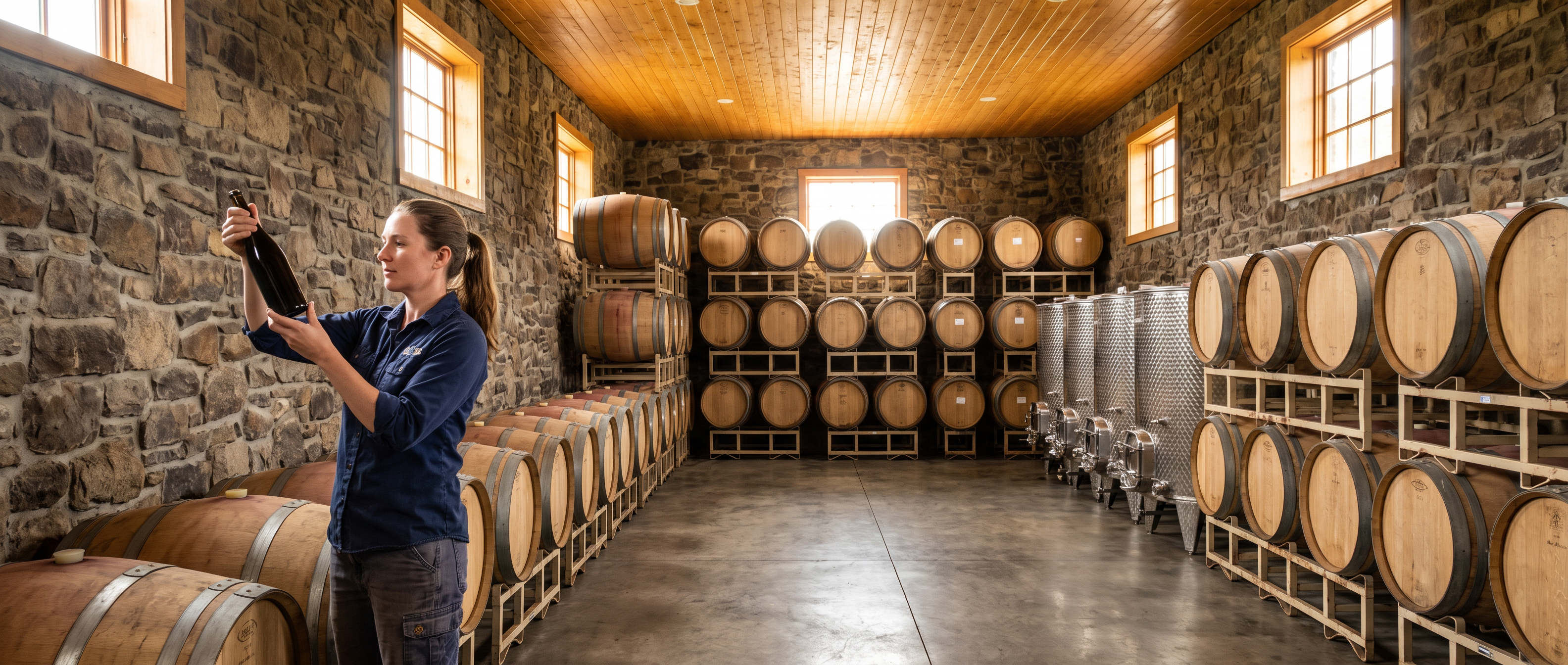
Keep containers and contents distinct. A tank, oak barrel, barrel rack and the wine inside can all be damaged in one incident, but their values and applicable provisions may differ. Empty barrels awaiting use are not the same category as wine aging in them. Bottles, corks, labels and cartons awaiting packaging also deserve an inventory category rather than being lost inside an estimate for finished cases.
Four inventory conversations
Follow the wine from harvest to delivery
Harvested grapes and wine in process
Identify when fruit becomes insured stock, who owns it and how juice, fermenters and production costs are documented.
Bulk wine and aging barrels
Track lot, vintage, volume and stage-specific value. Separate the contents from the tank, barrel and rack that hold them.
Finished bottles and library collections
Distinguish current releases from scarce vintages. Support prices, quantities, ownership and any special valuation arrangement.
Wine stored or moved elsewhere
Map custom-crush facilities, warehouses, tasting rooms and shipments. Confirm coverage while moving, not just at each destination.
Grapes on the vine and harvested stock are different insurance questions
USDA's grape crop fact sheet lists harvest among the events that end the crop insurance period.[1] That is a reason to review the transition carefully, not an assurance that a winery property policy begins at the same moment. Confirm current crop terms with a qualified crop insurance professional and ask the winery insurer when harvested fruit becomes covered property, under whose ownership and at which locations.
Describe grapes still awaiting pickup, fruit on a truck, bins held overnight and grapes delivered to another producer for processing. Purchased fruit can have a different ownership timeline from grapes grown by the winery. Contracts may address responsibility before arrival, after weighing or upon acceptance. Have those handoffs reviewed before assuming the grower's insurance, the hauler's coverage and the winery's policy fit together.
An integrated vineyard's farm and ranch insurance discussion should distinguish vines, growing crops, harvested stock, buildings and equipment. A farm-property schedule does not itself confirm wine-stock coverage. Crop eligibility, underwriting and policy availability require separate evaluation; this article is not a recommendation of a specific crop product or a claim that one program covers every stage.
Bulk wine and aging barrels: agree on a valuation method before a loss
Production cost, selling price and current market value are not interchangeable. Brown & Brown describes these as different valuation approaches for wine businesses.[3] An accounting balance may reflect costs incurred so far. A price list may reflect future direct-to-consumer revenue. A bulk-wine buyer may use another market basis. Ask which method the issued policy uses for each stage rather than choosing the largest number.
Specialist guidance describes a possible wine-stock provision based on finished selling price less costs not yet incurred, such as bottling or packaging.[4] That is an example of policy design, not a rule applying to every winery. For aging wine, confirm the assumed product, channel, quantity and remaining costs. Also ask how the insurer treats unfinished lots without a settled release price or a firm sales contract.
Explain custom-crush and alternating ownership arrangements precisely. If the winery holds another brand's bulk wine, it may have custody without ownership. If it owns wine held at a processor, it may have ownership without possession. Review property of others, contractual responsibility and any separate coverage for customers' stock. A building's commercial property insurance schedule is not proof that all wine in the building is included.
Does your stock schedule reflect today's cellar?
Bring current inventory, peak values, storage addresses and policy valuation wording to Gerald Ross Agency for a winery-specific review.
Request a wine inventory insurance reviewFinished bottles and library collections need more than a case count
Current releases may be intended for distributors, restaurants, tasting-room retail or wine-club fulfillment. Ask whether the valuation provision recognizes the actual channel and any costs or discounts that would not be incurred after a loss. Reservations, prepaid club orders and cases awaiting shipment also deserve clarification about ownership and settlement. An expected sale is not automatically the same as an insured receivable or guaranteed lost profit.
Library collections need a separate conversation. Older vintages may have limited availability, but age alone does not establish appreciation. Preserve provenance, quantities, storage history and supportable current values. Brown & Brown notes that rare or vintage stock may warrant third-party appraisal.[3] Historical importance to the winery and sentimental value do not automatically become covered monetary value.
Be precise with “agreed value.” A commercial-property agreed-value option may address coinsurance—the policy condition that can reduce payment when insured values are inadequate—rather than guarantee payment of an itemized bottle price.[6] Ask whether a special schedule or valuation arrangement is available, how values are accepted and updated, and how covered losses are settled. The answer depends on the actual form, not the label on a proposal.
Also identify concentration. Reserve wine stored in one locked room may be secure against casual access yet expose a large value to one fire or cooling incident.[5] Discuss room and location limits, shelf and rack stability, access control and emergency relocation. Do not count a wine collection's value once in general stock and again in a separate schedule without checking how the insurer avoids duplication.
Seasonal peaks can exceed an annual-average stock estimate
Winery inventory can rise when harvest arrives while earlier vintages remain unsold. A bottling run, delayed release or bulk purchase can concentrate more stock at one address than a quiet-month balance suggests. Build a location-by-location estimate of the highest combined values, including purchased wine, customers' stock where applicable and cases awaiting fulfillment.
A peak-season extension and a value-reporting form are different tools. A seasonal endorsement may increase limits during defined periods; a reporting arrangement requires values submitted under its own rules. Specialized winery programs provide examples of seasonal adjustments.[2] Do not assume one is included, that its dates match your operation or that an automatic increase is enough.
Ask about reporting frequency, valuation basis, maximum limits and the consequences of inaccurate or missed reports. Confirm whether each warehouse, processor and temporary location must be reported separately. Changes in ownership or storage need attention even if total gallons stay unchanged. Keep evidence of submitted reports and insurer acknowledgments rather than relying only on an internal spreadsheet.
Leakage, contamination and production errors are not the same event
A damaged valve can release wine. A hose connection can fail during transfer. A cooling-system leak can introduce an unwanted substance. A fermentation problem can affect quality without a visible spill. Specialized programs discuss some of these exposures separately, which is precisely why a generic promise that “inventory is covered” is not enough.[2] [4]
For leakage, ask about tanks, barrels, hoses, transfers, collapse, employee error and the loss of product itself. Coverage for repairing a tank does not establish payment for its contents. Slow seepage, ordinary evaporation, wear and tear, deterioration and an accidental break may be treated differently. Have the insurer explain the relevant cause-of-loss wording and any deductible or sublimit.
For contamination, ask what the policy means by that term. Does it address wine in process, ingredients introduced by mistake, cleaning substances or a cooling-system failure? Does it restrict bacteria, oxidation, smoke-related quality issues or processing errors? Do not assume that an unpleasant taste, failed laboratory result or decision not to release a vintage automatically qualifies as insured damage. Preserve laboratory and lot evidence and seek appropriate technical advice.
Stock damage is also different from harm to a customer or the expense of withdrawing distributed bottles. A product liability insurance review concerns defined third-party allegations and claims. Recall, withdrawal, replacement and reputation expenses may need separate provisions. A contamination endorsement should not be described as automatic coverage for all of those costs.
Cooling failure: review the machine and the wine separately
PAK's winery-storage guidance notes that coverage for failed cooling equipment may not include spoiled wine unless the relevant product-loss coverage is in place.[5] Ask separate questions about the chiller, the stock, cleanup and the interrupted business. Include sensors, controls, electrical distribution and the consequences of losing power away from the premises.
Discuss mechanical breakdown, on-site power failure and offsite utility interruption as distinct triggers. Confirm the affected property, waiting periods, temperature requirements, sublimits and any excluded utility equipment. Not every temperature fluctuation causes a loss, and not every loss is insured. Monitoring records can help establish conditions, but a temperature alarm does not replace policy wording.
Three cooling questions to ask together
The equipment: Is the failed system insured for this cause, and who maintains or repairs it?
The inventory: Is resulting damage to these specific lots covered, and how is it valued?
The business: Does any income or extra-expense coverage respond, for how long and under which conditions?
Record backup power capability, remote alarms, after-hours response and alternate storage contacts. A rented generator, temporary chiller or borrowed transfer equipment may help an emergency plan but introduces another property and contract question. Review rented and borrowed equipment insurance before assuming an emergency rental is covered or every related expense will be reimbursed.
Moving wine offsite or changing storage?
Share the new address, values, processor or warehouse contract and transfer arrangements before assuming your existing policy follows the wine.
Talk through your winery stock questionsOffsite storage and transit: do not leave coverage at the cellar door
Wine can move between custom-crush premises, a bonded warehouse, a tasting room, a bottling contractor and a fulfillment partner. PAK cautions against assuming another producer or warehouse's insurance covers your stock.[5] Review addresses, maximum values, activities, custody and whose policy is intended to respond. A certificate is evidence of insurance, not a substitute for the coverage and storage contract.
Confirm whether your insurer covers wine being processed by others, wine you hold for someone else and your stock at unscheduled locations. Ask counsel to review liability limits in the warehouse or production agreement. A contract may limit another party's responsibility even when its insurance limit looks substantial. Keep ownership and lot records so wine is not mistaken for the processor's own inventory.
Coverage at both ends of a trip is not proof of coverage while moving.[5] Ask about loading and unloading, bulk tankers, common carriers, your own delivery vehicle, temperature damage, breakage, theft, shipment limits and territory. Determine when ownership and risk pass under the sales contract. A specialist contingent-transit provision can be narrower than ordinary cargo coverage; the product name alone does not answer the question.[2]
A commercial auto insurance review addresses vehicles and defined auto exposures. It does not automatically insure the value of every case in the van. Wine in transit, the vehicle carrying it and liability for an accident need coordinated but distinct coverage discussions. Retain bills of lading, pickup condition records and delivery exceptions.
Fire, flood, earthquake and smoke require cause-specific review
A fire can damage structures, stock and equipment together. A flood or earthquake can have different coverage arrangements, deductibles and limits. Winery specialists emphasize that catastrophe provisions vary by location and policy.[5] Ask about building damage and inventory damage separately, including stock stored below grade and values at third-party facilities.
Review commercial flood insurance for the actual storage locations rather than assuming an ordinary property form includes flood. Earthquake, rack movement, bottle breakage and debris removal also need policy-specific answers. Smoke affecting harvested wine should not be assumed to receive the same treatment as crop damage before harvest or direct fire damage in a cellar.
Business-income coverage is not a guarantee of every missed release, closed tasting room or canceled shipment. Ask what covered damage must occur, whether offsite property is included, how waiting periods work and how restoration time is measured. Producing another vintage can take far longer than repairing a wall; that business reality does not automatically extend the policy's period of indemnity.
Use inventory records to support a claim—not to assume one
Federal wine inventory rules address identification of wine, bulk containers and bottled quantities. They include vintage, varietal or geographical identification where appropriate, tank numbers and separate bulk and bottled totals.[7] TTB's report instructions also distinguish materials, wine in fermenters, bulk wine, bottled stock and different losses.[9] Those records are useful starting evidence, but they do not decide insurance values or causes of loss.
TTB's inventory-loss rules address normal production and storage losses differently from unexplained bottled shortages.[8] A tax allowance or operations-report entry is not an insurer's agreement to pay. Keep tax-compliance advice with qualified specialists and compare insurance reporting duties separately. For the insurance file, preserve the lot, quantities before and after the event, location, ownership, costs, price support and what happened.
After a suspected loss, protect people first and follow emergency procedures. Notify the insurer promptly, segregate affected lots where safe and preserve photos, alarm data, maintenance records and relevant samples under professional guidance. Coordinate safe disposal, salvage, regulatory duties and insurer inspection before taking irreversible action. Do not delay necessary safety measures, but do not assume destroying stock without documentation simplifies a claim.
Prepare a stock file before renewal, harvest or relocation
The most useful review can connect the cellar inventory, accounting records and storage map without forcing the agent to guess. Update it when acquiring bulk wine, retaining another vintage, changing warehouses or introducing a new sales channel. For the broader operation, the vineyard, winery and tasting-room insurance guide addresses guests, events and direct sales beyond this inventory-focused discussion.
Eight items for a wine inventory insurance review
- 1
Stock by lot, vintage and stage: harvested fruit, fermenters, bulk tanks, aging barrels, packaged cases and library bottles.
- 2
Current and peak quantities at each address, including overlapping vintages, stock awaiting release and holiday fulfillment.
- 3
Ownership records for your wine, customers' wine, consigned cases, purchased bulk wine and stock committed to buyers.
- 4
Cost records, price lists, sales-channel details and current appraisal or market evidence for unusual library vintages.
- 5
Storage and custom-crush contracts, warehouse insurance evidence, carrier agreements and shipment handoff records.
- 6
Cooling and power arrangements, alarms, backup procedures, maintenance logs, barrel-rack inspections and emergency contacts.
- 7
Policy schedules and endorsements for valuation, leakage, contamination, breakdown, spoilage, transit and offsite locations.
- 8
Claims history, lot traceability, photos, TTB inventory records, secure backups and insurer reporting contacts.
Frequently asked questions
Does grape crop insurance cover wine after harvest?
Do not assume it does. USDA's grape crop fact sheet lists harvest among the events that end the crop insurance period. Harvested grapes, juice, wine in process and finished stock need a separate review of winery property and stock coverage. Confirm current crop terms with a qualified crop insurance professional and the stock coverage attachment point with the winery insurer.
Will insurance pay the retail price for wine lost in a barrel?
Not automatically. Production cost, selling-price provisions and market-value arrangements are different. A specialized provision may account for the intended finished selling price less costs not yet incurred, but this is not a universal settlement method. Confirm the valuation wording for each stage, plus deductibles, limits and any coinsurance or reporting conditions.
Is an agreed-value option a guaranteed payout for library wines?
No. In commercial property insurance, an agreed-value option may address coinsurance rather than guarantee an itemized bottle settlement. Ask how distinctive vintages are scheduled, what valuation evidence is accepted, how market changes are handled and which covered-loss settlement method applies.
Does equipment breakdown insurance cover wine spoiled by a cooling failure?
Equipment repairs and damaged wine are separate questions. Ask about spoilage, temperature change, utility interruption, causes of loss, waiting periods, exclusions and sublimits. A policy that covers repairing a failed chiller does not necessarily cover every affected barrel or bottle.
Is my wine automatically insured at a custom-crush facility or warehouse?
No. Review your own offsite coverage, the storage or processing agreement, ownership and responsibility for loss, and the other business's actual insurance. A warehouse's insurance certificate does not establish that it covers your stock, every cause of damage or the wine's full value. Transit between locations also needs separate confirmation.
Does a normal inventory shortage qualify as an insurance claim?
Not simply because a count is lower. Ordinary evaporation, processing shrinkage, unexplained shortages and a documented accidental spill can receive different policy treatment. TTB reporting or tax allowances do not determine insurance coverage. Preserve records of the cause, quantities and condition, and notify the insurer under the actual policy.
Sources and further reading
These government, regulatory and winery-specialist resources informed this guide. Public program descriptions illustrate coverage questions; they are not your issued policy and do not establish Gerald Ross Agency's appointment with the referenced companies. Older educational materials are used for general distinctions, not current pricing or filing deadlines. Confirm current regulatory requirements and your actual policy wording with qualified advisors.
- [1] USDA Risk Management Agency: Grapes fact sheet — crop insurance period and coverage boundaries
- [2] COUNTRY Financial: Winery insurance — stock stages, leakage and processors
- [3] Brown & Brown: Wineries, vineyards and wine businesses — valuation methods
- [4] The Grapevine Magazine: Endorsements Unique to the Wine Making Industry — Brian Kennon
- [5] PAK Programs: How Wine Storage Decisions Can Affect Winery Insurance Needs
- [6] Independent Insurance Agents & Brokers of America: Understanding the Agreed Value Option
- [7] Cornell Legal Information Institute: 27 CFR 24.313 — Wine inventory record
- [8] Cornell Legal Information Institute: 27 CFR 24.266 — Wine inventory losses
- [9] Alcohol and Tobacco Tax and Trade Bureau: Wine premises operations report — detailed instructions
A coverage review that follows your wine
Gerald Ross Agency can help Oregon and Northern California wine businesses organize a policy-specific review of stock, storage, equipment and shipments. Bring the inventory stages and location details so the conversation reflects your actual operation.
Request a winery insurance quoteImportant: General educational information only, not legal, tax, crop-insurance, winemaking, regulatory or coverage advice. Coverage availability and claim outcomes depend on underwriting, issued policy wording, endorsements, exclusions, limits, deductibles, valuations, reporting duties and the facts of the loss. No policy, valuation arrangement, inventory record or safety measure discussed here guarantees compliance, payment or a particular result.