


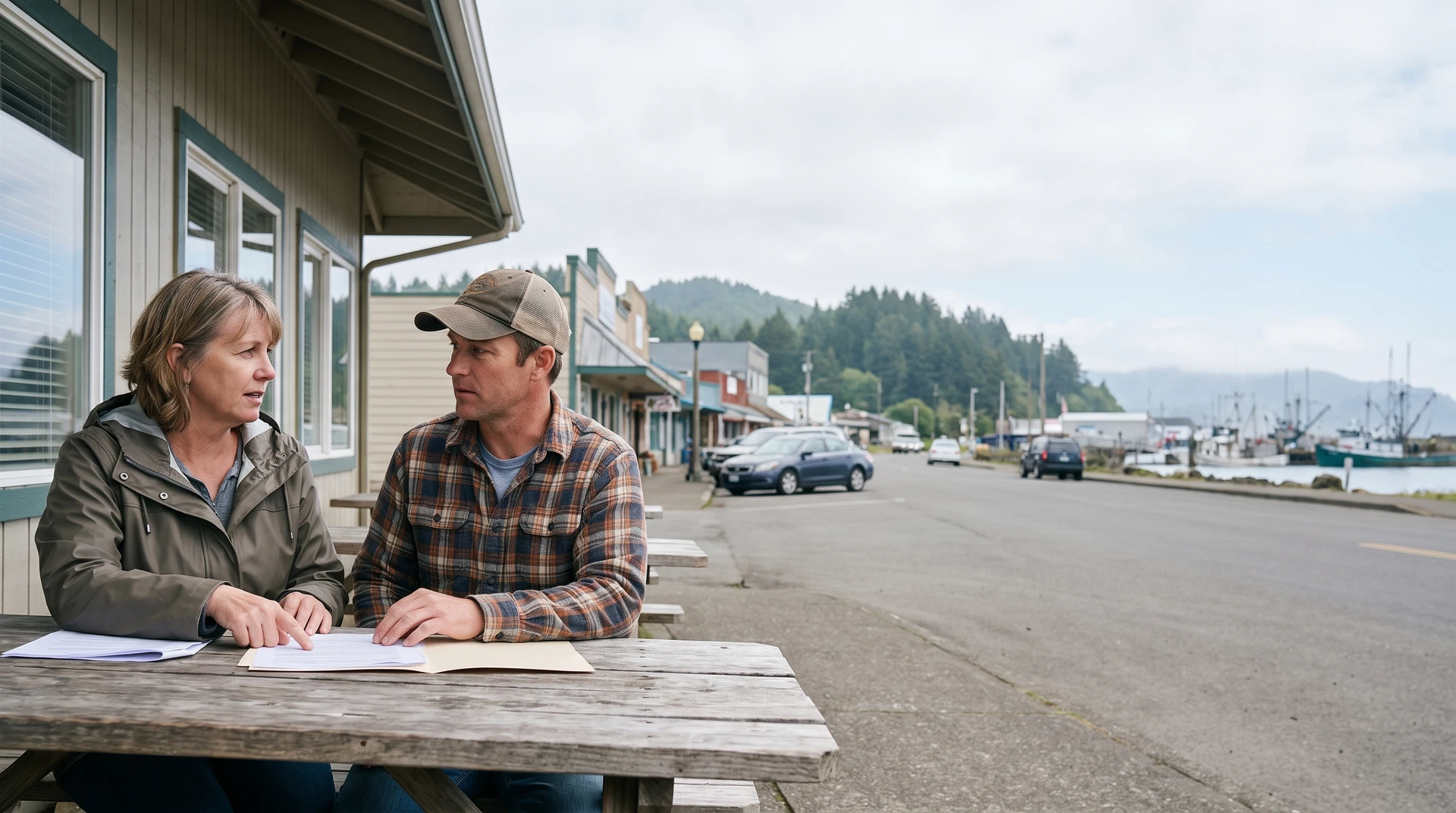

Homeowners associations govern millions of residential units across Oregon and Northern California — from oceanfront condominiums in Brookings and Lincoln City to planned communities in Bend, Medford, Eureka, and Arcata. Whether you serve on an HOA board or simply own a unit in a community governed by one, understanding how HOA insurance works is essential. The stakes are high: a single underinsured loss event can result in a six-figure special assessment levied against every unit owner in the community. This guide explains what Oregon and California law require, what the essential coverages are, and what individual unit owners need to protect themselves when the association's policy falls short.
Does Your HOA Have the Right Coverage?
Oregon ORS 94.675 and California's Davis-Stirling Act impose specific insurance requirements on HOA boards. Gerald Ross Agency reviews HOA master policies, D&O coverage, fidelity bonds, and loss assessment gaps for associations across Oregon and Northern California.
Part One: What Oregon and California Law Require
Oregon: ORS 94.675 and ORS 100.435
Oregon's insurance requirements for community associations are codified in two statutes. ORS 94.675 governs planned communities — single-family home subdivisions and townhome communities governed by an HOA — while ORS 100.435 governs condominium unit owners associations. Both statutes require the board of directors to obtain and maintain two core coverages: property insurance covering all insurable improvements in the common property against fire and other hazards at full replacement cost, and a public liability policy covering all common property and all damage or injury caused by the negligence of the association.
The 2019 amendment to ORS 94.675 added a mandatory fidelity bond requirement for Class I and Class II planned communities. The fidelity bond must cover all persons with access to association funds — directors, officers, employees, managing agents, and employees of any management company — and must also cover computer fraud and funds transfer fraud. The required bond amount must equal at least the combined total of all funds maintained in association accounts plus any U.S. government obligations purchased by the association. For a community with $500,000 in reserves, the fidelity bond must be at least $500,000.
Oregon law also allows the board to adopt a higher deductible than specified in the governing documents, but not to exceed the greater of the Federal National Mortgage Association's maximum acceptable deductible or $10,000. If the board exercises this option, it must notify all owners within 10 days of the resolution. Higher deductibles can significantly reduce premium costs in today's challenging insurance market — but they also increase the risk of a special assessment if a covered loss occurs.
California: The Davis-Stirling Act
California's Davis-Stirling Common Interest Development Act (Civil Code Sections 5800–5810) establishes the insurance framework for all common interest developments in the state, including HOAs in Humboldt, Mendocino, Del Norte, and Trinity counties. Civil Code Section 5805 requires associations to maintain Commercial General Liability insurance at minimum limits that scale with community size: at least $2 million for associations with 100 or fewer separate interests, and at least $3 million for associations with more than 100 separate interests.
Civil Code Section 5806 requires California HOAs to maintain crime insurance, employee dishonesty coverage, or fidelity bond coverage for directors, officers, employees, and anyone who handles association funds. The required amount is the greater of $2,000 or the association's current reserve funds plus three months of operating expenses. California law also requires the association to disclose its insurance coverage to all members annually, including the type of coverage, carrier, policy limits, and deductibles.
Civil Code Section 5800 limits the personal liability of volunteer HOA officers and directors for negligent acts or omissions, provided the association maintains the minimum required insurance. This is one of the most important reasons for California HOA boards to maintain adequate coverage: without it, individual board members can be personally liable for decisions made in good faith while serving the community.
Part Two: The Essential HOA Insurance Coverages
1. The HOA Master Policy: Property and Liability
The master policy is the foundation of HOA insurance. It has two components: commercial property coverage for the association's physical assets, and commercial general liability coverage for bodily injury and property damage claims arising from common areas. From a commercial insurance perspective, the master policy functions like a commercial package policy — but with specific endorsements and coverage structures tailored to community associations.
For condominium associations, the master policy comes in three forms that determine how much of the individual unit is covered. A bare walls-in policy covers only the building's basic structure — exterior walls, roof, framing, and shared utility systems — leaving unit owners responsible for everything inside their walls. A single entity policy adds coverage for original fixtures and appliances installed by the developer, but not owner upgrades. An all-inclusive policy covers the structure, common areas, and most fixtures and improvements inside individual units, including owner upgrades. Understanding which type of master policy your association carries is the single most important thing a unit owner can do to determine how much individual coverage they need.
Replacement cost valuation is critical and frequently underestimated. Construction costs in Oregon and Northern California have risen sharply since 2020, driven by supply chain disruptions, labor shortages, and increased demand. A community that insured its buildings at replacement cost five years ago may be significantly underinsured today. Boards should commission a professional appraisal every three to five years to ensure coverage keeps pace with actual replacement costs.
2. Directors and Officers (D&O) Liability Insurance
HOA board members make decisions every day that affect the rights, property values, and finances of every homeowner in the community. When those decisions are challenged — and they frequently are — D&O insurance pays for the legal defense costs and any resulting settlements or judgments. Without D&O coverage, board members can be personally liable for decisions made in good faith while serving the community.
Common D&O claims against HOA boards include failure to enforce CC&Rs consistently, discrimination in rule enforcement, failure to maintain common areas, improper handling of architectural review requests, and mismanagement of reserve funds. Many of these claims are non-monetary — a homeowner seeking to compel the board to take a specific action — but the legal defense costs alone can be substantial. California's Davis-Stirling Act requires at least $500,000 in D&O coverage, but most associations with significant assets should carry considerably more.
When evaluating D&O policies, boards should look for several key features: a "duty to defend" provision (which guarantees defense funding even if the loss itself is not ultimately covered), coverage for non-monetary claims, full prior acts coverage, coverage for committee members and spouses, and no "insured versus insured" exclusion that would prevent one board member from suing another under the policy.
3. Fidelity Bond / Crime Insurance
HOAs collect dues, manage reserve funds, and make significant financial decisions — making them attractive targets for embezzlement and fraud. Fidelity bond coverage (also called crime insurance or employee dishonesty coverage) protects the association against financial losses resulting from dishonest acts by board members, employees, management company staff, or contractors who handle association funds.
As noted above, Oregon law now mandates fidelity bond coverage for Class I and Class II planned communities, and California law requires it for all common interest developments. Beyond the statutory minimums, associations should consider coverage for computer fraud and funds transfer fraud — both of which are increasingly common attack vectors. A management company employee who initiates a fraudulent wire transfer can drain an association's reserve account in minutes; coverage for this exposure is no longer optional.
4. Workers' Compensation
If the association employs any workers — even part-time maintenance staff, groundskeepers, or pool attendants — it is required by law to carry workers' compensation insurance in both Oregon and California. Oregon's workers' compensation system is administered through the Workers' Benefit Fund, and coverage must be obtained through a licensed carrier or the State Accident Insurance Fund (SAIF). Failure to carry workers' compensation exposes the association to significant civil and criminal penalties, as well as direct liability for injured workers' medical expenses and lost wages.
5. Commercial Umbrella Liability
A commercial umbrella policy extends the liability limits of the master policy's general liability coverage, the D&O policy, and other underlying liability policies. For larger associations — particularly those with pools, fitness centers, playgrounds, or other amenities that create elevated liability exposure — an umbrella policy is an inexpensive way to add a significant additional layer of protection. Umbrella policies typically provide coverage in excess of the underlying policy limits and can also provide first-dollar coverage for losses that are excluded by the underlying policies but covered by the umbrella.
6. Flood and Earthquake Insurance
Standard HOA master policies exclude flood and earthquake damage. For communities in Oregon and Northern California, both of these exclusions are significant. The Oregon Coast is subject to tsunami inundation risk from Cascadia Subduction Zone events, and many coastal communities sit in FEMA-designated Special Flood Hazard Areas. Inland communities near rivers — including those in the Rogue Valley and along the Klamath River in Northern California — face periodic flooding risk as well.
Earthquake risk is substantial throughout the Pacific Northwest and Northern California. The Cascadia Subduction Zone is capable of producing a magnitude 9.0 or greater earthquake, and the resulting damage to unreinforced masonry buildings and older wood-frame construction could be catastrophic. Associations that do not carry earthquake insurance are gambling that a major seismic event will not occur during their policy term. An independent agent like Gerald Ross Agency can access both admitted and surplus lines markets to find earthquake and flood coverage for associations in high-risk areas.
HOA Insurance Coverage Summary
| Coverage | What It Covers | Oregon Required? | CA Required? |
|---|---|---|---|
| Master Policy — Property | Common area buildings at full replacement cost | Yes (ORS 94.675) | Yes (Davis-Stirling) |
| Master Policy — General Liability | Bodily injury and property damage in common areas | Yes (ORS 94.675) | Yes — $2M/$3M min |
| Fidelity Bond / Crime | Employee dishonesty, computer fraud, funds transfer fraud | Yes (ORS 94.675) | Yes (CC §5806) |
| Directors & Officers (D&O) | Board member liability for decisions made while serving | Strongly recommended | Yes — $500K min |
| Workers' Compensation | Employee injuries (maintenance, groundskeeping, pool staff) | Yes if employees | Yes if employees |
| Commercial Umbrella | Excess liability above GL, D&O, and other policies | Recommended | Recommended |
| Flood Insurance | Flood damage to common areas and buildings | Recommended in flood zones | Recommended |
| Earthquake Insurance | Seismic damage to common areas and buildings | Strongly recommended | Strongly recommended |
| Cyber Liability | Data breach, ransomware, digital access system failures | Recommended | Recommended |
Is Your HOA Board Fully Protected?
D&O claims against HOA boards have doubled in recent years. Gerald Ross Agency can review your current D&O policy, identify coverage gaps, and connect you with specialty programs designed for community associations in Oregon and Northern California.
Part Three: What Individual Unit Owners Need to Know
The HO-6 Policy: Filling the Gaps
The HOA's master policy covers the association and its common areas — not the individual unit owner's belongings, interior improvements, or personal liability. Unit owners in condominiums and townhome communities need their own insurance policy, typically an HO-6 (condominium unit owner) policy, to fill the gaps left by the master policy.
What an HO-6 policy covers depends on what the master policy does not. If the association carries a bare walls-in master policy, the unit owner needs coverage for all interior improvements — drywall, flooring, cabinetry, fixtures, and appliances — in addition to personal property and personal liability. If the association carries an all-inclusive master policy, the unit owner may need less structural coverage but still needs personal property and liability protection. The key is to read the association's master policy carefully and coordinate your HO-6 coverage to eliminate gaps.
Personal liability coverage under an HO-6 policy protects the unit owner if a guest is injured inside their unit, if their pet injures someone, or if they accidentally cause damage to a neighboring unit. This exposure is entirely separate from the association's general liability coverage, which only applies to common areas.
Loss Assessment Coverage: The Hidden Exposure
One of the most important — and most overlooked — coverages for HOA unit owners is loss assessment coverage. When the association suffers a loss that exceeds its insurance coverage, or when a liability judgment exceeds the master policy's limits, the association can levy a special assessment against all unit owners to cover the shortfall. In communities with large deductibles on the master policy, even a relatively modest loss event can trigger a significant assessment.
Loss assessment coverage, which is typically available as an endorsement to an HO-6 policy, pays for special assessments levied against the unit owner as a result of a covered loss. Standard HO-6 policies often include a default limit of $1,000 for loss assessments — far too low for most communities. Unit owners should consider increasing this limit to at least $25,000 to $50,000, particularly in communities with high master policy deductibles or significant common area amenities. In wildfire-prone areas of Southern Oregon and Northern California, where master policy deductibles have risen sharply in recent years, adequate loss assessment coverage is more important than ever.
The Oregon and Northern California Insurance Market Challenge
HOA boards and unit owners in Oregon and Northern California face a more challenging insurance market than most of the country. Wildfire risk has driven significant carrier withdrawals from Southern Oregon's Rogue Valley, Josephine County, and Northern California's Humboldt, Mendocino, and Trinity counties. Some standard admitted carriers have stopped writing new HOA master policies in these areas entirely, forcing associations into surplus lines markets where premiums are higher and coverage terms are less predictable.
The Oregon Coast presents a different set of challenges: coastal properties face elevated wind and water damage risk, and some carriers apply coastal surcharges or restrict coverage for properties within a certain distance of the ocean. Tsunami inundation risk is a real concern for communities in Brookings, Gold Beach, Port Orford, and other coastal communities, and standard flood insurance through the National Flood Insurance Program (NFIP) may not provide adequate coverage for a major tsunami event.
Working with an independent insurance agent who has access to both admitted and surplus lines markets is essential for HOA boards in these areas. Gerald Ross Agency has been placing commercial insurance for Oregon and Northern California clients since 1935, and we have the market relationships to find competitive coverage even in the most challenging environments. If your association has received a non-renewal notice, our guide on what to do when your carrier drops you provides a practical roadmap for finding replacement coverage.
Special Considerations for Vacation and Short-Term Rental Communities
Many HOA communities in Oregon and Northern California — particularly on the coast and in resort areas like Bend and the Rogue Valley — include a significant number of units used as vacation rentals or short-term rentals through platforms like Airbnb and VRBO. Standard HO-6 policies typically exclude or limit coverage for short-term rental activity. Unit owners who rent their units on a short-term basis need either a short-term rental endorsement on their HO-6 policy or a separate landlord policy that covers rental activity. The association's master policy generally does not cover liability arising from rental activity within individual units — that exposure falls on the unit owner.
Associations that permit short-term rentals should also review their D&O coverage to ensure it covers claims arising from the board's decisions about rental policies. Disputes over short-term rental restrictions have become one of the most common sources of HOA litigation in recent years, and boards need adequate D&O protection when navigating these issues. For more on the unique insurance challenges facing Oregon's tourism and hospitality sector, see our guide to RV resort and park insurance in Oregon and Northern California.
Why an Independent Agent Is the Right Choice for HOA Insurance
HOA insurance is a specialty line, and not every commercial insurance agent has deep experience placing it. The specialty coverages — D&O, fidelity bonds, earthquake, and flood — are not standard commercial package items, and finding a carrier that bundles them competitively requires access to specialty programs that most captive agents do not have.
Gerald Ross Agency is an independent agency serving the Oregon Coast, Southern Oregon, and Northern California. We have relationships with specialty HOA programs as well as the surplus lines markets that are essential for associations in high-risk zones. We can advise boards on Oregon and California statutory requirements, help unit owners understand what their HO-6 policy covers and where the gaps are, and review loss assessment coverage limits to ensure they are adequate for the community's risk profile.
We recommend an annual coverage review for HOA boards — not just at renewal, but whenever the community adds amenities, completes major renovations, or experiences a significant change in the insurance market. For unit owners, the right time to review your HOA-related coverage is when you purchase your unit, when the association changes its master policy, and whenever you make significant improvements to your unit's interior.
To learn more about the full range of commercial insurance options available through Gerald Ross Agency, or to explore related topics such as insurance in Northern California's Emerald Triangle or self storage insurance in Oregon and Northern California, visit our blog or contact us directly.
Frequently Asked Questions
Is HOA insurance the same as homeowners insurance?▼
What is loss assessment coverage and why do I need it?▼
What does Oregon law require HOAs to carry?▼
What does California's Davis-Stirling Act require for HOA insurance?▼
What is the difference between bare walls-in, single entity, and all-inclusive HOA master policies?▼
Does the HOA master policy cover my personal belongings?▼
What happens if the HOA does not have enough insurance to cover a major loss?▼
Ready to Review Your HOA's Coverage?
Whether you serve on an HOA board in coastal Oregon, the Rogue Valley, or Northern California, or you are a unit owner trying to understand what your policy actually covers, Gerald Ross Agency has the expertise and carrier relationships to get you the right protection. Call us or request a quote today.


