


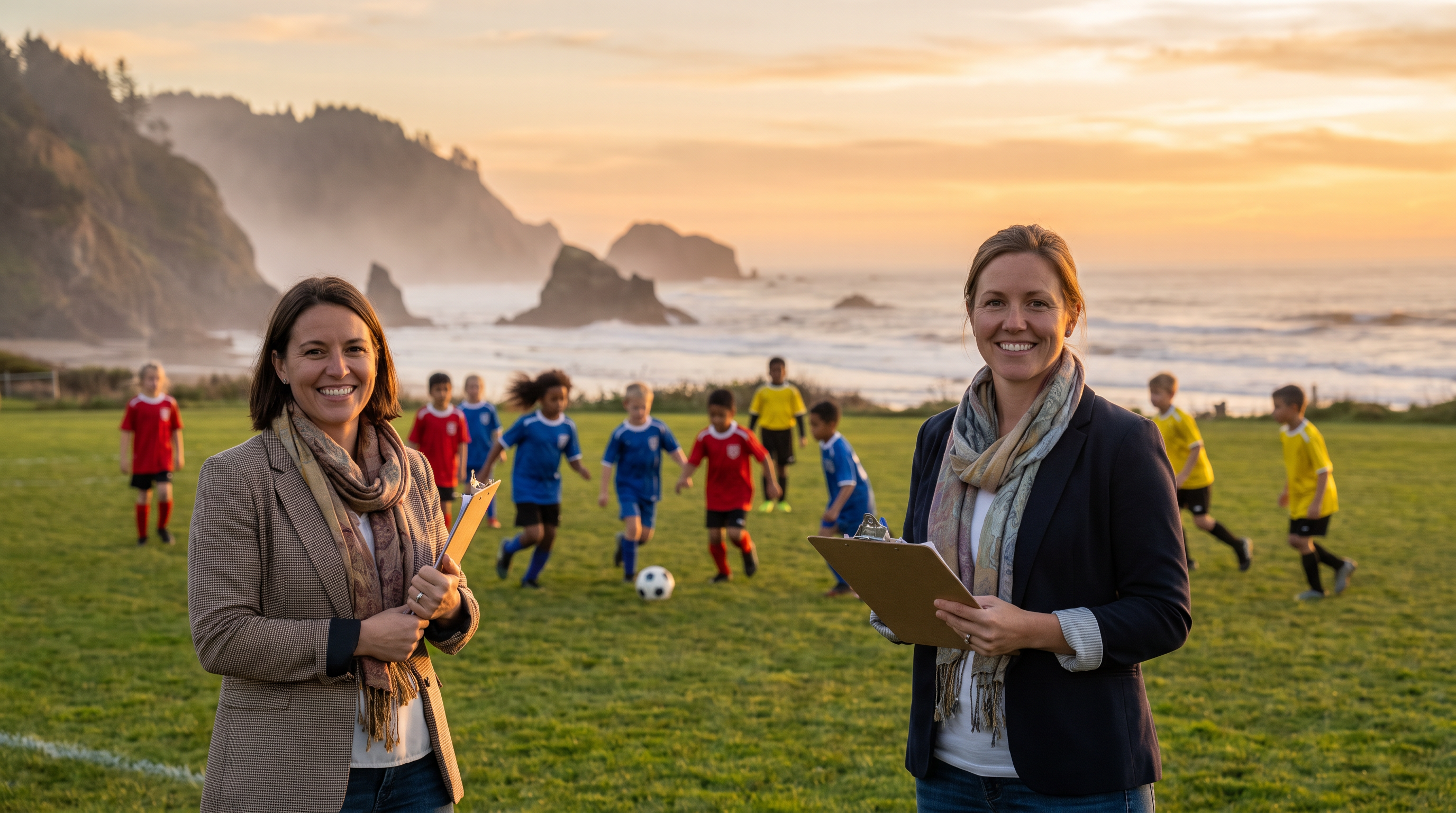

Every weekend across Oregon's coast, valleys, and mountains — and throughout Northern California's Humboldt, Trinity, Mendocino, and Shasta counties — thousands of children take the field, the court, the pool, and the trail under the supervision of volunteer coaches, paid staff, and nonprofit board members. Youth sports and youth-serving organizations are the backbone of community life in these regions. They are also, from an insurance standpoint, among the most complex and underinsured categories of organizations in the country. This guide explains what coverage your organization needs, what the law requires in Oregon and California, and what happens when a claim arises without the right protection in place.
Running a Youth League or Sports Organization? Get a Specialized Quote.
Standard commercial policies leave youth organizations exposed. Gerald Ross Agency has access to specialty programs that include sexual abuse and molestation coverage, participant accident, D&O, and volunteer protection — all in one package built for Oregon and Northern California organizations.
Part One: Why Youth Organizations Face Unique Insurance Risks
Youth organizations are not simply small businesses with younger customers. They carry a distinct set of legal and moral obligations that create insurance exposures most standard commercial policies are not designed to address. Three factors drive this complexity: the involvement of minors, the reliance on volunteers, and the physical nature of sports activities.
Minors cannot legally waive their own rights. When a parent signs a liability waiver on behalf of their child before a soccer season, that waiver provides far less protection than it would for an adult participant. Oregon courts have been skeptical of pre-injury waivers signed by parents on behalf of minor children, and California courts have been even more restrictive. This means that when a child is injured at practice or during a game — even in a sport where injuries are expected and accepted — the organization can face a lawsuit that a waiver alone will not defeat.
Volunteers create a different kind of exposure. Most youth sports organizations rely heavily on parent volunteers as coaches, referees, scorekeepers, and drivers. When a volunteer coach gives a player incorrect technique instruction that results in a neck injury, or when a volunteer driver gets into an accident transporting athletes to an away game, the organization can be held vicariously liable for the volunteer's actions. Standard general liability policies may or may not cover volunteers, depending on how the policy is written — and many organizations do not discover this gap until a claim is filed.
The physical nature of sports creates participant injury exposure that is entirely separate from third-party liability. When a player breaks a wrist in a fall, tears an ACL during a game, or suffers a concussion at practice, the organization is not necessarily legally liable — but the family may face significant medical bills. Participant Accident insurance provides a no-fault medical benefit that covers these costs directly, reducing the likelihood that an injured athlete's family will resort to a lawsuit to recover their expenses.
The Most Dangerous Coverage Gap: Sexual Abuse and Molestation
Of all the coverage gaps in youth organization insurance, the most consequential is the absence of Sexual Abuse and Molestation (SAM) coverage. Standard general liability policies exclude intentional acts — and allegations of abuse or molestation are, by definition, intentional acts. This means that without a specific SAM endorsement or standalone policy, a claim of abuse against a coach, staff member, or volunteer would not be covered by the organization's GL policy at all.
SAM coverage is not just about paying claims. It also provides legal defense costs, which can be enormous even when an organization is ultimately found not liable. A single SAM claim can cost hundreds of thousands of dollars to defend, and a judgment against an uninsured organization can be financially devastating. Many funders, grant-making foundations, and facility owners now require proof of SAM coverage before they will work with a youth organization. Recommended minimum limits are $1 million per occurrence and $2 million aggregate.
Youth Organization Coverage Summary
| Coverage | What It Covers | Recommended Minimum | In Standard GL? |
|---|---|---|---|
| General Liability (CGL) | Third-party injuries, property damage, spectator claims | $1M per occurrence / $2M aggregate | Yes |
| Participant Accident | Medical bills for registered athletes, no-fault | $25K–$100K per person | No — specialty coverage |
| Sexual Abuse & Molestation (SAM) | Abuse/misconduct claims against staff or volunteers | $1M per occurrence / $2M aggregate | No — excluded from GL |
| Directors & Officers (D&O) | Board member personal liability for organizational decisions | $500K–$1M | No — specialty coverage |
| Volunteer Accident | Medical benefits for injured volunteers | Replacement cost | No — specialty coverage |
| Non-Owned & Hired Auto | Liability when volunteers drive athletes in personal vehicles | $1M combined single limit | No — specialty coverage |
| Workers' Compensation | Paid employees (coaches, staff) injured on the job | State minimum (required by law) | Required — separate policy |
| Commercial Property | Owned equipment, scoreboards, goals, storage facilities | Replacement cost | Separate policy |
| Event Cancellation | Lost revenue if tournaments or events are cancelled | Event budget | No — specialty coverage |
| Commercial Umbrella | Excess liability above GL and other liability limits | $1M–$5M | Separate policy |
Part Two: Oregon Law and Insurance Requirements
Oregon does not have a single statute that mandates liability insurance for all youth sports organizations. However, several laws create de facto insurance requirements, and the practical reality is that most organizations cannot operate without coverage.
ORS 336.485: Oregon's Concussion Protocol
Oregon Revised Statute 336.485 establishes a mandatory concussion protocol for youth sports programs. Under this law, any athlete who is suspected of having sustained a concussion must be immediately removed from play and may not return until they receive written medical clearance from a licensed health care provider. Organizations affiliated with the Oregon School Activities Association (OSAA) must comply with OSAA's concussion management policy, which includes annual training for coaches and athletes.
The insurance implication is significant: if an organization fails to follow the concussion protocol and an athlete suffers a second impact injury, the organization's failure to comply with ORS 336.485 can be used as evidence of negligence in a lawsuit. Participant Accident coverage pays the medical bills; general liability coverage defends the organization against the negligence claim. Both are essential for any contact sport program operating in Oregon.
Oregon Workers' Compensation: Paid Coaches and Staff
Oregon requires most employers with one or more employees to carry workers' compensation insurance. This applies to youth organizations that pay coaches, program directors, administrative staff, or any other workers — even part-time. Volunteer coaches are generally not employees and are not covered by workers' comp, but they should be covered by Volunteer Accident insurance as a best practice. Misclassifying a paid coach as a volunteer to avoid workers' comp obligations is a compliance risk that can result in significant fines and personal liability for organizational officers.
As an independent agency serving Oregon since 1935, Gerald Ross Agency can help organizations navigate the distinction between employees and volunteers and ensure that workers' comp coverage is structured correctly for their staffing model.
Facility and Venue Requirements: The Practical Mandate
Even without a statutory mandate, the practical reality for most Oregon youth sports organizations is that they cannot operate without insurance. Oregon State Parks requires a Certificate of Insurance before issuing a recreational facility permit. Portland Parks & Recreation, Coos Bay Parks, and most other municipal parks departments have the same requirement. School districts that allow youth organizations to use their facilities require proof of general liability coverage — typically $1 million per occurrence — and often require the school district to be named as an additional insured on the policy.
National Governing Bodies (NGBs) such as US Soccer, USA Baseball, and USA Swimming typically require member organizations to carry specific minimum coverages as a condition of affiliation. These requirements often include SAM coverage, which is one reason why NGB membership can actually improve an organization's insurance profile — the NGB's requirements push organizations toward more comprehensive coverage than they might otherwise purchase.
Does Your Organization Have the Right Coverage?
Sexual abuse and molestation coverage, participant accident, and D&O insurance are not included in standard commercial policies. Gerald Ross Agency can review your current coverage and identify any gaps before they become claims.
Part Three: California AB 506 and Northern California Youth Organizations
California Assembly Bill 506, which went into effect January 1, 2022, fundamentally changed the compliance landscape for youth-serving organizations in Northern California. The law was sponsored by the California Department of Insurance and was explicitly designed to reduce child abuse exposure — and the insurance liability that follows from it.
What AB 506 Requires
AB 506 applies to any organization — for-profit or nonprofit — that provides services or activities for minors. This includes youth sports leagues, travel teams, sports camps and clinics, afterschool programs, summer camps, religious youth groups, and any other organization that works with children under 18. The law requires three categories of compliance:
First, background checks: all administrators, employees, and regular volunteers (those working 16 or more hours per month, or 32 or more hours per year) must undergo LiveScan fingerprint-based background checks. Second, mandated reporter training: the same group must complete training in child abuse and neglect identification and California's reporting requirements. The California Department of Social Services provides an approved online training program. Third, written prevention policies: organizations must develop and implement written child abuse prevention policies and procedures, including protocols for reporting suspected incidents to authorities outside the organization, and policies requiring at least two trained adults to be present whenever staff or volunteers are supervising children.
The insurance connection is direct. California Insurance Commissioner Ricardo Lara co-sponsored AB 506 specifically because of the insurance liability created by child abuse in youth organizations. California carriers may require proof of AB 506 compliance to issue or renew liability coverage — and non-compliance can result in loss of insurance. For Northern California youth organizations in Humboldt, Mendocino, Trinity, Del Norte, and Shasta counties, AB 506 compliance is not optional. Our guide to insurance for Northern California's Emerald Triangle covers the broader commercial insurance landscape for this region.
Directors and Officers Liability: Protecting Your Board
Nonprofit youth organizations are governed by volunteer board members who make decisions about finances, hiring, programming, and organizational policy. When those decisions go wrong — a coach is hired without adequate background checks, a financial irregularity occurs, a program is discontinued and participants feel harmed — board members can face personal liability for their decisions. Directors and Officers (D&O) insurance protects individual board members and officers from personal financial exposure arising from their organizational decisions.
D&O coverage is particularly important for youth organizations because the stakes of a bad hiring decision can be catastrophic. If a board member votes to hire a coach without conducting a background check, and that coach later harms a child, the board member's personal assets could be at risk in a lawsuit. D&O insurance provides both defense costs and indemnification for covered claims. For Oregon nonprofit organizations, D&O coverage is one of the most important and most frequently overlooked components of a complete insurance program.
Part Four: Regional Considerations for Oregon and Northern California
The geography and demographics of Oregon's coast and Northern California create specific insurance considerations for youth organizations operating in these regions.
Along the Oregon Coast — from Astoria through Lincoln City, Newport, Coos Bay, Gold Beach, and Brookings — youth sports organizations often operate in outdoor environments with significant weather exposure. Coastal wind, rain, and the occasional tsunami evacuation zone create event cancellation risks that inland organizations do not face. Organizations that run outdoor tournaments or multi-day events should consider event cancellation coverage, which reimburses non-refundable expenses when an event must be cancelled due to weather, venue closure, or other covered causes.
In Southern Oregon — Medford, Ashland, Grants Pass, Klamath Falls — youth sports organizations face the same wildfire-driven insurance market challenges as other commercial entities. If your organization owns or leases a facility, commercial property coverage in wildfire-prone areas requires careful placement. An independent agent with access to surplus lines markets can often find coverage where standard carriers have declined. Our guide on what to do when your carrier drops you is relevant for organizations that have received non-renewal notices.
In Northern California's Humboldt, Mendocino, Trinity, and Shasta counties, youth organizations serve communities that are often geographically isolated, with limited access to specialty insurance markets. Gerald Ross Agency's relationships with carriers that specialize in rural and coastal Oregon and Northern California mean that organizations in these communities can access competitive coverage without having to work with out-of-state brokers unfamiliar with local conditions.
For organizations that operate aquatic programs — swim teams, water polo clubs, surf instruction programs along the Oregon Coast — the liability exposure is heightened. Drowning and near-drowning incidents are among the most serious claims in youth sports, and the legal standard for supervision in aquatic environments is high. Aquatic programs should ensure their GL policy explicitly covers water-based activities and that their participant accident coverage includes drowning-related claims. Consider also whether your commercial umbrella policy provides adequate excess coverage above your GL limits for this elevated-risk activity.
Common Coverage Gaps and How to Close Them
When Gerald Ross Agency reviews youth organization insurance programs, we consistently find the same gaps. The most common is the absence of SAM coverage — organizations assume their GL policy covers everything, not realizing that intentional acts are excluded. The second most common gap is reliance on the facility's insurance rather than carrying the organization's own policy. If your organization uses a school gym, a city park, or a private facility, the facility's insurance covers the facility — not your organization's activities. You need your own policy.
The third gap is volunteer driver exposure. When a parent volunteer drives athletes to an away game in their personal vehicle, the volunteer's personal auto insurance is the primary coverage for any accident. But personal auto policies often have low liability limits, and if those limits are exhausted, the organization can be brought into the lawsuit. Non-Owned and Hired Auto coverage fills this gap by providing the organization with liability coverage for accidents involving volunteers' personal vehicles used for organizational purposes.
Finally, many organizations carry outdated policies that no longer reflect their current participant numbers, activities, or geographic reach. A policy written for a 50-player recreational soccer league may not adequately cover a 200-player travel club program that competes in multiple states. Annual coverage reviews — not just at renewal, but whenever the organization's activities change significantly — are essential for maintaining adequate protection. To learn more about related coverage topics, see our guides on HOA insurance and nonprofit insurance in Oregon.
Frequently Asked Questions
Is youth sports insurance required by law in Oregon?▼
What is Sexual Abuse and Molestation (SAM) coverage and why is it essential?▼
What does California AB 506 require for youth organizations?▼
What is the difference between General Liability and Participant Accident insurance?▼
Are volunteer coaches and board members covered by the organization's insurance?▼
Do liability waivers protect Oregon youth sports organizations from lawsuits?▼
How much does youth sports insurance cost in Oregon and Northern California?▼
Protect Your League, Your Coaches, and Your Athletes
Whether you run a recreational soccer league on the Oregon Coast, a travel baseball club in Southern Oregon, or a youth swim program in Northern California, Gerald Ross Agency has the specialty coverage programs and carrier relationships to protect your organization, your board, your volunteers, and your athletes. Call us or request a quote today.


