


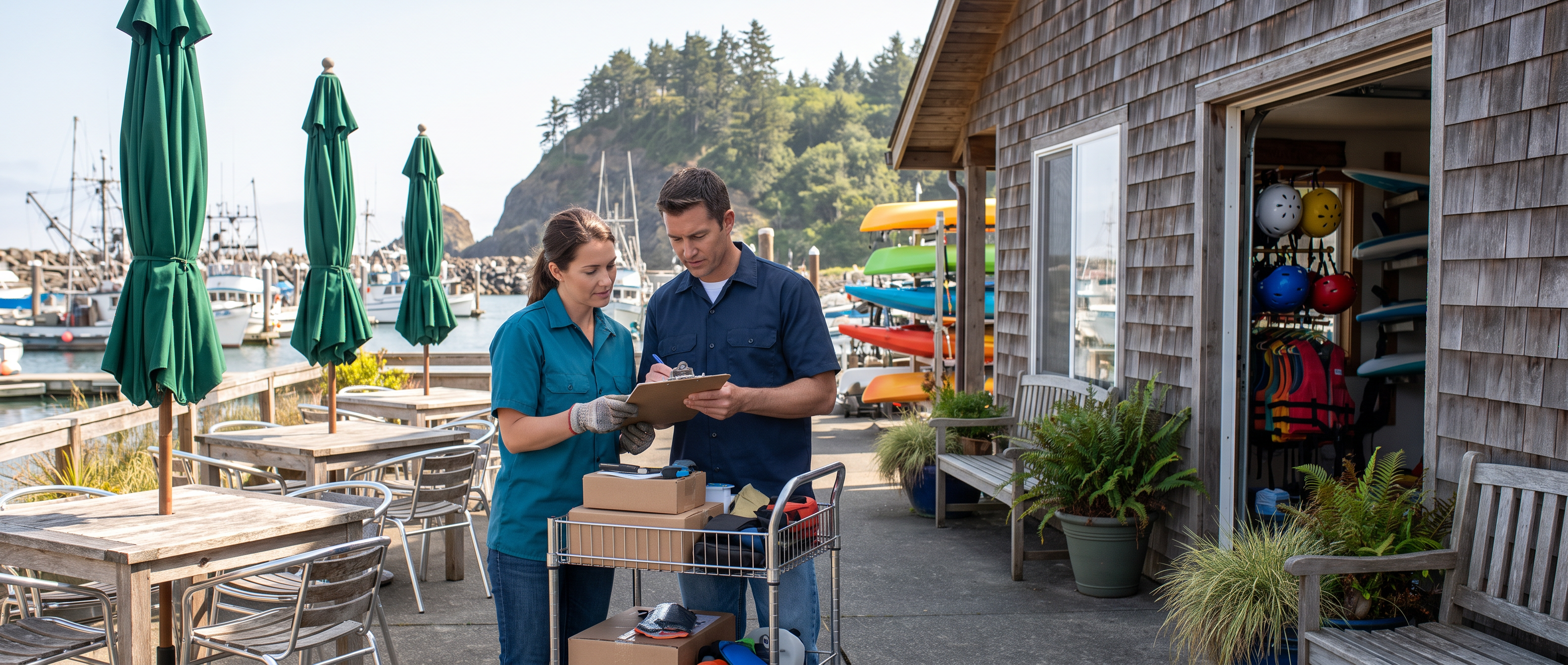

A seasonal business does not have the same insurance needs on the day it orders stock, the busiest weekend of the year and the day it locks up for winter. A useful seasonal business insurance review follows those changes instead of treating the opening date and renewal date as the only moments that matter.
For an Oregon Coast cafe, Northern California recreation shop, summer tour operator, holiday retailer or seasonal contractor, a short selling period can carry a large share of annual revenue. Meanwhile, buildings, equipment, leases and some liability exposures can remain after customers leave. This guide explains what to bring to a review before opening, what to report during peak season and what to confirm before closing.
The central distinction
Seasonal operations are not the same as seasonal risk
A closed business can still suffer a fire, theft or frozen-pipe loss. A busy business can outgrow its original inventory and payroll estimates. Insurance adjustments need to reflect the actual exposure and issued policy—not simply whether the doors are open.[1] [8] [9]
Start with the whole operating calendar
“Seasonal business insurance” is not one universally standardized policy. It is a way of coordinating relevant coverages, limits and endorsements around an operation that changes during the year. A commercial insurance review should begin with the business itself: what it does, what it owns, where it operates and when each exposure begins.
Write down setup, deliveries, employee training, test operations, customer opening, peak weekends, closing work and anticipated reopening. A shop can receive valuable inventory before its first sale. A contractor can move tools to a site before the active job starts. Insurance intended only around customer-facing dates can miss that broader preparation period.
Distinguish a year-round business with a seasonal surge from a business that closes for several months. Both may need a peak-value review, but the latter also needs attention to occupancy and shutdown conditions. Give the insurer the planned timeline rather than assuming that low winter sales, a temporary closure and a vacant building are treated alike.
Three reviews—not just one renewal
Before opening
Review arriving stock, premises, payroll, activities, contracts and the dates when protection needs to begin.
During peak season
Compare actual inventory, staffing, vehicles and sales patterns with the information used to arrange coverage.
After closing
Address vacancy conditions, remaining property, inspections, winter protection and continuing obligations.
Before opening: insure the property that will actually be there
Start with buildings, tenant improvements, furniture, computers, tools, machinery and stock. California's Commercial Insurance Guide identifies inventory and equipment among business personal property and explains that limits, valuation and policy conditions matter.[1] A commercial property insurance review should use current values, not simply last season's declaration page.
Separate the building from business contents and property owned by others. A tenant may have paid for counters, lighting or permanent improvements without owning the structure. A seasonal repair shop may hold customers' equipment. A consignment retailer may possess goods it does not own. Identify each category and ask which policy provision, limit and valuation basis applies.
Map every address where property will be kept. Include a storage unit, rented warehouse, temporary stall and inventory awaiting delivery. Property coverage at the main shop does not by itself establish equal protection everywhere else. Ask about location schedules, temporary storage, transit and any distance or duration restrictions before moving goods.
Peak inventory: review both the amount and the dates
An average inventory figure can be inadequate when a retailer stocks for the holidays or an outdoor shop prepares for summer demand. California DOI describes a peak-season endorsement as additional inventory limits during a designated period.[1] The important questions are what value is insured, which dates apply and whether early deliveries and late remaining stock fit that period.
Some forms include a conditional automatic seasonal increase; others require an endorsement or a different reporting arrangement. Do not assume a particular percentage is universal. Ask about qualifying conditions, the base limit, maximum increase, valuation method and whether the policy's assumptions match the business's real monthly stock pattern.
Track the highest combined value at each location, including stock already on hand and incoming orders. Revenue forecasts are not automatically inventory values: the policy may use cost, replacement cost or another settlement provision. Ask how coinsurance or reporting conditions affect a loss if values are understated or reports are late.[1]
Consider a hypothetical holiday shop that receives an extra shipment earlier than expected. Its calendar endorsement might begin after the shipment arrives, or its limit might be too low for the larger order. This is an illustration of a review question—not a real customer claim or assurance of payment. Share changed values and dates while there is still time for underwriting.
Opening soon or building up seasonal stock?
Bring your calendar, property values, delivery dates and existing policies to Gerald Ross Agency for a business-specific review.
Request a seasonal business insurance reviewBusiness income: protect the busy months without assuming every cancellation is covered
Many business income forms respond to a qualifying suspension following covered physical loss or damage. Potential protection can include lost net income and continuing expenses, subject to the issued policy.[1] [2] A fall in tourist traffic, rainy weekend, weak customer demand or decision to close is not, by itself, proof of a covered interruption.
Give the agent month-by-month revenue, expenses and payroll rather than only an annual total. Reservations, prior-season sales and supportable forecasts can help explain the significance of a short peak period. Preserve the assumptions behind projections. Insurance is not a guarantee of achieving a new sales target, and claim valuation depends on the policy and evidence.
Ask about waiting periods, income limits, monthly limitations or coinsurance, extra expense and the period of restoration. A waiting period can matter greatly when the business relies on a few busy weekends. Repairing the building and rebuilding customer demand are different timelines; extended business income provisions, if present, have their own terms.
Separate missed sales from losses caused by utility failures, damage at suppliers, government access restrictions or evacuation. Civil authority and dependent-property provisions can have additional conditions and limits. Do not assume that an order, road closure or cancellation is enough. Ask what must happen, where it must happen and how long coverage can apply.[2]
Equipment, refrigeration and outages: ask three separate questions
A failed refrigerator can create three losses: damaged equipment, spoiled stock and interrupted operations. HSB's public equipment-breakdown overview illustrates that these can be distinct coverage features.[3] Ask separately about repair or replacement, resulting product damage and business income or extra expense. Buying one coverage does not prove that every consequence is included.
Identify the equipment whose failure could stop the season: refrigeration, heating and cooling, pumps, electrical panels, payment systems or other machinery. Discuss maintenance records, service agreements, age and spare-parts availability. Breakdown insurance should not be treated as a maintenance warranty or a promise to replace worn-out equipment.
Offsite utility interruptions deserve another review. Triple-I distinguishes time-element utility coverage for income and expenses from direct-damage utility coverage for property damage.[2] Ask which services and utility equipment qualify, what covered damage is required, and whether exclusions, waiting periods or sublimits apply. A preventive power shutoff or rolling blackout should not be assumed covered.
Have a safe response plan for temperature alarms, after-hours contacts, alternate storage and professional repairs. If using a rental generator or temporary machine, the rented and borrowed equipment insurance guide helps frame ownership and responsibility questions. Emergency rentals and mitigation costs still need policy-specific confirmation.
Seasonal workers: review coverage before the first shift
Short-term employment does not automatically eliminate workers' compensation duties. Oregon's Workers' Compensation Division explains that workers are subject to coverage unless an exemption applies; California's DWC describes employer obligations for businesses with employees.[4] [5] A workers' compensation insurance review should precede hiring, onboarding and training work.
Describe actual tasks rather than only job titles. One employee may handle retail sales, unload trucks and make deliveries. Another may prepare food, work around machinery or travel to customer sites. Correct descriptions and payroll estimates help the coverage and classification discussion. Do not assume family help, students, temporary agency workers or people labeled contractors all receive the same treatment.
Identify where employees will work, particularly when operations cross the Oregon–California border. Confirm appropriate state provisions, contractor arrangements and any required notices with qualified advisers. State-specific obligations cannot be reduced to a promise that a policy issued in one state automatically satisfies every other state's requirements.
Keep payroll and duty records throughout the season. If the operation grows faster than expected, update estimates rather than waiting for the next renewal. Ask how audits, records and adjustments work. Safety training, supervision and emergency procedures support the operation, but neither a safety checklist nor an insurance certificate guarantees compliance.
More customers and new activities can change liability exposure
A quiet shop can become a crowded destination on peak weekends. Temporary displays, outdoor seating, deliveries and unfamiliar staff introduce different situations to manage. Review general liability insurance for the actual premises, activities and products, rather than assuming an existing business description covers every seasonal expansion.
Tell the agent before adding demonstrations, rentals, classes, food service, alcohol, guided trips or special events. Some activities require separate provisions or policies, and exclusions can matter. Review any vendors or outside operators as distinct businesses. A waiver, certificate or verbal agreement should not be described as automatic protection against all claims.
Use practical controls: keep walkways clear, document inspections, train staff for customer interactions and retain incident reports. These are risk-management steps, not guarantees against a lawsuit. Ask about products and completed-operations exposure, the applicable policy period and any claims-made features where relevant, because a later allegation may outlast the selling season.[1]
Vehicles, deliveries and employee errands need their own conversation
A businessowners policy does not replace vehicle coverage. Triple-I's vehicle guide discusses owned, hired, leased and employee-owned vehicles used for business.[6] Coordinate commercial auto insurance with seasonal deliveries, pickup routes, temporary vehicles, driver lists and the actual covered-auto designations.
Do not assume employees' personal auto policies settle the business's liability exposure for errands. Ask about hired and non-owned auto liability and physical damage for rentals where appropriate. Non-owned liability should not be presented as automatic payment for damage to the employee's own car. Vehicle protection also does not automatically insure the full value of inventory carried inside.
Before parking vehicles for winter, discuss what remains at risk: fire, theft, storm damage, finance obligations and occasional business use. Review permissible storage adjustments, registration and lender requirements before removing coverage. A parked vehicle that later makes one delivery can create a different exposure from a vehicle kept fully out of service.
During peak season: make changes visible to the insurer
Use a short recurring comparison between actual operations and the assumptions given before opening. Has inventory exceeded the planned peak? Did the season extend? Are employees working different tasks? Has a second location or new service started? Ask for a review when a change matters, not only after a claim or annual audit.
Give dates, addresses, values and activity details. Adding “another booth” may really mean transporting stock, hiring more people and signing a new venue contract. Keep written requests, endorsements and insurer responses together. Sending a message is not itself confirmation that a requested change has been accepted or coverage has been bound.
Peak season can also bring more payments, passwords and rushed vendor instructions. Review cyber liability insurance separately from crime and payment-fraud questions. Use verified contact channels, restricted access and secure backups. Do not assume one cyber policy pays every fraudulent transfer or every problem with a reservation platform.
Has the season become bigger or different than expected?
Share changes in stock, staffing, locations, services or closing dates so your insurance discussion reflects today's business.
Talk through your seasonal coverage changesAfter closing: vacancy is a policy definition, not a casual description
“Unoccupied” and “vacant” may sound similar in everyday conversation, but their policy treatment can differ. IRMI explains that some commercial forms define a tenant's vacancy by whether enough business property remains for customary operations; building-owner definitions can use a different occupancy test.[8] Furniture in the space does not automatically resolve the question.
Ask how your own form defines vacancy or unoccupancy, when restrictions begin and which causes of loss are affected. A familiar day threshold from one standard form should not be treated as a rule for every insurer. Some forms exclude specified causes or reduce payment for other losses after a vacancy period. Others use different provisions.[8]
Tell the insurer the planned closure dates, remaining stock, equipment, utilities, visits, maintenance work and reopening plan before locking up. Ask whether written permission, a vacancy permit or another endorsement is available and what exclusions remain. Periodic visits, stored furniture or an alarm should not be promised to override the condition.
Build a shutdown plan for property that remains
Travelers' idle-property guidance recommends securing doors and windows, maintaining appropriate heat, keeping power for critical equipment and preserving automatic fire protection.[9] Apply those principles through a building-specific plan developed with the landlord and qualified contractors. Do not shut off a system just because the customer season has ended.
Document responsibility for inspections, alarms, roof and drain checks, temperature monitoring and responding to a leak or intrusion. Frequency and procedures should fit the property, insurer conditions and professional advice. Preserve dated photos and maintenance logs. A risk-control plan supports prevention and evidence but does not change the issued coverage.
Review weather exposures by cause. Fire, wind, freezing, water intrusion, flood and earth movement are not interchangeable policy terms.[1] Consider commercial flood insurance for the actual locations and remaining values. Do not assume ordinary commercial property insurance includes flood or that property protection automatically provides the same business-income benefits.
Do not reduce coverage before checking what continues
Closing the register does not end a premises lease, equipment rental, lender requirement or responsibility for remaining stock. The Hartford's property guidance highlights rental and lease obligations as reasons to review coverage.[7] Bring the actual agreements to the agent and use qualified legal advice for interpreting indemnity, insurance and cancellation duties.
Ask what liability exposure may remain from products sold or work performed, how the policy period applies and whether claims-made reporting or tail questions are relevant. Avoid the assumption that every later claim will be covered by last season's policy—or that every policy must be retained unchanged forever. The right adjustment is specific to the coverage and operation.
Discuss any proposed reductions or cancellations before they take effect. Lower payroll or sales might affect rating, but a smaller premium is not proof of adequate protection. Confirm changes in writing, including dates and remaining limits. Allow time before reopening for underwriting, inspections or repairs instead of assuming protection can be restored instantly.
Keep a review file that follows the season
Store the operating calendar, policy schedules, endorsements, current stock values, sales records and contact details in one accessible file. Keep a secure copy away from the premises. For a new venture, explain how forecasts were developed; for an established operation, compare prior seasons with actual changes rather than copying old estimates.
If a loss occurs, protect people first, follow emergency instructions and notify the insurer under the policy. Preserve photos, damaged-property details, maintenance evidence, inventory records and income records where safe. Keep receipts for reasonable emergency work, but do not assume all mitigation, disposal or relocation costs will be reimbursed.
Eight items to bring to your seasonal insurance review
- 1
Opening, setup, stock-delivery, closing and planned reopening dates—not just the customer-facing calendar.
- 2
Current and highest expected property values at each address, including temporary storage and property of others.
- 3
Monthly sales, continuing expenses, payroll, reservation records and any supportable upcoming-season projections.
- 4
Employee counts, actual job duties, contractors, payroll estimates and every state where people will work.
- 5
Owned, rented and employee-owned vehicles used for deliveries, errands or other business activities.
- 6
Premises leases, equipment rentals, vendor and event agreements, required limits and insurance responsibilities.
- 7
Equipment condition, refrigeration, alarms, utilities, emergency contacts and safe alternate operating arrangements.
- 8
Shutdown plans, remaining stock and equipment, inspection responsibilities and policy vacancy or unoccupancy wording.
Frequently asked questions
Is seasonal business insurance one special type of policy?
Usually it is a coordinated review of property, liability, business income, workers' compensation, vehicles and any relevant endorsements. A peak-season inventory endorsement or vacancy permit can address a specific exposure, but it is not a substitute for reviewing the whole operation. Available products and terms depend on the business and insurer.
Does my inventory limit automatically rise during the busy season?
Do not assume it does. Some policies provide a conditional seasonal increase; others require a designated peak-season endorsement or another arrangement. Confirm the actual limit, valuation basis, qualifying conditions and dates. Include stock arriving before opening and goods remaining after the selling season.
Will business income insurance pay when rain or smoke keeps customers away?
Not simply because sales fall. Many business income forms require covered physical loss or damage and a qualifying suspension of operations. Civil authority, dependent property and utility interruption provisions have additional conditions. Ordinary bad weather, lower demand and voluntary closure are not themselves proof of coverage.
Do short-term seasonal employees need workers' compensation review?
Yes. Temporary or seasonal hiring does not itself remove an employer's workers' compensation obligations. Oregon and California have their own rules and exemptions. Confirm worker status, job duties, payroll and the states where people work before the season begins; do not assume a contractor label answers the question.
Can a closed shop be considered vacant if furniture remains inside?
Possibly. Commercial policies can define vacancy by the property and activities needed for customary operations, not just whether the building contains furniture. Building-owner and tenant definitions may differ. Ask how your own policy treats the closing period, when restrictions begin and whether written permission or an endorsement is available.
Should I cancel every policy as soon as the season ends?
Not without a policy-specific review. Stock, buildings, parked vehicles, leases and some liability exposures can remain after the last sale. Claim timing and coverage conditions vary. Discuss permissible adjustments with the agent and insurer before canceling or reducing protection, and obtain any changes in writing.
Sources and further reading
These regulatory, insurance-institute and specialist resources informed the guide. Public coverage descriptions illustrate questions to ask; they are not your issued policy and do not establish Gerald Ross Agency's appointment with the referenced insurers. Confirm current state requirements and actual policy terms with qualified advisers.
- [1] California Department of Insurance: Commercial Insurance Guide — peak season, property and policy conditions
- [2] Insurance Information Institute: Do I need business interruption insurance?
- [3] Hartford Steam Boiler: Equipment breakdown — examples of equipment, income and service interruption coverages
- [4] Oregon Workers' Compensation Division: Workers' compensation insurance overview
- [5] California Division of Workers' Compensation: Frequently asked questions for employers
- [6] Insurance Information Institute: Business vehicle insurance
- [7] The Hartford: Commercial property insurance — property and lease considerations
- [8] IRMI: Vacancy: What Does It Mean for Commercial Property Coverage?
- [9] Travelers Risk Control: Tips to help address the impact of unexpected property shutdowns
Make the next season's review start with this season's facts
Gerald Ross Agency can help Oregon and Northern California business owners organize a policy-specific discussion of opening preparations, peak activity and offseason property. Bring your calendar and records so the review fits your actual operation.
Request a seasonal business insurance quoteImportant: General educational information only, not legal, employment, tax, safety or individualized coverage advice. Coverage availability and claim outcomes depend on underwriting, issued forms, endorsements, exclusions, limits, deductibles, valuations, reporting duties and the facts of the loss. A quote request does not bind coverage. No seasonal adjustment, safety measure or record discussed here guarantees compliance, payment or a particular result.


