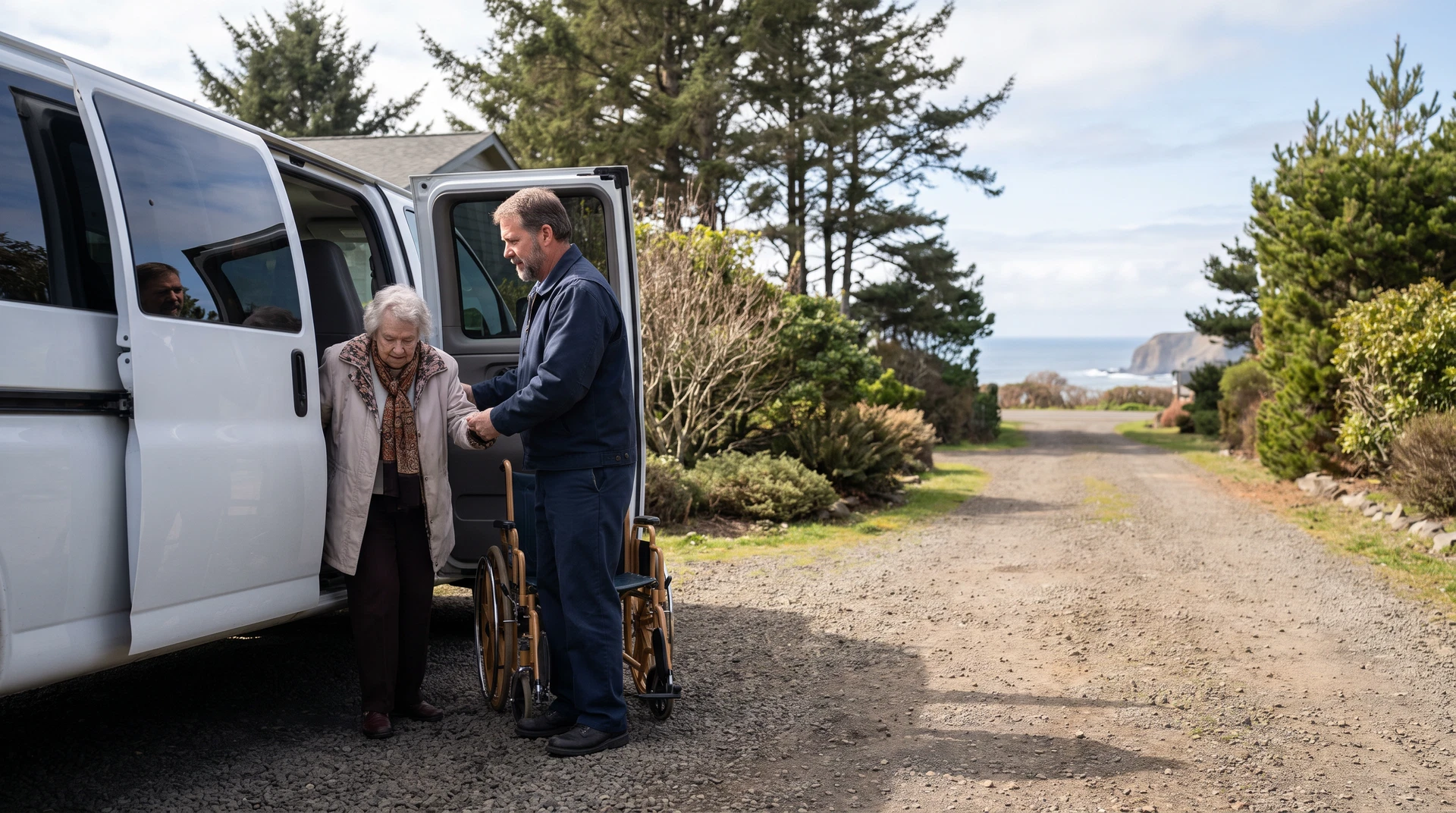

Non-emergency medical transportation (NEMT) is one of the fastest-growing segments of the healthcare support industry — and one of the most underinsured. Whether you operate a single wheelchair-accessible van serving Oregon Health Plan patients along the coast or manage a multi-vehicle fleet transporting dialysis patients in Northern California, the insurance requirements for medical transport are fundamentally different from standard commercial auto. Getting this wrong does not just mean a denied claim. It can mean losing your Medicaid enrollment, facing a personal liability judgment, or watching your business disappear after a single accident.
Standard Commercial Auto Does Not Cover NEMT
The moment you accept payment — including Medicaid reimbursement — for transporting a patient, most standard commercial auto policies void coverage through the livery exclusion. NEMT requires a specialty policy with for-hire passenger endorsements. This is the single most common and most costly mistake new operators make.
What Is NEMT Insurance and Who Needs It?
Non-emergency medical transportation insurance is a specialized commercial coverage package designed for businesses that transport patients to medical appointments, dialysis centers, physical therapy, mental health services, and other healthcare facilities when the trip does not involve an emergency. The "non-emergency" designation refers to the nature of the transport, not the seriousness of the patient's condition — many NEMT passengers are medically fragile, mobility-impaired, or cognitively vulnerable, which is precisely why standard auto policies are inadequate.
Any individual or company transporting patients for compensation — including Medicaid reimbursement, Medicare Advantage payments, or private pay — needs NEMT insurance. This includes independent owner-operators with a single van, small fleets serving rural Oregon Coast communities, wheelchair-accessible vehicle (WAV) operators, stretcher transport services, and companies contracted through broker networks. If you are providing transportation to Oregon Health Plan (OHP) beneficiaries, you are required to meet Oregon Health Authority insurance standards as a condition of Medicaid enrollment.
Starting or Growing a Medical Transport Business?
Gerald Ross Agency specializes in commercial insurance for Oregon Coast and Northern California businesses. We work with specialty NEMT carriers and can help you get properly covered — and stay enrolled with Oregon Health Plan.
Why Standard Commercial Auto Policies Fall Short
The gap between a standard commercial auto policy and proper NEMT coverage is not a technicality — it is a fundamental difference in what is covered. Standard commercial auto policies are written for vehicles used in the general conduct of business: deliveries, sales calls, employee commuting. They typically exclude three categories of risk that define NEMT operations.
The first is the livery exclusion. The moment you accept Medicaid reimbursement or a private fare for transporting a patient, most standard commercial policies void coverage entirely. This exclusion is explicit and nearly universal in standard commercial auto forms.
The second is ADA Title III passenger liability. Wheelchair securement failures, lift malfunctions, and accessibility accommodation failures trigger ADA civil rights claims that fall entirely outside standard auto coverage. In Oregon, ADA compliance is enforced aggressively, and a single securement failure that injures a passenger can generate a claim far exceeding standard auto policy limits.
The third is door-through-door liability. NEMT creates three distinct liability phases: at the patient's home, inside the vehicle, and at the medical facility. Standard commercial auto covers only vehicular incidents. The loading, unloading, and escort phases — where most NEMT injuries actually occur — require separate coverage layers that standard policies do not provide.
The Essential NEMT Insurance Coverage Stack
Proper NEMT insurance is never a single policy. It is a coordinated stack of coverage types, each filling a gap the others leave behind. Oregon and California operators enrolled in Medicaid programs or broker networks typically need all of the following.
| Coverage Type | Typical Minimum (Oregon/CA) | What It Covers |
|---|---|---|
| Commercial Auto Liability | $1,000,000 CSL | Bodily injury and property damage from vehicle accidents |
| General Liability | $1M / $2M aggregate | Loading/unloading injuries, premises liability, advertising injury |
| Workers' Compensation | Statutory (required) | Driver injuries, medical costs, lost wages |
| SAM Coverage | $500K–$1M sublimit | Sexual abuse and molestation claims involving vulnerable passengers |
| Physical Damage | Recommended | Collision and comprehensive coverage for your vehicles |
| Umbrella / Excess Liability | $1M–$5M recommended | Additional liability above primary policy limits |
Oregon Health Plan NEMT Requirements
Oregon Health Authority (OHA) provides non-emergency medical transportation as a benefit for Oregon Health Plan (OHP) members who have no other means of getting to covered medical services. Providers enrolled to transport OHP members must meet OHA's insurance requirements as a condition of enrollment — and a lapse in coverage, even for a single day, can trigger enrollment suspension.
The types of vehicles authorized for OHP NEMT include wheelchair-accessible vans, standard sedans and taxis, stretcher cars, and buses. Each vehicle type has different insurance requirements based on gross vehicle weight and passenger capacity. Vehicles under 10,001 pounds GVW are required to carry a minimum of $300,000 in commercial auto liability under federal baseline rules, but Oregon Medicaid enrollment typically requires $1,000,000 CSL to satisfy both state and broker network requirements simultaneously.
Oregon Coast communities — including Brookings, Gold Beach, Coos Bay, Florence, and Lincoln City — have significant OHP populations with limited transportation options. For NEMT operators serving these communities, maintaining continuous enrollment and proper coverage is not just a compliance matter; it is essential to the healthcare access of some of the most vulnerable residents on the coast. An independent agent familiar with both OHA requirements and specialty NEMT carriers can be invaluable in navigating this landscape.
Northern California NEMT Requirements
California NEMT operators face a similarly layered compliance environment. The California Department of Health Care Services (DHCS) sets insurance requirements for Medi-Cal NEMT providers, and the California Public Utilities Commission (CPUC) regulates certain for-hire passenger carriers. California generally requires $1,000,000 in commercial auto liability for vehicles transporting Medi-Cal beneficiaries, with workers' compensation mandatory for any business with employees.
Del Norte County and the Crescent City area — served by the Gerald Ross Agency — have a significant rural healthcare access challenge, with many residents relying on NEMT services to reach medical facilities in Eureka or Medford. Operators in this region often serve both Oregon and California patients, which means satisfying the requirements of both states simultaneously. A commercial insurance policy structured for multi-state NEMT operations requires careful coordination between your agent and your carrier.
The Livery Exclusion: Where Most NEMT Claims Are Denied
If you are transporting patients using a standard commercial auto policy — even one that covers your business vehicles for other purposes — your NEMT claims will likely be denied. The livery exclusion is not buried in fine print; it is a standard exclusion in virtually every commercial auto form. Before your next trip, confirm with your agent that your policy specifically covers for-hire passenger transport.
What NEMT Insurance Costs in Oregon and Northern California
NEMT insurance premiums vary significantly based on vehicle type, driver history, coverage limits, business location, and claims history. For Oregon and Northern California operators in 2026, typical annual premiums per vehicle range from approximately $3,000 for a standard ambulatory sedan with a clean driving record to $8,000 or more for a wheelchair-accessible van with lift equipment. Stretcher transport vehicles, which carry higher liability exposure, can cost $10,000 or more per vehicle annually.
Small operators — the majority of NEMT businesses run fleets of one to five vehicles — often pay 30 to 50 percent more per vehicle than larger fleets because they cannot spread risk across volume. This makes working with an independent agent who has access to multiple specialty NEMT carriers especially important for small operators on the Oregon Coast and in rural Northern California.
Factors that can reduce your NEMT premium include telematics and dash camera programs, documented driver training, clean driving records across your fleet, and a multi-year claims-free history. Some carriers offer meaningful discounts for operators who implement formal safety programs and maintain complete driver qualification files. An umbrella policy layered on top of your primary NEMT coverage provides additional protection at a relatively modest incremental cost.
NEMT Insurance Compliance Checklist for Oregon Operators
- Confirm your commercial auto policy has for-hire passenger endorsements — not just standard commercial auto
- Verify your coverage meets Oregon Health Authority minimums for OHP NEMT enrollment ($1M CSL)
- Ensure general liability covers loading and unloading operations, not just vehicle incidents
- Confirm workers' compensation covers all drivers, including any owner-operators you use
- Check that your policy includes SAM (sexual abuse and molestation) coverage if required by your broker network
- Verify continuous coverage — even a one-day lapse can trigger OHP enrollment suspension
- Keep a certificate of insurance on file with OHA and any broker networks you work with
- Review your policy annually as your fleet size, vehicle types, and service area change
The Role of an Independent Agent in NEMT Insurance
NEMT insurance is a specialty market. The carriers that write it well are not the same carriers that write standard personal or commercial auto. An independent agent with access to specialty NEMT markets can compare coverage and pricing across multiple carriers, ensure your policy structure satisfies both state Medicaid requirements and broker network standards simultaneously, and advocate for you if a claim is disputed.
For Oregon Coast and Northern California NEMT operators, working with a local independent agent also means having someone who understands the specific healthcare access landscape of your region — the rural distances, the OHP enrollment requirements, the California-Oregon border compliance challenges, and the seasonal population fluctuations that affect transport demand and risk. The Gerald Ross Agency has served businesses across this region for years, and our commercial insurance team can help you build a coverage program that keeps your business protected and your Medicaid enrollment secure.
Frequently Asked Questions
What insurance do I need for a NEMT business in Oregon?
At minimum: commercial auto liability with for-hire passenger endorsements ($1M CSL for OHP enrollment), general liability ($1M/$2M), and workers' compensation. Most broker networks also require SAM coverage. Standard commercial auto policies will not cover NEMT operations.
Does my personal auto insurance cover medical transport trips?
No. Personal auto policies exclude any commercial or for-hire use. Even if you occasionally transport a neighbor to a medical appointment for payment, your personal policy will deny the claim. You need a commercial NEMT policy for any compensated medical transport.
How much does NEMT insurance cost in Oregon?
Typically $3,000–$8,000 per vehicle per year for standard NEMT operations. WAV and stretcher transport vehicles cost more. Small operators often pay more per vehicle than large fleets. Working with an independent agent who has access to specialty NEMT carriers is the best way to find competitive pricing.
Can I use the same policy for Oregon and California trips?
Possibly, but your policy must be structured to satisfy both states' requirements. Oregon and California have different Medicaid insurance minimums, and if you cross state lines, federal FMCSA rules may also apply. An independent agent can structure a policy that covers both states.
Get a Quote for NEMT Insurance Today
Gerald Ross Agency works with specialty NEMT carriers across Oregon and Northern California. We will review your operation, confirm your Medicaid enrollment requirements, and find you competitive coverage. No obligation.
Related Coverage Areas
Protect Your Medical Transport Business
Whether you operate one van or a fleet of wheelchair-accessible vehicles, the Gerald Ross Agency can help you get the right NEMT coverage — and keep your Oregon Health Plan enrollment secure. Serving Brookings, Gold Beach, Coos Bay, Crescent City, and the entire Oregon Coast.