


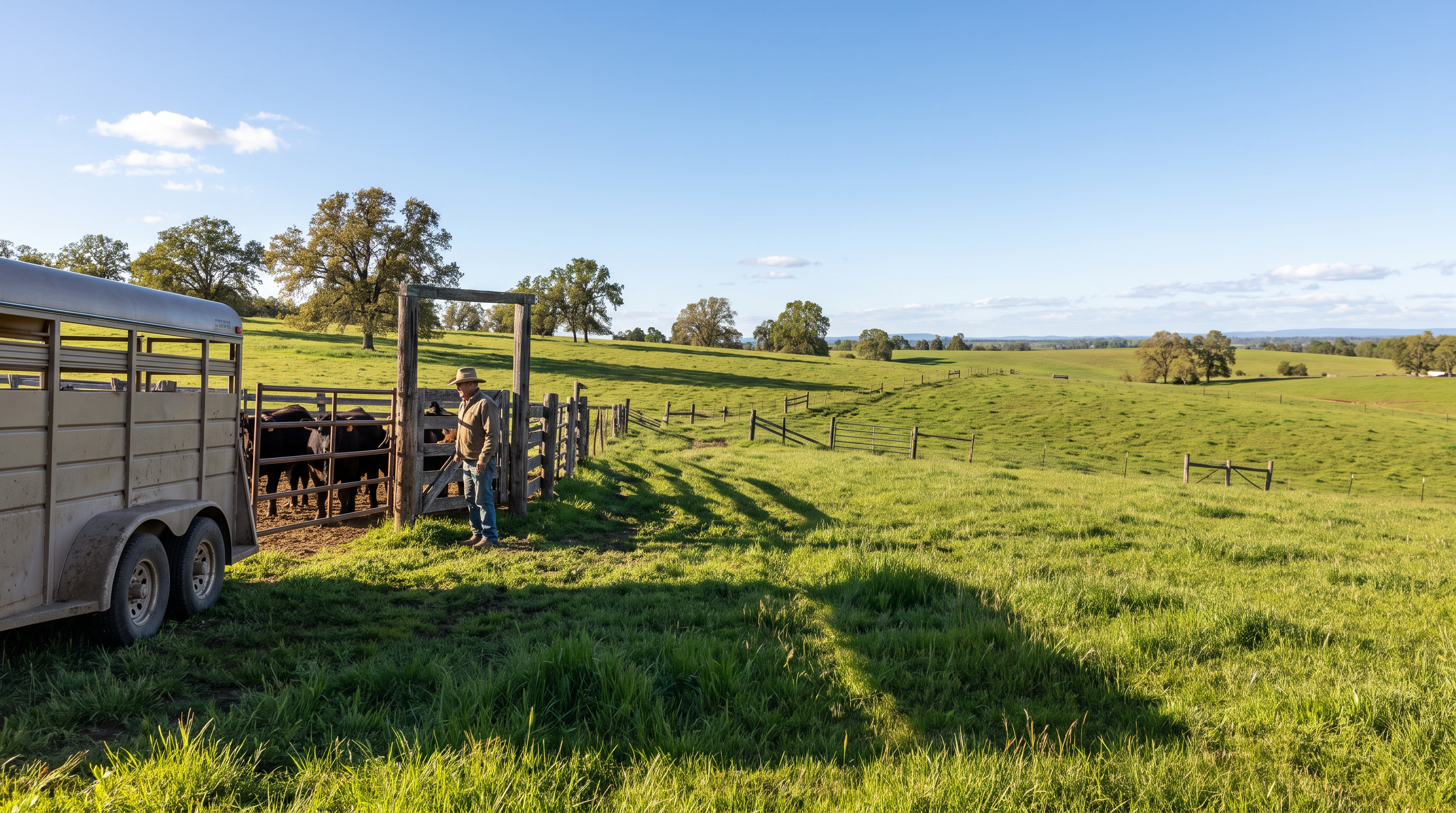

A calf can leave an Oregon ranch on a hired trailer, spend a night at a livestock market, sell to a buyer, and arrive on leased Northern California pasture. Its physical location, caretaker, owner, and financial risk may each change at a different moment. That is why the most useful insurance question is not simply “Are my cattle covered?” It is “Who is responsible for this animal at each handoff—and what does that party’s actual policy say?”
The critical distinction
Four changes can happen on four different dates
Movement is not necessarily a sale. Custody is not necessarily ownership. A brand inspection is not an insurance endorsement. A signed grazing lease does not automatically insure the herd. Check the agreement, the receiving party’s role, and the issued policy for each interval.
Why does the handoff matter for Oregon and Northern California ranches?
A long-established farm and ranch insurance program may have been set up around animals kept on the home premises. Seasonal grass, rented pasture, a hired livestock hauler, an auction yard, and a different buyer create new locations and relationships. The farm policy, animal mortality or transit endorsement, commercial auto policy, market’s custody coverage, and liability policies have different insureds, property descriptions, triggers, territories, exclusions, and limits.
Before a shipment, map six facts: who holds title; who has physical care, custody, and control; who bears loss under the sale or lease agreement; where and when the animals are moved; which party is named on each policy; and the exact start and end of each policy’s animal coverage. A truck driver’s responsibility for the road does not necessarily make a carrier responsible under a livestock mortality policy. Nor does an owner’s farm declaration automatically insure a third party’s negligence.
The movement map
Four places, four insurance conversations
Use the map to organize a review—not to infer that a specific loss is insured.
At the home ranch
Owner and named insured, headcount and values, scheduled breeding animals, premises, theft or escape, disease and mortality exclusions.
On the trailer
Who loads, owns or hires the rig, drives it, bears risk in transit, and insures the animals separately from vehicle liability.
At the sale barn
Consignment and custody, arrival and release times, title and risk-of-loss terms, market policy, buyer pickup and outbound trip.
On borrowed or leased grass
Animal owner versus landowner or caretaker, fencing and water, visitors, wildfire, escapes and contract-required insurance.
At the ranch: is the herd scheduled and valued where it actually lives?
Start with headcount, species, age, location, and valuation. Is the policy written for a herd as a group, named animals, or a combination? Are higher-value bulls, registered breeding stock, show animals, or newly purchased calves within limits? Ask whether the covered causes of loss are named perils or broader mortality terms, and review disease, intentional slaughter, unexplained disappearance, theft, predation, flood, wildfire, and veterinary-expense exclusions or conditions rather than assuming any one form responds.
Then ask about the physical geography: the main ranch, replacement grass, a neighbor’s corral, an auction holding pen, and a quarantine or staging area. For a seasonal herd, one shared total value may conceal a peak accumulation in a single pen or vehicle. A policy-specific schedule and updated animal values make the where and when of ownership easier to understand, even though an inventory alone never creates coverage.
During loading and travel: keep vehicle liability separate from animal loss
Whether a ranch-owned pickup pulls the trailer or a professional hauler moves the herd, the commercial auto policy is not the same as insurance on the animals inside. Discuss collision liability and vehicle physical damage separately from livestock mortality or transit, which may address particular covered injuries or deaths while animals are in due course of transportation. Carrier-specific products demonstrate that some forms include optional after-unloading periods, substitute vehicles, or additional property—but these options are neither universal nor automatically included.[12]
Ask whether transit starts at loading or only after departure, whether unloading and overnight layovers count, whether a hired hauler’s vehicle must be listed, which states are within territory, and whether a trailer breakdown, overturn, fire, heat event, escape, or illness is within a covered cause of loss. Compare per-head and per-load limits, deductibles, valuation, carcass removal, claim reporting and any notice or veterinary certification conditions. The transportation insurance page explains broader fleet and operational questions, but live-animal cargo calls for an explicit animal-transit review.
Risk control still matters. Mississippi State University Extension recommends checking trailer floor, tires, brakes and gates, using low-stress loading, cleaning and sanitizing equipment, matching animal size to compartment capacity, planning for weather, and arriving with the documents needed for the trip.[8] These practices can reduce avoidable loss but do not guarantee a policy will pay.
Know where the transit form starts and stops
Bring the trip, trailer, hauler agreement, animal values and loading plan to a policy-specific review before the next move.
Request a livestock coverage reviewAt auction: consignment, custody, title and risk of loss may not line up
Oregon’s Department of Agriculture says cattle ownership inspection is generally required when ownership changes, before an out-of-state shipment, before auction sale and before slaughter, even if the animal is not branded.[1] Oregon licenses livestock auction market operators.[13] California’s Bureau of Livestock Identification sets cattle inspection triggers for sale or transfer and release from sale yards and lists documents that accompany cattle in transport.[4] These steps help establish identity or comply with movement rules; they do not say which private insurer pays for an animal injured in the yard.
Before consigning, obtain the sale barn’s written terms and ask whether the seller remains at risk until sale, when title passes, who cares for the animals during a postponed sale, and who arranges pickup. Ask how market-premises, care/custody/control and optional inbound or outbound transit coverage work. A carrier describes separate auction-market premises and transit options,[12] but its marketing description is only an illustration of the coverage questions, not proof a particular market carries them.
If you operate a market rather than merely consigning animals, map customers’ property, pens and chutes, trucks, livestock while in your care, public visitors, employees and market contracts. A general liability review of visitor and premises allegations is a different conversation from livestock mortality in custody. Even after the auctioneer says “sold,” unloading, release and the buyer’s outbound trailer may create separate time periods; written consignment and sale terms should define them.
On leased pasture: separate the animal owner, landowner and caretaker
When an owner rents grazing land or pays someone to care for stock, the animal owner, lessor and caretaker may be three different parties. Ask who checks fences, maintains water, controls gate access, feeds or moves cattle, contacts a veterinarian, handles escapes, watches for toxic plants or predators, and arranges relocation during wildfire, drought or a road closure. UC Agriculture and Natural Resources recommends written grazing leases with the property and livestock described and responsibilities assigned for infrastructure, animal care, emergencies, and insurance.[7]
Review boarding, breeding and training exposures if a third party accepts responsibility beyond allowing pasture access. Clarify whether the animal owner’s mortality form follows animals off-site; whether any care, custody and control protection is intended for the caretaker; whether the landlord’s land or structures are insured under their own property policy; and whether a fence failure or animal escape could raise a liability allegation. Do not assume that naming an additional insured protects the landlord’s own animals, covers every contractual promise, or changes the policy’s animal-property exclusions.
A lessee’s commercial umbrella insurance may merit review for certain liability layers, but an umbrella is not a substitute for animal mortality or a properly described grazing operation. UC ANR discusses lessee liability insurance, potential additional-insured requirements and workers’ compensation proof in its model lease considerations.[7] What the parties actually need—and what an insurer will provide—must be checked against the contract, the insurance forms and applicable law.
Crossing the Oregon–California line adds a separate documentation layer
Do not treat ownership papers, brand inspection and animal-health clearance as interchangeable. Oregon’s cattle transportation certificate permits in-state movement but expressly is not valid for out-of-state movement or a change of ownership.[2] Oregon has special reciprocal grazing permits for eligible breeding cattle moving seasonally to certain states, including California. The program requires no ownership change and a return to the origin state; it does not erase Oregon’s outbound cattle brand inspection requirement, and eligibility is specific.[3]
California advises that most incoming livestock and poultry have entry-permit and Certificate of Veterinary Inspection requirements and that special pasture-to-pasture documents may be allowed in certain circumstances.[5] Oregon’s import requirements differ by species and movement purpose.[10] USDA APHIS likewise describes different interstate identification and documentation rules for cattle, horses, sheep and goats, and exceptions.[6] Check the current origin and destination agency requirements and an accredited veterinarian before a trip: outbreak-related restrictions can change, and insurance is not a movement permit.
People, roads, and premises liability at each stop
Animal handling creates work around ramps, gates, frightened stock, equipment and traffic. Employees may be injured while loading at the ranch, assisting a sale barn or repairing a water line at rented pasture. The workers’ compensation discussion should reflect who employs each worker, where they work, travel between locations, payroll, contractors and state-specific rules. A lease’s label for a caretaker is not itself an employment classification or a coverage determination.
General liability may also be relevant for allegations involving a visitor, neighboring property or an escaped animal, subject to policy terms. The parties should review off-premises farming operations, leased premises, contractual liability, additional insureds and cross-border territory, without assuming every loss involving an animal is a bodily-injury or property-damage claim. Check where trailers, chutes and portable panels are insured under commercial property coverage; an animal is not necessarily treated as equipment or other ordinary property under that form.
Mortality, disease, price protection and liability are not synonyms
USDA’s Livestock Risk Protection product addresses price declines, while Livestock Gross Margin addresses loss of gross margin.[9] Neither name establishes coverage for an individual animal that dies in a trailer, becomes ill after commingling, or escapes from a leased pasture. Those events raise distinct animal-loss, disease, transit, custody or liability questions. Review the full animal-policy insuring agreement, covered perils, exclusions, death or necessary-destruction conditions, reporting windows and valuation with a licensed agent.
Oregon State University Extension emphasizes animal identification, traceability and biosecurity as tools for disease response and continuity.[11] A clean trail of individual IDs, purchase records, movement dates, health paperwork, source herds and receiving locations can help identify an event and support an insurance discussion. It is not a substitute for veterinary guidance or proof that disease is covered. If your ranch also sells meat or specialty foods directly, that adds a different set of exposures discussed in our farm-to-table business insurance guide; it should not be conflated with insuring a live-animal handoff.
Before the next transfer
Eight things to put in a handoff file
Share the file with the right parties before transport; it is a review aid, not an insurance certificate.
Animal species, identifiers, number of head, typical and peak total value, and individually valuable breeding or show animals.
Home ranch, alternate pasture and market addresses; ownership, grazing lease, consignment and care agreements.
Movement dates, origin and destination, load and unload time, routes, driver, hauling company, truck and trailer details.
Brand/ownership inspections, bills of sale or consignment, transport certificate, CVI and permits as applicable to the species and destination.
Current farm, livestock mortality, transit, auto, general liability and umbrella declarations and endorsements.
Who reports injury, loss, escape or road incidents; emergency veterinary contact, photos, identification and value records.
Who supplies feed, water, fencing repairs, gate checks, predator control and evacuation at the receiving pasture.
Exact date and event when title, custody, risk of loss and insurance responsibility begin or end for every handoff.
Changing pasture, hauler, or sale arrangement?
Tell the agency what changes, who takes custody, the animal values, and when the move occurs. We can help organize questions for the available forms.
Discuss the next livestock handoffFrequently asked questions
Does farm insurance automatically cover cattle while a hauler transports them?
Not necessarily. Farm animal coverage, livestock transit coverage, the hauler's auto liability, and any cargo or customer-property arrangement address different risks. Confirm animal ownership, named insured, listed trailers or carriers, loading and unloading, territory, covered causes of loss, valuation, and exactly when transit begins and ends in the issued forms.
Who insures livestock while it is at an auction?
It depends on the sale and consignment terms, the point at which ownership and risk of loss transfer, the auction market's actual animal-custody policy, and the seller's or buyer's policies. Do not infer that a brand inspection, market license, or auction receipt guarantees insurance for an animal in a pen or trailer.
Does a grazing lease transfer insurance responsibility to the landowner?
No automatic transfer follows from use of another person's land. A written agreement should allocate animal care, fences, gates, water, access, liability, emergency response, and any insurance or additional-insured requirements. The lease and issued policy forms should be reviewed together by the parties and qualified advisers.
Is an Oregon cattle transportation certificate enough for a sale or interstate trip?
No. Oregon's transportation certificate is for in-state cattle movement and is not valid for a change of ownership or out-of-state movement. Oregon cattle brand/ownership inspection has separate triggers; destination animal-health rules can require additional documents. Confirm current rules with the appropriate agencies and veterinarian before moving animals.
Does Livestock Risk Protection cover a cattle death during transport?
No: USDA Livestock Risk Protection addresses a decline in market prices. Physical loss, mortality, accident, transit, disease, and animal custody are separate insurance questions. Review a suitable animal or transit policy's actual terms and limits rather than treating a price-risk policy as animal mortality coverage.
Sources and further reading
Official state and federal guidance, university extension publications and one insurer’s illustrative product description informed this guide. Regulations, agency guidance, policy availability and wording can change. A carrier’s explanation of its own offering does not determine the terms of any other insurer’s policy.
- [1] Oregon Department of Agriculture: Livestock Identification and Inspection
- [2] Oregon Department of Agriculture: Transportation Certificate
- [3] Oregon Department of Agriculture: Grazing Permits
- [4] California Department of Food and Agriculture: Bureau of Livestock Identification
- [5] California Department of Food and Agriculture: Livestock and Pet Movement Entry Requirements
- [6] USDA APHIS: Interstate Movement of Cattle, Horses, Swine, Sheep and Goats
- [7] UC Agriculture and Natural Resources: A Guide to Livestock Leases for Annual Rangelands
- [8] Mississippi State University Extension: Transporting Beef Cattle by Road
- [9] USDA Risk Management Agency: Livestock Insurance Plans
- [10] Oregon Department of Agriculture: Oregon Import Requirements
- [11] Oregon State University Extension: Livestock Disease Traceability Programs
- [12] The Hartford: Livestock & Animal Mortality Business Insurance
- [13] Oregon Department of Agriculture: Livestock Auctions
Map every animal from ranch to receiving pasture
Bring the animal list, sale and grazing agreements, route, hauler details, and current policies to Gerald Ross Agency for a practical, policy-specific conversation.
Request a farm and ranch quoteImportant: General educational information only; not legal, veterinary, regulatory, or insurance-coverage advice. Nothing here promises availability or payment. Coverage, eligibility, value, deductibles, exclusions, limits, animal identification, named insureds, territorial scope, and claims results depend on the issued policy, endorsements, contracts, underwriting and facts. An inspection, permit, certificate, inventory or lease does not create insurance. Consult the current state agencies and qualified veterinary or legal advisers on movement and contract requirements and discuss the actual policy wording with a licensed producer.


