


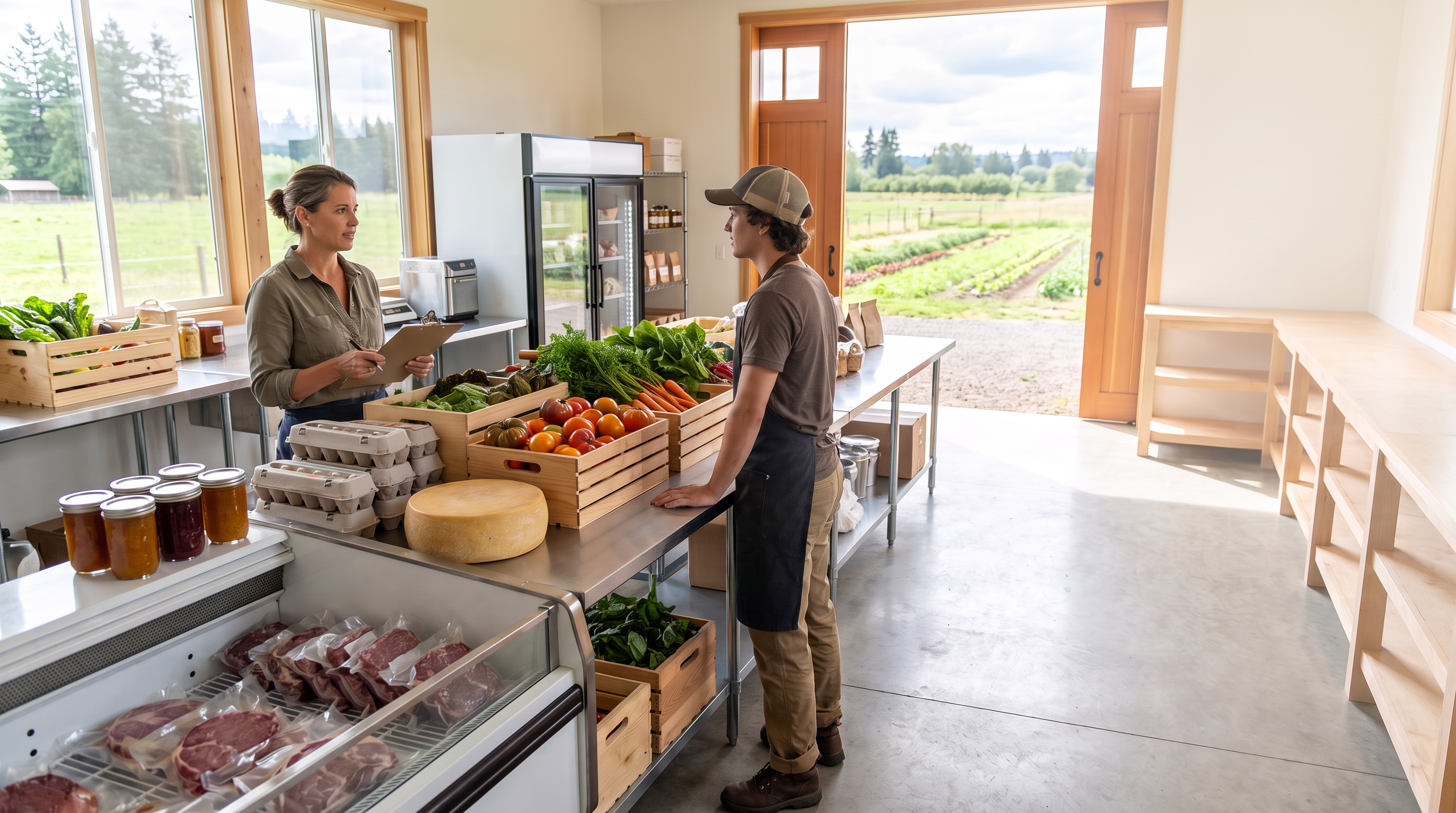

A farm-to-table enterprise is rarely only a farm. Once it slaughters animals, washes and packs eggs, bottles milk, makes cheese or jam, trims produce, operates a cold room, opens a farm store, sells at markets, supplies restaurants, takes online orders, or delivers to customers, the operation can combine agriculture, food processing, retail, warehousing, transportation, and public access. A useful insurance review therefore starts with the business as it actually works—not with the assumption that one farm policy automatically follows every product from field or barn to the customer’s table.
At a glance
Key takeaways
- Map every product, process, location, worker, visitor, sales channel, vehicle, and custody handoff before discussing coverage.
- Buildings, equipment, stock, spoilage, product liability, product-event expenses, employees, vehicles, cyber systems, contracts, and lost income are separate policy questions.
- Licensing, inspection, food safety, labeling, employment, and contract responsibilities do not transfer to insurance. Confirm them with the responsible agencies and qualified professionals.
- Update the insurance conversation before adding wholesale distribution, online sales, delivery, cold storage, visitors, a new process, or a new product category.
Farm-to-table is a supply chain, not one exposure
The central risk-management question is not simply, “What type of farm do you operate?” It is, “What happens to the product from its origin to the final customer?” A beef animal may move through custom or inspected slaughter, cutting, packaging, refrigeration, storage, delivery, and retail sale. Milk may move through a bulk tank, processing, testing, packaging, cold storage, and a farm store. Eggs may be collected, washed, graded, labeled, cooled, delivered, and sold through several channels. Produce may be harvested, washed, trimmed, cooled, packed, mixed with product from other farms, and delivered to restaurants or community-supported agriculture customers.
Begin with the broader farm and ranch insurance picture, then identify the activities that look more like processing, retail, warehousing, or transportation. Species, product state, production volume, ownership, location, customer type, distribution method, and whether the business handles another party’s goods can affect both regulatory and insurance questions.
Operations map
Three connected areas to document
These categories organize the review. They do not determine regulatory status or insurance coverage.
Farm and processing sites
Fields, barns, packing sheds, licensed plants, home or commercial kitchens, cold rooms, farm stores, mobile units, rented storage, and market booths may involve different property and operating facts.
Food, equipment, and records
Animals, crops, ingredients, work in process, finished stock, refrigeration, processing equipment, utilities, labels, temperature logs, and traceability records form one connected production chain.
Sales and handoffs
Farm pickup, markets, community-supported agriculture, restaurants, grocers, distributors, online orders, delivery, co-packers, and carriers create different custody, contract, and continuity questions.
Regulatory boundaries change with the product and process
Federal and state oversight is activity-specific. USDA’s Food Safety and Inspection Service has primary relevance for most meat establishments and inspects egg products, while FDA frameworks address produce, shell eggs, sanitary transportation, many dairy and specialty-food activities, and preventive controls. Oregon Department of Agriculture and California agencies add separate licensing, inspection, direct-marketing, cottage-food, dairy, egg, produce, meat, and retail pathways. Local health, environmental, planning, fire, water, wastewater, and county agricultural authorities may also have a role.[1] [2] [3] [4] [5]
A custom-slaughter exemption, a state meat-inspection grant, an egg-handler exception, a cottage-food registration, a farm-direct pathway, and an FDA qualified exemption are not interchangeable. A change from custom work to retail sale, direct sale to wholesale, shell eggs to processed egg products, raw produce to fresh-cut produce, or a home-kitchen product to commercial production deserves a fresh agency and insurance review. Insurance does not establish that an operation is licensed or compliant.
Build one operations file
Give regulators, advisers, and insurers the same factual picture
List every product, process, location, permit or registration, equipment item, cold-storage point, employee task, visitor activity, vehicle, sales channel, co-packer, carrier, buyer, contract, and customer handoff. Include current values, revenue by channel, seasonal peaks, labels, traceability records, and loss history. Accurate facts improve the review but do not create coverage or prove compliance.
Property insurance should follow production, not just the main building
Farm-to-table property can include barns, farm stores, processing rooms, leased commercial kitchens, packing sheds, mobile units, cold rooms, rented storage, tenant improvements, market equipment, signs, computers, packaging stock, ingredients, work in process, and finished inventory. The equipment schedule may include saws, grinders, smokehouses, milking systems, bulk tanks, pasteurizers, freezers, egg washers, graders, conveyors, wash lines, pumps, forklifts, ovens, mixers, pH meters, generators, alarms, and delivery refrigeration.
A commercial property insurance review should separate buildings, business personal property, stock, mobile equipment, property away from the premises, leased or borrowed equipment, and property belonging to others. Ask how valuation, locations, seasonal stock, refrigeration, utility service, equipment breakdown, spoilage, debris or disposal costs, and business income are addressed by the proposed forms. A modestly priced cold room can still create a long recovery if installation, inspection, sanitation, testing, and product replacement delay reopening.
The cold chain is an operating system
Refrigeration is more than a compressor. It can depend on electrical service, controls, alarms, doors, packaging, labor, backup power, pre-cooling, loading practices, vehicle performance, third-party storage, maintenance vendors, and rapid decision-making. FDA’s sanitary-transportation guidance identifies inadequate refrigeration, vehicle cleaning, cross-contact, and insufficient protection during transit as food-safety concerns for covered operations.[6] Oregon and California egg materials identify refrigerated storage requirements, and dairy guidance similarly emphasizes temperature control.[3] [4] [7]
Keep temperature logs, alarm notices, maintenance records, generator tests, load and delivery times, sanitation schedules, water or ice records, backup-storage agreements, and written product-hold authority. These records may help manage an event and substantiate what happened. They do not guarantee that spoilage, contamination, disposal, testing, delayed revenue, or a customer rejection is covered.
Map every point where food condition depends on equipment, utilities, or another company
Bring your equipment schedule, temperature controls, maintenance agreements, backup-power plan, storage arrangements, peak inventory, delivery process, and recovery timeline to one coordinated review.
Request a farm-to-table insurance reviewEach product sector changes the questions
Farm-to-table businesses should resist the temptation to describe themselves only as “a farm,” “a food business,” or “a market vendor.” The product and process determine which facts matter. The following sector map is a starting point for discussion, not a licensing or coverage determination.
Five operating models
Describe the work at the level an underwriter and regulator can understand
On-farm meat and poultry
Identify species, slaughter or custom work, raw and ready-to-eat products, smoking or curing, mobile operations, waste systems, cold storage, retail and wholesale channels, and every processor or carrier involved.
Dairy and value-added dairy
Map milking systems, bulk tanks, pasteurization or raw-milk controls, cheese or yogurt rooms, bottling, refrigeration, laboratory testing, cultures, packaging, farm-store sales, and tanker or delivery arrangements.
Egg production and packing
Follow eggs from flock and housing through collection, washing, candling, grading, packing, refrigerated storage, labeling, direct or wholesale sale, delivery, and any commercial egg-breaking activity.
Fresh produce
Document field or harvest lot, agricultural and wash water, trimming or fresh cutting, cooling, packing, mixed-source product, cold storage, farm stands, community-supported agriculture, markets, mobile sales, buyers, and transport.
Specialty foods
Describe every formulation and process precisely, including baking, cooking, hot filling, acidification, fermentation, refrigeration, shelf stability, allergen controls, batch records, labels, home or commercial kitchens, and online or wholesale distribution.
On-farm meat and poultry
Oregon says most businesses that slaughter, process, or sell raw meat need a meat license, subject to limited fact-specific exceptions. Its state meat-inspection program covers specified species and excludes poultry and rabbits. California’s Meat, Poultry and Egg Safety Branch oversees specified federally exempt operations, including some retail-only processing, custom slaughter, poultry plants, mobile slaughter, and registered producer locations.[1] [8] [9] Because custom work, retail sale, wholesale distribution, and ready-to-eat production are not the same model, the insurance description should match the exact species, processes, locations, ownership, and channels.
Dairy and value-added dairy products
Oregon separately identifies licensing for Grade A production, milk marketing or handling, tanker or transfer activity, dairy processing, and specified operator roles. California says each separate milk-products plant or place of business needs the appropriate license or permit and describes pre-issuance inspection and approval.[2] [10] A dairy review should map milking, bulk storage, pasteurization or raw-milk controls, processing, packaging, testing, freezing or refrigeration, delivery, and farm-store sales. Raw milk introduces additional health, labeling, testing, cold-chain, and sales-channel questions that should be confirmed with the responsible agencies.[7]
Egg production, washing, and packing
Oregon describes an egg-handler licensing baseline, a limited direct-producer-to-consumer exception with labeling responsibilities, and a separate license for commercial egg breaking. California states that shell-egg and egg-product producers, sellers, or handlers must register handling locations and describes packaging, grading, temperature, and inspection requirements.[3] [4] The insurance review should follow the operation from housing and collection through washing, grading, labeling, refrigeration, delivery, and sale, including equipment, water, cartons, labels, customer records, and backup power.
Fresh produce
FDA’s Produce Safety Rule addresses growing, harvesting, packing, and holding produce, including agricultural water, soil amendments, animals, worker health and hygiene, equipment, buildings, and sanitation. Applicability depends on the products, activities, destination, sales, and possible exclusions or exemptions.[5] Oregon and California materials add state-specific produce-safety and direct-marketing context.[11] [12] Fresh cutting, mixed-source sales, off-farm stands, mobile sales, third-party storage, and wholesale distribution should be described directly because they can change operational, regulatory, and insurance facts.
Specialty foods
Oregon defines food processing broadly and identifies separate issues for acidified and low-acid canned foods, commercial processing, warehousing, and farm-direct products. California distinguishes Processed Food Registration from locally administered cottage-food pathways, which are limited to approved foods and stated sales channels and conditions.[13] [14] [15] A jam, hot sauce, fermented vegetable, baked good, refrigerated dip, meat-filled product, or shelf-stable item should not be grouped under a vague “homemade food” label. Formulation, process, refrigeration, allergen controls, pH or batch records when applicable, kitchen type, sales channels, and distribution all belong in the factual submission.
Product liability and product-event expenses are different questions
A customer allegation may involve foodborne illness, allergen exposure, a foreign object, labeling, bodily injury, defense, causation, and damages. A product-removal event may involve isolation, testing, notices, retrieval, shipping, disposal, replacement, consultants, crisis communications, and lost sales. FDA distinguishes a recall from a market withdrawal, and the food-safety or legal classification of an event is separate from whether any cost is insured.[16]
A product liability insurance review should examine the exact products, ingredients, labels, territories, channels, customer contracts, and distribution. Ask separately about product contamination, product recall or withdrawal expense, crisis services, government action, stock loss, third-party financial loss, business interruption, defense, limits, sublimits, deductibles or retentions, notice requirements, and exclusions. No single coverage label establishes the answer.
Traceability can narrow the operational impact of an event. Link each lot or batch to the animal group, field or harvest date, ingredients and suppliers, water or sanitation records, temperature or pH records when applicable, label version, production line, storage location, carrier, buyer or customer, inventory balance, complaint, hold decision, and final disposition. USDA FSIS describes written recall-planning requirements for official establishments, while FDA materials describe recall planning and traceability concepts for covered operations.[17] [18]
Employees, contractors, customers, and visitors create different liability paths
Food production combines agricultural and industrial tasks. Employees may work around animals, tractors, power take-off equipment, knives, saws, grinders, conveyors, forklifts, heat, cold rooms, wet floors, chemicals, refrigerants, lifting, repetitive work, and delivery vehicles. OSHA’s agricultural and meatpacking materials describe many of these task-based hazards.[19] [20] A workers’ compensation insurance review should use actual work duties, payroll, seasonal or family labor, contractors, drivers, training, and incident history—not only job titles.
Customers and visitors are a separate exposure. Farm stores, pickup areas, market booths, tours, samples, parking, animal contact, demonstrations, and proximity to equipment can create premises and operations questions. A commercial general liability discussion should include visitor activities, contracts, additional-insured requests, product operations, and exclusions. Employee injuries, auto accidents, pollution, professional services, and every food-product expense should not be assumed to fall within a general liability form.
Delivery is a business function, not an errand
Identify every owned, leased, borrowed, employee-owned, hired, contracted, or platform-affiliated vehicle. Record drivers, trailers, refrigerated units, loading points, delivery radius, product owner, transfer of custody, temperature responsibility, accident procedures, and the contracts governing a rejected or damaged load. The business should know whether it transports its own goods, another party’s property, or stock held for customers.
A commercial auto insurance review can address liability, physical damage, drivers, garaging, radius, trailers, hired and non-owned auto, and loading or unloading. Cargo or inland-marine terms, refrigerated transit, carrier responsibility, and product condition are separate questions. Do not assume a farm or personal auto policy follows regular business delivery.
Digital systems support physical food operations
Farm-to-table businesses increasingly rely on online stores, subscriptions, community-supported agriculture lists, point-of-sale terminals, cloud accounting, label files, lot records, temperature alerts, delivery routing, email, payment processors, and customer contact databases. A ransomware event, account takeover, payment outage, lost mobile device, or inaccessible cloud account can stop orders, compromise data, or interrupt traceability even when the food and equipment remain intact.
A cyber liability insurance review can examine data restoration, incident services, vendor events, payment fraud, business interruption, privacy liability, limits, waiting periods, and security conditions. Insurance does not replace multifactor authentication, access control, tested backups, manual order forms, offline contact lists, vendor management, and an incident-response plan.
Contracts may assign costs the policy does not accept
Retailers, distributors, markets, co-packers, cold-storage providers, carriers, commercial kitchens, landlords, event organizers, equipment lessors, and suppliers may impose insurance limits, indemnity, additional-insured, waiver, specification, audit, temperature, label, recall-cost, return, destruction, custody, and notice requirements. A certificate summarizes insurance information; it does not amend the policy or prove that every contract obligation is covered.
Have qualified legal counsel review the agreement and ask an insurance professional to compare the obligations with the proposed coverage. A commercial umbrella insurance review may address higher-limit questions over qualifying underlying policies, but an umbrella has its own exclusions, conditions, and attachment requirements. It cannot repair an inaccurate application or an uninsured contractual promise.
Business income should reflect the real recovery chain
A fire or equipment failure is not the only event that can interrupt sales. A farm-to-table business may depend on electricity, water, wastewater, refrigeration, generator fuel, labor, animal or crop supply, cultures, ingredients, packaging, labels, laboratory testing, a co-packer, a cold-storage provider, carriers, markets, road access, payment systems, and key buyers. A failed test, regulator hold, buyer rejection, market cancellation, road closure, or utility interruption is not automatically an insured business-income loss.
Estimate revenue and expenses by season and channel. Ask how business income, extra expense, waiting periods, utility service, equipment breakdown, civil authority, dependent property, cyber interruption, and the period of restoration are defined. Smaller eligible operators may also discuss a business owners policy, but packaged coverage should not end the analysis when the operation has food products, processing, livestock, refrigeration, mobile equipment, delivery, visitors, or multiple locations.
Coordinate the farm, food, property, people, and delivery story
Gerald Ross Agency can help organize a commercial-insurance conversation around your real products, production steps, equipment, workers, customers, vehicles, contracts, and recovery dependencies.
Talk with our commercial teamTen changes to review every year—and before expansion
Annual review checklist
Update the facts before the policy renews
Update the complete product list, species or crops, ingredients, processes, product states, annual volume, revenue by channel, website claims, labels, and every location.
Reconfirm the responsible federal, Oregon, California, county, city, health, agricultural, water, wastewater, fire, planning, labor, and environmental authorities for the current operation.
Update building, equipment, mobile-unit, refrigeration, generator, stock, packaging, utility, leased-property, replacement-cost, repair-lead-time, and peak-season values.
Test lot or batch identification, supplier and ingredient records, temperature and sanitation logs, label control, customer lists, product-hold authority, and forward-and-backward traceability.
Review the recall or withdrawal team, food-safety and legal contacts, insurance-notice process, customer communications, retrieval logistics, alternate storage, and product-disposition records.
Update payroll, job tasks, family or seasonal labor, contractors, drivers, safety records, visitor areas, parking, tours, samples, animal contact, markets, and event activity.
Confirm vehicles, drivers, trailers, delivery radius, cargo ownership, temperature responsibility, carrier agreements, loading practices, accident procedures, and vehicle maintenance.
Inventory ordering, point-of-sale, payment, accounting, temperature-alert, cloud-storage, traceability, and customer-contact systems; test backups and manual fallback steps.
Collect current market, retailer, distributor, carrier, co-packer, landlord, equipment, event, vendor, and cold-storage contracts before renewal.
Compare the real operation with declarations, schedules, endorsements, definitions, limits, sublimits, deductibles, exclusions, location restrictions, notice conditions, and recovery assumptions.
Build on the direct-to-consumer food insurance review
Operators selling through farm stands, farmers’ markets, subscriptions, websites, and delivery can also use the Gerald Ross Agency guide to commercial insurance for food producers selling directly to consumers. This Farm-to-Table guide goes further into on-farm processing, meat, dairy, eggs, produce, specialty-food controls, cold-chain dependencies, and multi-party contracts. Read both with current agency guidance and the actual insurance contracts.
Ready for a policy-specific Farm-to-Table review?
Bring your operations map, permits and agency contacts, equipment and stock values, payroll, vehicles, labels, customer channels, contracts, traceability records, continuity plan, and current policies.
Frequently asked questions
What insurance should a farm-to-table food business review?
A review may consider farm or commercial property, business personal property and stock, equipment breakdown, spoilage, general and product liability, product-event or recall-related options, workers compensation, commercial auto, cargo or inland marine, cyber, business income and extra expense, crime, pollution, and umbrella liability. The appropriate structure depends on the products, processes, locations, employees, visitors, vehicles, contracts, sales channels, and the actual policy wording.
Does a farm policy automatically cover food processing and direct sales?
Do not assume so. Slaughter, processing, packaging, refrigeration, farm stores, markets, online orders, wholesale distribution, visitor activities, and delivery can create facts beyond ordinary farming. Coverage depends on the issued policy, endorsements, definitions, limits, exclusions, underwriting information, and circumstances of a loss.
Are spoilage, contamination, and product recall the same insurance exposure?
No. Spoilage, contamination, an alleged foodborne illness, a product hold, a recall, and a market withdrawal can overlap operationally but may involve different policy definitions, triggers, costs, exclusions, and sublimits. The food-safety and legal classification of an event is separate from the insurance analysis.
When should a farm-to-table operator update its insurance agent?
A review is appropriate before adding a product, process, location, cold-storage site, farm store, market, wholesale buyer, co-packer, vehicle, delivery service, online-sales channel, employee group, visitor activity, or material change in equipment, inventory, revenue, or contracts.
Can insurance replace food-safety licensing, permits, and operating controls?
No. Food-safety, licensing, inspection, labeling, employment, transportation, contract, and local land-use responsibilities are separate from insurance. Operators should confirm current requirements with the responsible agencies and qualified professionals and describe the business accurately during the insurance review.
References
- Oregon Department of Agriculture, “Meat Licensing”
- Oregon Department of Agriculture, “Dairy Licensing”
- Oregon Department of Agriculture, “Eggs Licensing”
- California Department of Food and Agriculture, “Egg Safety and Quality Management Program”
- U.S. Food and Drug Administration, “FSMA Final Rule on Produce Safety”
- U.S. Food and Drug Administration, “FSMA Final Rule on Sanitary Transportation of Human and Animal Food”
- California Department of Public Health, “Raw Milk and Raw Dairy Products”
- Oregon Department of Agriculture, “State Meat Inspection Program”
- California Department of Food and Agriculture, “Meat and Poultry Program”
- California Department of Food and Agriculture, “Milk Product Plant Licenses and Permits”
- Oregon Department of Agriculture, “Are You Covered?”
- California Department of Food and Agriculture, “Produce Safety Program—Regulate”
- Oregon Department of Agriculture, “Food Processing and Warehouse Licensing”
- California Department of Public Health, “Processed Food Registration”
- California Department of Public Health, “Cottage Food Operations”
- U.S. Food and Drug Administration, “Recalls Background and Definitions”
- USDA Food Safety and Inspection Service, “Recall Process”
- U.S. Food and Drug Administration, “Food Traceability Rule”
- Occupational Safety and Health Administration, “Agricultural Operations—Hazards and Controls”
- Occupational Safety and Health Administration, “Meatpacking—Hazards and Solutions”


