


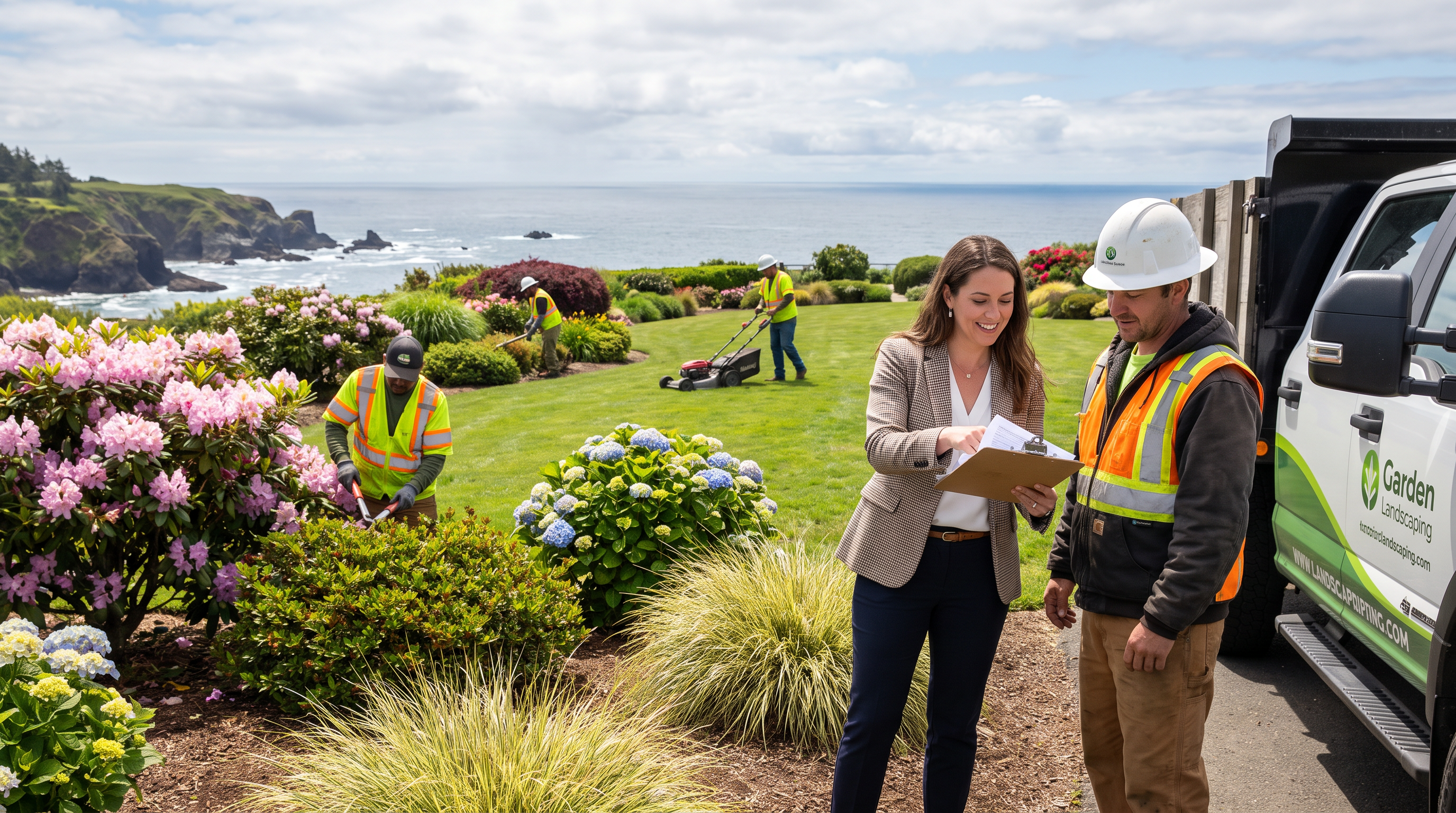

Landscaping and lawn care is one of Oregon and Northern California's most active small-business sectors. From solo operators maintaining residential lawns on the Oregon Coast to multi-crew commercial landscaping companies serving HOAs and commercial properties across Humboldt and Mendocino counties, the industry spans an enormous range of business sizes, service types, and risk profiles. What they all share is a set of insurance exposures that are more complex than most business owners realize — and a licensing framework that makes proper insurance coverage not just good business practice, but a legal requirement. This guide covers everything a landscaping business owner in Oregon or Northern California needs to know about insurance in 2026.
Run a Landscaping Business? Get a Specialized Quote.
Standard commercial policies often miss key landscaping exposures — pesticide liability, equipment on job sites, and hired/non-owned auto. Gerald Ross Agency works with carriers that specialize in green industry risks to build the right program for your business.
Part One: Licensing and Insurance Requirements by State
Before discussing what coverages a landscaping business should carry, it is important to understand what the law requires. Oregon and California have distinct licensing frameworks for landscape contractors, and both tie insurance requirements directly to the licensing process. Operating without the required coverage is not just a business risk — it can result in license suspension, fines, and personal liability for any claims that arise while you are uninsured.
Oregon: Landscape Contractors Board (LCB) Requirements
In Oregon, landscape contracting businesses must be licensed with the Oregon Landscape Contractors Board (LCB). The LCB administers licensing under ORS Chapter 671 and OAR 808-003-0095, which set out the insurance and bonding requirements that must be met before a license is issued or renewed. As of January 1, 2026, the requirements are as follows.
Every licensed landscape contracting business must carry a minimum of $500,000 in general liability insurance — specifically, public liability, personal injury, and property damage coverage. The Oregon Landscape Contractors Board must be listed as the certificate holder on your insurance policy. This is not optional: the LCB will not issue or renew your license without a compliant certificate of insurance on file, and if your policy lapses, the LCB may immediately suspend your license under OAR 808-003-0095(5) and (6).
Oregon Senate Bill 864, which took effect January 1, 2026, increased the required surety bond amount for most landscape contracting businesses to $20,000 (probationary license holders still require $15,000). The bond must be filed with the LCB and must remain continuously in effect. As an independent insurance agency, Gerald Ross Agency can bundle your LCB surety bond with your commercial insurance program, simplifying the renewal process and ensuring both stay current.
Workers' compensation insurance is required for any Oregon landscaping business with employees. Oregon's workers' comp system is administered by the Department of Consumer and Business Services (DCBS), and the penalties for non-compliance are severe: $250 per day in fines and personal liability for any workplace injury claims. Given the physical nature of landscaping work — operating heavy equipment, working with power tools, exposure to chemicals, and working in all weather conditions — workers' compensation is one of the most important coverages a landscaping employer can carry. Learn more about Oregon surety bond requirements for contractors.
California: CSLB C-27 Landscape Contractor License
In California, landscape contractors performing work valued at $500 or more (including labor and materials) must hold a C-27 Landscaping Contractor license issued by the Contractors State License Board (CSLB). The C-27 license covers the construction, maintenance, repair, installation, and subcontracting of landscape systems and facilities — including irrigation, drainage, planting, and hardscaping.
The CSLB requires all C-27 applicants to file a $25,000 contractor's license bond with a surety company licensed through the California Department of Insurance. If a qualifying individual (the person whose experience qualifies the business for the license) is different from the license applicant, an additional $25,000 qualifying individual bond is required. These bonds protect consumers against contractor misconduct, incomplete work, and failure to pay subcontractors or suppliers.
California law makes failure to carry workers' compensation insurance a criminal offense. For landscaping businesses with employees, the penalties range from $10,000 to $100,000 in fines, and the CSLB can suspend or revoke your license. General liability insurance is not mandated by the CSLB itself, but virtually every commercial property owner, HOA, and general contractor in California requires proof of GL coverage before allowing a landscaping contractor on site. For Northern California landscaping businesses serving Humboldt, Mendocino, Del Norte, and Trinity counties, our guide to insurance in Northern California's Emerald Triangle covers the broader regional risk landscape.
Part Two: Essential Coverages for Landscaping Businesses
Meeting the minimum licensing requirements is the floor, not the ceiling, of a sound landscaping insurance program. The coverages described below represent the full range of protections that a landscaping business in Oregon or Northern California should consider, based on the specific risks of the industry.
General Liability Insurance: Your First Line of Defense
General liability (GL) insurance covers third-party bodily injury and property damage claims — the most common exposures for any landscaping business. A rock thrown by a mower that breaks a client's window. A crew member who accidentally severs an irrigation line. A customer who trips over equipment left on a walkway. A tree limb that falls on a neighbor's car during pruning work. These are everyday scenarios in the landscaping industry, and a single claim can easily exceed $50,000 in legal costs and damages.
The Oregon LCB minimum of $500,000 is a starting point, but many commercial contracts and HOA agreements require $1 million or $2 million in GL coverage. If your business serves commercial clients, property management companies, or government entities, you will almost certainly be required to carry higher limits. An umbrella policy is an efficient way to increase your total liability limits without dramatically increasing your premium — learn more about commercial umbrella insurance and how it works with your underlying GL policy.
Workers' Compensation: Required, and for Good Reason
Landscaping is consistently ranked among the most physically demanding and injury-prone industries in the United States. Workers operate power equipment, handle sharp tools, apply chemicals, work in extreme weather, and perform repetitive physical labor. Common injuries include lacerations, back injuries, heat exhaustion, chemical exposure, and equipment-related accidents. Workers' compensation insurance covers medical expenses and lost wages for employees injured on the job — and in Oregon and California, it is legally required for any business with employees.
Workers' comp rates for landscaping businesses are calculated based on payroll and the classification of work performed. Businesses that perform tree work, operate heavy equipment, or apply pesticides typically pay higher rates than those doing only lawn maintenance. Accurate classification of your employees' duties is important: misclassification can result in premium audits, additional charges, and coverage disputes at claim time. An experienced agent can help you structure your workers' comp policy to accurately reflect your operations and avoid surprises at audit.
Commercial Auto: Covering Your Trucks, Trailers, and Crews
Landscaping businesses are road-dependent operations. Trucks, trailers, and equipment transport vehicles are on the road every day, often carrying expensive equipment and crew members. Personal auto insurance does not cover vehicles used for business purposes — a fact that many solo operators discover only after an accident, when their personal insurer denies the claim.
A commercial auto policy covers your business vehicles for liability (bodily injury and property damage to others), collision (damage to your own vehicle), and comprehensive (theft, vandalism, weather damage). Trailers used to haul mowers and equipment should be specifically listed on the policy. If your employees drive their own vehicles to job sites or on company business, you also need hired and non-owned auto liability coverage — this protects your business if an employee has an accident in their personal vehicle while performing work for you.
Inland Marine / Equipment Floater: Protecting Your Tools at the Job Site
Commercial property insurance covers equipment stored at your listed business address. But landscaping equipment spends most of its time somewhere else — in transit, at job sites, or at a staging area. When a $15,000 zero-turn mower is stolen from a job site overnight, or a $3,000 trimmer is damaged in a trailer accident, standard commercial property insurance will not pay the claim.
Inland marine insurance — also called an equipment floater — covers your tools and equipment wherever they are. This includes mowers, trimmers, blowers, aerators, edgers, chainsaws, irrigation equipment, and any other tools of the trade. Coverage can be written on a scheduled basis (listing each piece of equipment individually) or on a blanket basis (covering all equipment up to a total limit). For landscaping businesses with significant equipment investments, this is one of the most cost-effective coverages available. Equipment theft is particularly common in Oregon and Northern California, where landscaping trailers parked overnight at job sites are a frequent target.
Pesticide and Herbicide Liability: The Coverage Most Landscapers Don't Have
If your landscaping business applies pesticides, herbicides, fertilizers, or other chemicals — even as a routine part of lawn maintenance — you have a pollution liability exposure that standard general liability policies typically exclude. The standard GL policy's pollution exclusion is broad: it can apply to any chemical application, not just industrial-scale contamination events.
Consider what can go wrong: herbicide drift that kills a neighbor's ornamental garden. A chemical spill that runs off into a drainage ditch and contaminates a waterway. An over-application of fertilizer that burns a client's lawn and damages the soil. A pesticide application that kills a client's beehives or damages a neighboring organic farm. Any of these scenarios can result in a claim that your GL policy will not cover without a pesticide/herbicide liability endorsement or a separate contractor's pollution liability (CPL) policy.
In Oregon and Northern California, where landscapers frequently work near coastal wetlands, salmon-bearing streams, organic farms, and other environmentally sensitive areas, this coverage is not optional — it is essential. Oregon's Department of Agriculture and California's Department of Pesticide Regulation both have strict rules about chemical applications near waterways and sensitive habitats, and violations can result in fines and remediation costs that dwarf the cost of the insurance.
Landscaping Business Insurance Coverage Summary
| Coverage | What It Covers | Required / Recommended |
|---|---|---|
| General Liability | Third-party bodily injury, property damage, flying debris, client property damage | Required — Oregon LCB ($500K min) |
| Workers' Compensation | Employee medical expenses and lost wages for work-related injuries | Required — Oregon & California (if employees) |
| Commercial Auto | Business vehicles, trucks, trailers, hired/non-owned auto | Required — personal auto does not cover business use |
| Surety Bond | Consumer protection against incomplete or defective work | Required — OR LCB ($20K), CA CSLB ($25K) |
| Inland Marine / Equipment Floater | Mowers, trimmers, tools at job sites and in transit | Strongly recommended |
| Pesticide / Herbicide Liability | Chemical application damage to property, waterways, neighboring land | Essential if applying chemicals |
| Business Owner's Policy (BOP) | GL + commercial property bundled at a discount | Good starting point for smaller operations |
| Commercial Umbrella | Excess liability above GL limits — often required by commercial clients | Recommended — $1M–$5M |
| Commercial Property | Shop, storage building, office equipment at business address | Recommended if you own/lease a business location |
Missing a Coverage? Let Us Review Your Program.
Pesticide liability, inland marine, and hired/non-owned auto are among the most commonly missing coverages for Oregon and Northern California landscaping businesses. Gerald Ross Agency can review your current policy and identify gaps before they become claims.
Part Three: Regional Risks for Oregon and Northern California Landscapers
The geography of Oregon and Northern California creates insurance challenges that are specific to this region. Landscaping businesses operating here face risks that their counterparts in other parts of the country do not, and understanding them is essential for building an adequate insurance program.
Oregon Coast: Wind, Salt Air, and Sensitive Ecosystems
Landscaping businesses serving coastal Oregon communities — from Astoria and Seaside down through Lincoln City, Newport, Florence, Coos Bay, and Brookings — work in a demanding environment. High winds can turn debris into projectiles and create liability exposures during tree work and pruning. Salt air accelerates equipment corrosion, increasing maintenance costs and the likelihood of equipment failure. Coastal wetlands, estuaries, and salmon-bearing streams are protected under Oregon's Removal-Fill Law and the federal Clean Water Act, and chemical applications near these areas require strict adherence to buffer zone requirements.
Landscapers working on HOA properties, vacation rental communities, and resort developments along the coast often face higher certificate of insurance requirements — $2 million in GL coverage is not uncommon for commercial coastal contracts. If you have received a non-renewal notice for your commercial insurance, read our guide on what to do when your carrier drops you — the surplus lines market is often the right solution for coastal commercial accounts.
Southern Oregon and the Wildfire Interface
Landscaping businesses in Southern Oregon's Rogue Valley, Umpqua Valley, and Klamath Basin operate in one of the highest wildfire-risk regions in the western United States. The 2020 Almeda Fire, which destroyed thousands of homes and businesses in Talent and Phoenix, demonstrated how quickly wildfire can move through landscaped residential areas. Landscapers in these areas face two distinct wildfire-related exposures: the risk that their own business property (equipment, vehicles, shop) will be destroyed in a fire, and the liability exposure that arises if a fire is ignited by their equipment or operations.
Spark arrestors on power equipment, defensible space maintenance, and proper equipment shutdown procedures are all important risk management practices for landscapers working in fire-prone areas. From an insurance standpoint, commercial property coverage for equipment and business assets in wildfire zones has become significantly more expensive since 2020, and some standard carriers have withdrawn from the market entirely. Wildfire insurance and surplus lines markets are increasingly important for Southern Oregon businesses.
Northern California: Emerald Triangle and Wine Country
Landscaping businesses serving Humboldt, Mendocino, Del Norte, and Trinity counties operate in a region with a unique mix of agricultural, cannabis, and rural residential clients. Chemical application liability is particularly important here: many properties in the Emerald Triangle are organic farms or cannabis cultivation sites where pesticide drift or contamination can cause significant economic damage to a client's crop. The region's river systems — the Eel, Trinity, Klamath, and Mad rivers — are critical salmon habitat, and chemical runoff into these waterways can trigger regulatory action and civil liability.
Further south, landscaping businesses serving the wine country areas of Mendocino and Lake counties work alongside vineyards where pesticide drift is a serious concern. California's Department of Pesticide Regulation enforces strict rules about chemical applications near vineyards, and a single drift incident can result in a claim for crop damage that exceeds $100,000. Contractor's pollution liability coverage is not optional for landscapers working in these areas.
Seasonal Operations and Snow Removal: Extending Your Coverage Year-Round
Many Oregon and Northern California landscaping businesses expand into snow removal and ice management during the winter months. This is a smart business decision, but it creates a distinct set of insurance exposures that are separate from your landscaping operations. Slip-and-fall claims from inadequate snow or ice removal are among the most common and costly liability claims for contractors who offer these services.
Before you add snow removal to your service offerings, confirm with your insurance agent that your general liability policy covers this work. Many GL policies exclude snow removal or require a specific endorsement to cover it. The same applies to equipment: a plow attachment on your truck may not be covered under your standard commercial auto policy without a specific endorsement. Getting these details right before the first snowfall is far better than discovering the gap after a claim.
Why an Independent Agent Is the Right Choice for Landscaping Insurance
Landscaping insurance is not a commodity product. The combination of GL, workers' comp, commercial auto, inland marine, pesticide liability, and surety bond requirements means that a landscaping business owner needs a comprehensive program — not a single off-the-shelf policy. Building that program requires access to multiple carriers, including specialty green industry programs that most captive agents do not offer.
Gerald Ross Agency is an independent insurance agency serving the Oregon Coast, Southern Oregon, and Northern California. We work with carriers that specialize in landscaping and lawn care businesses, and we understand the specific requirements of the Oregon Landscape Contractors Board and California's CSLB. We can bundle your LCB surety bond with your commercial insurance program, help you navigate the workers' comp classification system, and ensure that your pesticide liability and equipment coverage are in place before you need them.
We also work with landscaping businesses that have been non-renewed by their current carrier — a situation that has become more common in Southern Oregon and Northern California as carriers continue to tighten their underwriting in wildfire and coastal zones. If you are facing a non-renewal, contact us before your current policy expires. The surplus lines market has options that standard carriers do not, and having an experienced agent in your corner makes a significant difference in the outcome. For related reading, see our guides on HOA insurance in Oregon and Northern California — many landscaping businesses serve HOA clients — and commercial insurance options available through Gerald Ross Agency.
Frequently Asked Questions
What insurance is required to get a landscape contracting license in Oregon?▼
What insurance does a California C-27 landscape contractor need?▼
Does my personal auto insurance cover my truck when I use it for landscaping?▼
What is pesticide and herbicide liability insurance for landscapers?▼
What is inland marine insurance for landscaping equipment?▼
Do I need workers' compensation insurance if I only have subcontractors?▼
Does a Business Owner's Policy (BOP) cover a landscaping business?▼
Build the Right Insurance Program for Your Landscaping Business
Whether you are a solo lawn care operator on the Oregon Coast or a multi-crew commercial landscaping company in Northern California, Gerald Ross Agency has the carrier relationships and industry expertise to build a program that covers your real exposures — not just the minimum required by your license. Call us or request a quote today.


