


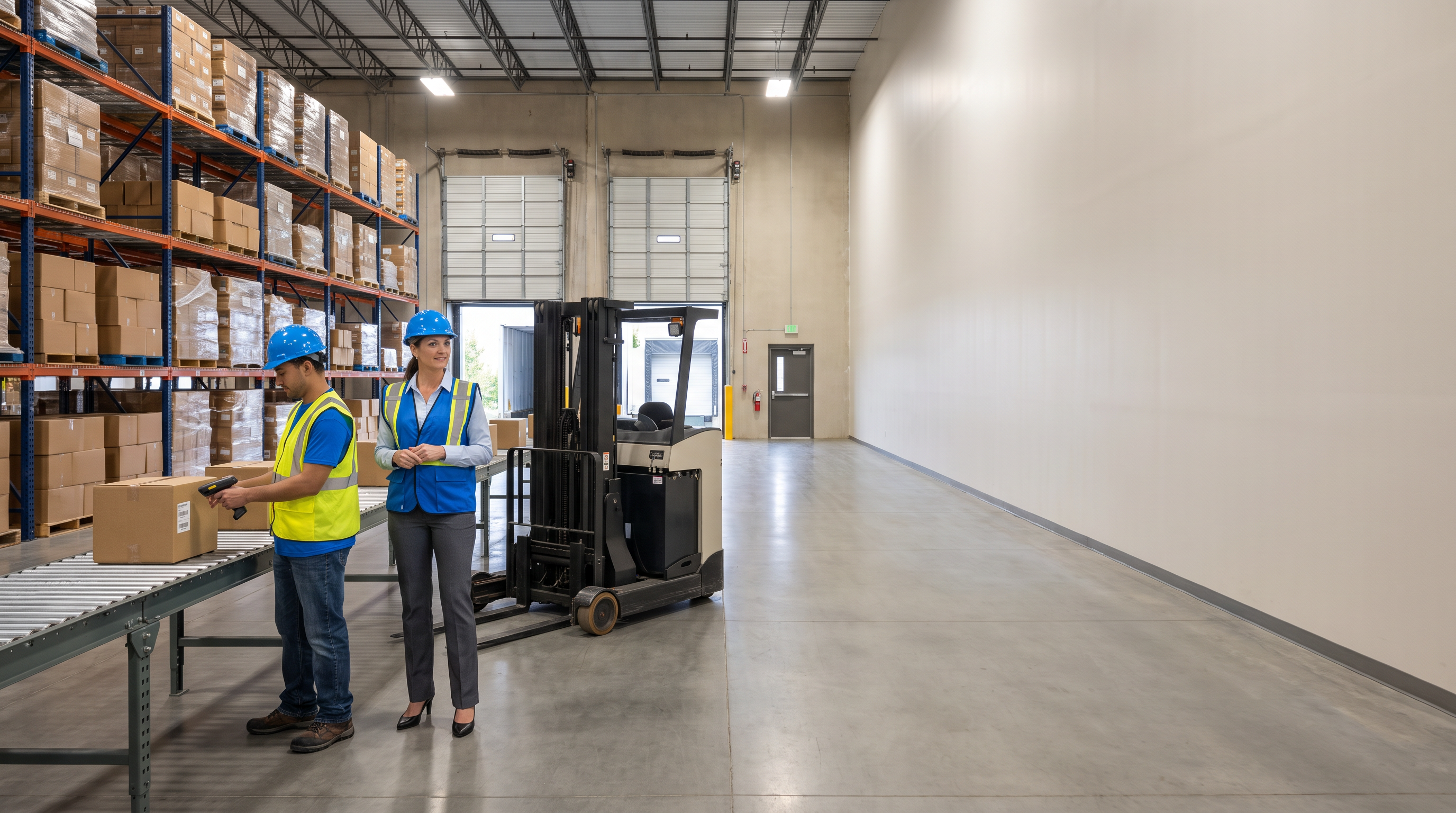

A warehouse can look quiet from the outside while thousands of risk decisions occur inside: inventory arrives, forklifts move through narrow aisles, employees pick and pack orders, customer goods pass through multiple hands, software directs the work, and trucks leave against delivery deadlines. Those exposures change again when a business adds third-party logistics, e-commerce fulfillment, returns processing, cold storage, temporary labor, high-value goods, or last-mile delivery. A useful insurance review starts with the operation as it actually works—not with a generic label such as “warehouse.”
Key takeaways
- Separate the building, owned business property, owned inventory, customer-owned goods, and property in transit. They may require different limits, valuation methods, and coverage forms.
- Map every inventory handoff—from receiving through storage, picking, packing, staging, carrier pickup, delivery, and returns—against contracts and policy language.
- Forklift traffic, loading docks, repetitive handling, temporary labor, automation, and peak-season schedules create employee and liability questions that ordinary office-based insurance reviews may miss.
- Warehouse management systems, order feeds, scanners, customer portals, and carrier integrations make cyber resilience part of operational continuity.
Why warehouse insurance deserves an operations-first review
The U.S. Census Bureau estimated that seasonally adjusted retail e-commerce sales reached $340.2 billion in the second quarter of 2026. That was 12.2 percent higher than the second quarter of 2025 and represented 17.1 percent of total retail sales.[1] Not every online order passes through a third-party fulfillment center, but the scale of e-commerce helps explain why more businesses depend on warehouses, distribution networks, inventory systems, and shipping partners.
Insurance terminology can obscure who owns what and who has agreed to be responsible for it. A fulfillment operator may own the building but not the products. A tenant may own racking and forklifts while leasing the structure. A third-party logistics provider may hold goods for dozens of clients under different contracts. A manufacturer may operate its own warehouse and remain responsible for products before shipment. A retailer may use an overflow site only during the holiday season. The coverage review should identify each party, each location, each category of property, and each transfer of custody.
A commercial property insurance review is an important starting point for the building, tenant improvements, office contents, racking, business equipment, and property the insured owns. It is not proof that every item at the location is covered. The policy’s property definitions, covered locations, limits, deductibles, valuation provisions, causes of loss, reporting requirements, exclusions, and endorsements determine the result.
Warehouse risk map
Three connected areas to review
These categories organize the conversation. They do not determine coverage, which depends on the actual policy, contracts, underwriting information, and facts of a loss.
Property and inventory
Buildings, racking, tenant improvements, owned stock, customer goods, peak-season values, refrigeration, fire protection, water damage, and valuation methods must be separated clearly.
Movement and handoffs
Receiving, docks, trailers, owned vehicles, hired carriers, delivery partners, bills of lading, and responsibility in transit can create gaps between property and cargo coverage.
People and systems
Forklifts, repetitive picking, temporary labor, automated equipment, warehouse software, customer data, and outage plans affect workers compensation, liability, cyber, and continuity questions.
Inventory ownership, custody, and valuation must be explicit
Start with an inventory map. Identify goods owned by the warehouse operator, goods held for customers, packing materials, returned products, damaged stock, samples, and items awaiting disposal. Record the maximum value at each location rather than relying only on an average month. Seasonal surges, promotional launches, harvest cycles, imported shipments, or a customer’s unusually large delivery can push values far above the normal inventory level.
Then identify the valuation method. Replacement cost, actual cash value, selling price, cost of repair, cost of replacement, declared value, and a contractual limitation of liability are not interchangeable. Inventory records should support the values reported to the carrier. Operators should ask how the policy addresses stock fluctuations, inventory at unnamed or temporary locations, property outdoors, property in trailers, and goods stored away from the scheduled premises.
Customer property deserves its own discussion. Do not assume that a standard property policy pays for goods owned by clients, or that a customer’s policy eliminates the warehouse’s exposure. A warehouse legal liability form or another property-in-custody arrangement may respond only when specified conditions are met. Negligence standards, contractual liability, valuation clauses, exclusions, deductibles, defense provisions, sublimits, and warehouse receipts may all matter. Legal counsel should review contracts; the insurance professional should compare those obligations with the proposed coverage.
Fire protection depends on what is stored and how it is stored
Two buildings with the same square footage can present very different property risks. Rack height, aisle width, commodity type, packaging, plastic content, pallets, flammable or combustible materials, aerosols, tires, batteries, cold storage, and the distance between stock and sprinkler heads can affect fire protection and underwriting. Renovations, new racks, mezzanines, tenant improvements, and a change in the product mix should be disclosed before they become an inspection or claim issue.
Returns processing can introduce products that are damaged, swollen, leaking, mislabeled, or otherwise different from ordinary sellable inventory. OSHA has explained that damaged or defective lithium-ion products can present fire and chemical-exposure hazards in some workplace operations, and that lithium batteries are also subject to U.S. Department of Transportation hazardous-material rules.[2] Operators that receive batteries or battery-powered products should coordinate storage, handling, charging, damaged-goods, disposal, fire-code, transportation, and emergency-response questions with qualified safety, fire, environmental, transportation, and insurance professionals.
Property limits should also reflect racking, conveyors, controls, wiring, refrigeration, scanners, servers, charging equipment, backup power, security systems, and tenant improvements. If the business depends on electrical, mechanical, or pressure equipment, ask how equipment breakdown coverage works with the property form and whether spoilage, utility interruption, data restoration, or expediting expenses have separate terms or sublimits.
Prepare a peak-value snapshot
Show the insurer the busiest month, not only the average month
Document the maximum owned and customer-owned inventory by location, commodity type, rack configuration, temperature requirement, theft sensitivity, and seasonal period. Include goods on docks, in trailers, at temporary overflow sites, awaiting returns decisions, and moving between facilities. Keep client-level reports and photographs that can support values after a loss. Reporting the facts accurately improves the review but does not create or guarantee coverage.
Forklifts, docks, conveyors, and repetitive work affect employee risk
Federal OSHA describes warehouses as workplaces where design, planning, and training are essential. Its warehousing guidance addresses ergonomics, forklifts, materials handling, slips and falls, hazardous chemicals, emergency planning, electrical hazards, lockout/tagout, heat, automation, refrigerated work, temporary workers, stress, and fatigue.[3] Oregon OSHA’s warehousing and distribution center inspection directive similarly highlights powered industrial vehicles, material handling and storage, walking-working surfaces, egress, heat illness, ergonomics, and fire protection.[4]
OSHA’s powered industrial truck standard requires employers to ensure that operators are trained and competent for the truck and workplace conditions involved. It also addresses loading and unloading precautions, including trailer brakes, wheel chocks, and protection against movement.[5] California’s warehouse worker guidance calls attention to forklifts, heat, conveyors, repetitive motion, slips and trips, personal protective equipment, temporary-worker safety, and workplace violence prevention.[6] These safety requirements are not insurance coverage. They do show why job descriptions, payroll, training records, temporary-labor arrangements, equipment, and the physical layout belong in a workers’ compensation insurance review.
Do not treat temporary workers as invisible to the exposure. The staffing agreement may allocate responsibilities, but the day-to-day work still occurs at the host site. Review who provides training and supervision, who records incidents, who supplies protective equipment, how injuries are reported, and what indemnity and insurance provisions the contract contains. Employment and worker-classification questions should be addressed with qualified legal or employment professionals.
Premises liability extends beyond visitors slipping in an aisle
Drivers, couriers, vendors, contractors, customers, inspectors, maintenance personnel, and temporary workers may enter the facility. Loading docks combine people, trailers, dock plates, forklifts, pallet jacks, uneven transitions, blind spots, and time pressure. A collision can damage a person, vehicle, rack, building component, or inventory. A dropped load can affect more than the item being moved.
A commercial general liability review can address premises and operations questions, contractual requirements, additional-insured requests, and limits. It should not be assumed to cover employee injuries, auto accidents, professional services, damaged customer goods in the operator’s care, product recalls, cyber incidents, or every obligation accepted by contract. Review exclusions and endorsements rather than relying on the coverage name.
Map property, custody, and shipping before renewal
Bring your locations, inventory reports, customer agreements, equipment schedules, vehicles, shipping arrangements, and continuity plan together for one coordinated review.
Request a warehouse insurance reviewShipping risk begins before the truck leaves
A shipment can be damaged or lost during picking, packing, staging, loading, transit, transfer, delivery, or return. The party responsible at each point may depend on the sales agreement, fulfillment agreement, warehouse receipt, bill of lading, carrier contract, shipment terms, and actual facts. A customer may expect the fulfillment provider to absorb a loss even when the insurance policy defines the exposure differently.
Operators that own or lease delivery vehicles should review scheduled autos, drivers, radius, use, garaging, vehicle weight, trailers, hired and non-owned auto exposures, and loading and unloading. A commercial auto insurance discussion should be coordinated with cargo and contractual review. Auto liability generally addresses liability arising from covered vehicle use; it is not a blanket promise to replace the cargo being carried.
FMCSA states that its cargo securement rules cover cargo-carrying commercial motor vehicles operated in interstate commerce and are intended to prevent cargo from shifting or falling. Cargo generally must be immobilized or secured through appropriate vehicle structures, dunnage, shoring bars, tiedowns, or a combination, with additional requirements for some commodities.[7] Operators should obtain qualified transportation guidance for the rules that apply to their vehicles and shipments. A cargo insurance review can then examine covered property, transit territory, conveyances, valuation, theft, loading and unloading, exclusions, deductibles, and any responsibility assumed for goods in transit.
Products and returns can create liability after fulfillment
A warehouse may be asked to label, bundle, kit, repackage, inspect, assemble, configure, refurbish, destroy, or process returns. Those services can change the risk from passive storage to active product handling. The contract should identify which party owns the specifications, supplies labels, approves substitutions, controls recalls, and communicates with consumers. The insurance application should describe these services accurately.
A product liability insurance conversation can help distinguish the warehouse operator’s role from the manufacturer, importer, distributor, seller, or brand owner. It is especially important when the operator imports products, sells under its own name, makes representations about products, or performs work that could affect product condition. Coverage, defense, additional-insured status, vendor endorsements, recall expenses, and contractual indemnity are separate questions.
Warehouse software can stop physical operations
Fulfillment depends on digital systems that connect orders, inventory locations, scanners, shipping labels, customer instructions, carrier pickups, invoices, and returns. If the warehouse management system fails, the building may remain physically intact while the business cannot find stock, release orders, verify addresses, print labels, or reconcile customer inventory. A cyber incident can also expose customer information or create fraudulent shipping and payment instructions.
CISA warns that ransomware and data-extortion events can make systems and critical data unavailable, disrupting business processes and services. Its guidance recommends offline encrypted backups, restoration testing, and maintained incident-response and communications plans.[8] A cyber liability insurance review can address policy-specific response services, data restoration, business interruption, cybercrime, liability, vendor events, waiting periods, sublimits, and security conditions. Insurance does not replace access controls, multi-factor authentication, tested backups, vendor management, privacy compliance, or incident-response practice.
Employee theft, fraudulent instructions, and inventory shrinkage require different questions
Not every missing item results from a covered theft, and ordinary inventory shortage or unexplained disappearance may be treated differently from documented burglary, employee dishonesty, robbery, social engineering, or computer fraud. High-value, portable products can require stronger controls or special underwriting. Segregation of duties, access logs, camera retention, visitor controls, driver verification, cycle counts, exception reports, and prompt incident documentation can support risk management and claim investigation.
Ask how crime, employee dishonesty, computer fraud, funds-transfer fraud, social engineering, and property coverage interact. The wrong payment instruction, fictitious carrier pickup, or changed shipping destination may involve facts that cross cyber, crime, cargo, property, and contractual coverage. The policy definitions and sequence of events matter.
Business income should reflect the real recovery timeline
A property loss can interrupt more than storage. The operator may need to relocate inventory, lease temporary equipment, rebuild system connections, re-create records, notify clients, expedite shipping, secure alternate space, and meet contractual service obligations. Fire authorities, landlords, utilities, contractors, equipment vendors, software providers, and clients can all influence how quickly operations resume.
Ready.gov recommends that business preparedness planning include communications, information-technology recovery, continuity plans, training, testing, and exercises.[9] For insurance purposes, estimate the time needed to restore the whole operation rather than only the physical building. Ask how business income, extra expense, utility interruption, dependent property, civil authority, equipment breakdown, cyber interruption, and waiting periods apply. Coverage depends on the triggering event and policy language; an operational slowdown or customer loss is not automatically insured.
Renewal and change checklist
Eight changes that should trigger a fresh insurance conversation
Opening, closing, moving, or expanding a warehouse, cross-dock, returns center, cold-storage area, overflow site, or temporary peak-season location.
Taking custody of customer inventory, changing warehouse receipts or fulfillment agreements, or accepting responsibility for higher-value or theft-sensitive goods.
Increasing rack height, changing storage density, adding mezzanines, modifying sprinkler protection, or storing goods with different fire, temperature, or contamination characteristics.
Adding forklifts, conveyors, robotics, automated storage and retrieval systems, refrigeration, charging stations, backup power, or specialized material-handling equipment.
Using owned delivery vehicles, employee vehicles, leased trucks, third-party carriers, or new shipping modes and transfer points.
Adding temporary labor, changing payroll or job duties, extending shifts, increasing production quotas, or creating new pedestrian and powered-equipment traffic patterns.
Connecting a new order platform, warehouse management system, customer portal, payment tool, carrier integration, scanner network, or third-party technology provider.
Handling lithium-ion batteries, aerosols, chemicals, food, pharmaceuticals, temperature-sensitive products, returns, damaged products, or regulated materials.
Contracts can create obligations that the policy does not automatically accept
Fulfillment and warehouse agreements may address inventory valuation, limitation of liability, indemnity, insurance limits, additional insured status, waivers of subrogation, security, service levels, data handling, claim deadlines, disposal, carrier selection, and responsibility for consequential losses. A certificate of insurance summarizes policy information; it does not amend the policy or guarantee that a contract obligation is covered.
Have qualified legal counsel review the contract and have the insurance professional review the resulting risk transfer. The two reviews serve different purposes. Ask whether the policy covers liability assumed under the agreement, whether the customer’s requested limit is available, and whether a commercial umbrella insurance review is appropriate over qualifying underlying policies. An umbrella has its own attachment requirements, exclusions, and conditions, and it cannot repair inaccurate underlying information or an uninsured contractual obligation.
Smaller operators still need a complete review
A small e-commerce business may store products in a light-industrial suite, operate a few forklifts, use seasonal labor, and ship through common carriers. It can still hold more inventory than its limits recognize, depend on one software platform, have customer goods in its care, or suffer a long interruption after a fire or water loss. A business owners policy discussion may be useful for an eligible operation, but packaged coverage should not end the analysis. Cargo, customer goods, equipment, cyber, crime, product work, temporary locations, and peak values may need separate attention.
Build the review from records the business already uses
The strongest insurance submission often begins with operational records rather than insurance forms. Prepare a location schedule, floor plan, rack and sprinkler information, equipment list, vehicle and driver schedule, payroll by job, three years of loss information, customer contracts, sample warehouse receipts, bills of lading, inventory reports, peak-value history, fire and security information, technology map, vendor list, and continuity plan. Explain unusual products or services directly.
Keep the application consistent with reality. If the business adds a new commodity, service, location, vehicle, delivery activity, automation system, or major client during the policy term, ask whether the insurer needs notice. Keep final applications, proposals, binders, declarations, endorsements, schedules, certificates, and correspondence. An insurance agent can help organize the submission and explain options, but the carrier decides eligibility and terms, and the policy controls a claim.
Ready to review your warehouse or fulfillment operation?
Gerald Ross Agency can help organize a commercial-insurance conversation around your facilities, inventory, customer goods, equipment, employees, vehicles, technology, contracts, and recovery plan.
Frequently asked questions
Does warehouse insurance cover goods owned by customers?
It may, but operators should not assume so. Customer goods can involve specific property-in-custody, warehouse legal liability, inland marine, or other forms. Ownership, negligence, contract language, valuation, location, cause of loss, limits, deductibles, exclusions, and reporting provisions can change the result. Review the actual policy and customer agreement together.
Should a fulfillment center insure inventory at cost or selling price?
The correct valuation depends on ownership, the policy, the contract, and the coverage form. Cost, replacement cost, selling price, declared value, and contractual limitation of liability can produce different figures. The warehouse should report values accurately and retain client-level inventory records. The insurer or agent can explain the proposed form; legal counsel should address contractual valuation obligations.
What coverage applies while products are on a truck?
Commercial auto liability, motor truck cargo, inland marine, shipper’s interest, warehouse coverage, and a hired carrier’s insurance address different interests. The result depends on who owns the goods, who has custody, shipment terms, contracts, the vehicle, the carrier, the route, and policy language. Map the handoff rather than assuming warehouse property coverage follows the shipment.
Can business-income coverage respond when warehouse software fails?
Only the policy and event can answer that question. Traditional business-income coverage may require a specified type of physical loss, while cyber coverage may have separate system-failure, security-event, contingent-provider, waiting-period, and restoration provisions. Operators should review both physical and cyber interruption scenarios.
When should a warehouse update its insurance agent?
Report material changes before renewal whenever possible: new locations, larger peak inventory, customer-owned goods, different commodities, higher racks, temporary sites, new vehicles, delivery services, automation, batteries, cold storage, temporary labor, new contracts, new technology, or a large change in sales and payroll. The carrier determines whether underwriting or policy changes are required.
References
- U.S. Census Bureau, “Quarterly Retail E-Commerce Sales, Second Quarter 2026”
- Occupational Safety and Health Administration, “Coverage of Lithium-Ion Batteries Under the Hazard Communication Standard”
- Occupational Safety and Health Administration, “Warehousing: Hazards and Solutions”
- Oregon OSHA, “Program Directive A-305: Warehousing and Distribution Center Operations”
- Occupational Safety and Health Administration, “29 CFR 1910.178: Powered Industrial Trucks”
- California Department of Industrial Relations, “Warehouse Worker Safety”
- Federal Motor Carrier Safety Administration, “Cargo Securement Rules”
- Cybersecurity and Infrastructure Security Agency, “#StopRansomware Guide”
- Ready.gov, “Ready Business”


