


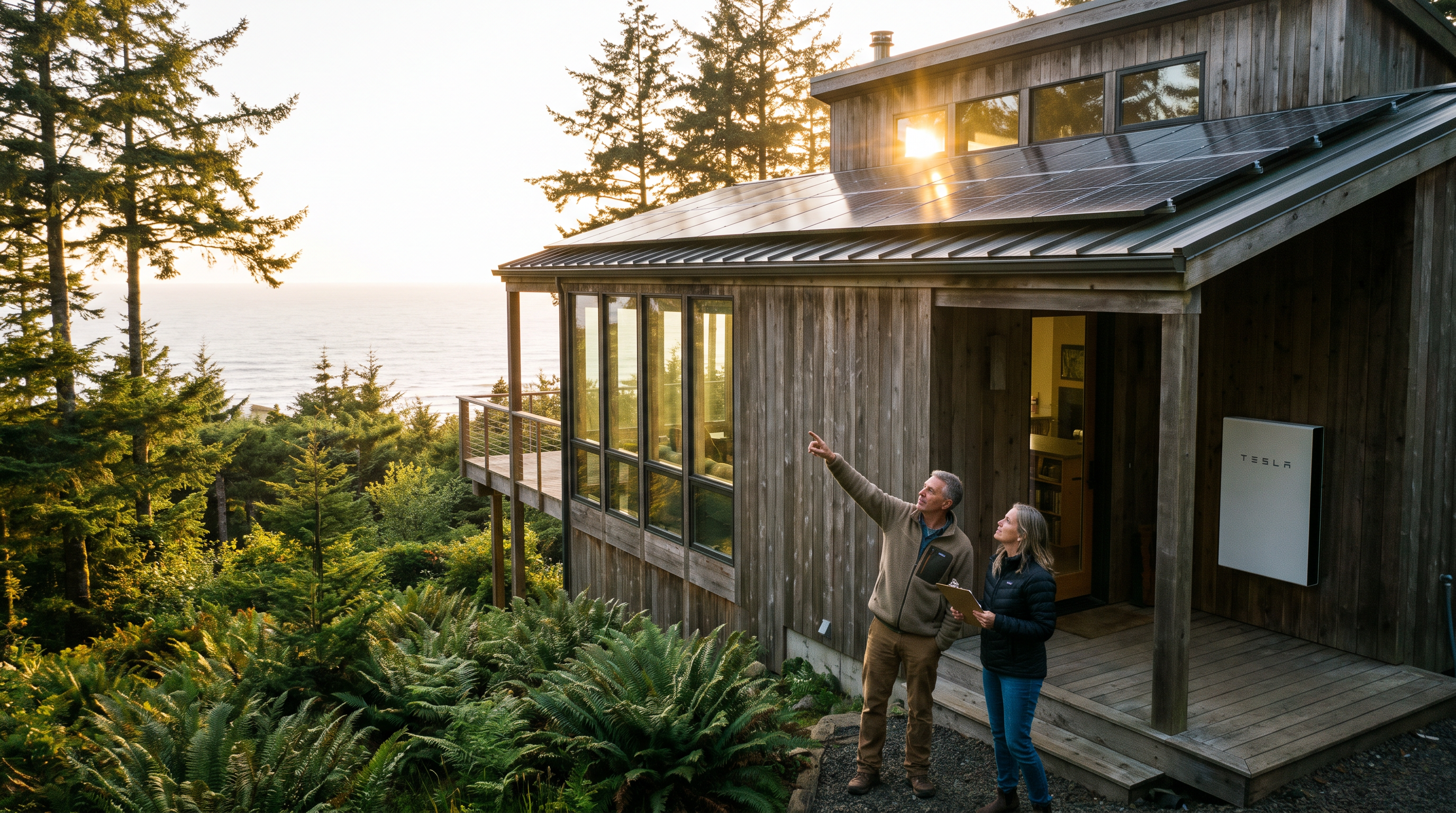

Solar installations are surging across Oregon and Northern California. Driven by rising Pacific Power and PG&E rates, federal tax credits under the Inflation Reduction Act, and the very real need for backup power during wildfire-season outages, thousands of homeowners are adding rooftop panels and home battery systems every year. A typical residential solar-plus-battery system costs between $25,000 and $45,000 — a significant investment that most homeowners assume their existing homeowners insurance policy automatically covers. That assumption is often wrong in ways that matter most.
This guide explains exactly what a standard homeowners policy covers when it comes to solar panels and home batteries, where the gaps are, what Oregon and Northern California homeowners face that homeowners in other states don't, and what steps to take before — not after — your installer shows up.
Installing Solar? Review Your Coverage First.
A 15-minute call with a Gerald Ross Agency advisor before your installation could prevent a six-figure coverage gap. We serve homeowners across Oregon and Northern California.
Get a Free Insurance ReviewDoes Your Homeowners Policy Cover Solar Panels?
The short answer is: usually yes, but with important limitations. Most standard homeowners policies extend dwelling coverage to rooftop solar panels because they are permanently attached to the structure. This means damage from covered perils — fire, lightning, windstorm, hail, falling trees, and the weight of snow or ice — is typically covered under the same dwelling coverage that protects the rest of your home.
However, there are several critical nuances that Oregon and Northern California homeowners need to understand:
Dwelling vs. Other Structures Coverage
Rooftop panels attached to your main home fall under dwelling coverage. Ground-mounted panels or panels on a detached garage fall under 'other structures' coverage — which is typically capped at just 10% of your dwelling limit. A $400,000 home has only $40,000 in other structures coverage by default. If your ground-mounted array cost $30,000, you may be right at the edge.
Dwelling Coverage Limits May Be Inadequate
Adding $25,000–$45,000 in solar equipment increases your home's replacement cost. If you don't notify your insurer and increase your dwelling coverage limit, you may be underinsured at claim time. Many Oregon homeowners are already underinsured by 20–40% before they add solar — a problem the Gerald Ross Agency team identifies and corrects during our annual review process.
Equipment Breakdown Is a Separate Coverage
Standard homeowners policies cover damage from external perils (fire, wind, hail) but typically do NOT cover mechanical or electrical breakdown of your inverter, charge controller, or battery management system. Equipment breakdown coverage — sometimes called 'systems breakdown' — is a separate endorsement that most homeowners don't know to ask for.
Leased Solar Systems: Who Insures What?
If you leased your solar system through a third-party provider (common with older SunPower or Sunrun contracts), the panels may be owned by the leasing company — not you. The leasing company may carry their own insurance, but you need to verify this in your lease agreement. Your homeowners policy may not cover damage to property you don't own.
Home Battery Storage: The Coverage Gap Most Homeowners Don't Know About
Tesla Powerwalls, Enphase IQ Batteries, Franklin WH, and other home battery storage systems are increasingly common in Oregon and Northern California — and they create insurance questions that most homeowners policies haven't fully caught up with.
Key Insurance Questions for Home Battery Systems
Is the battery covered under dwelling coverage?
If the battery is permanently mounted to the interior or exterior wall of your home, most insurers treat it as part of the dwelling structure. However, some carriers classify it as personal property or 'other structures,' which affects both the coverage limit and the deductible. Confirm this classification with your agent before installation.
What if the battery causes a fire?
Lithium-ion battery fires are a growing concern for the insurance industry. Most homeowners policies cover fire damage regardless of cause — including battery fires. However, some newer policy forms include exclusions or sublimits for lithium-ion battery fires, particularly in commercial and condo policies. Review your policy language carefully.
Does the battery affect my liability coverage?
If your battery system malfunctions and causes damage to a neighbor's property — or if your solar system feeds power back to the grid and causes an equipment failure — your personal liability coverage may respond. However, some utility interconnection agreements require minimum liability limits of $300,000 to $1 million. If your current liability limit is lower, you may need to increase it or add a personal umbrella policy.
Is the battery covered during a wildfire evacuation?
If your home is destroyed in a wildfire, the battery system should be covered under your dwelling coverage (subject to your coverage limit). However, if you evacuate and the battery is damaged during the evacuation process — or if it's stolen from an evacuated property — coverage depends on your specific policy terms.
Oregon-Specific Risks: Wildfire, Wind, and the Carrier Retreat
Oregon homeowners face a set of solar insurance challenges that are more acute than in most other states. The wildfire insurance crisis that has devastated California's homeowners market is now spreading into Southern Oregon, Curry County, Josephine County, and Douglas County. As carriers pull back from high-risk zones, homeowners who add solar panels face two compounding problems:
- Carriers may decline to renew or write new policies on homes with solar panels in high wildfire-risk areas, citing the increased fire risk from electrical components and the difficulty of firefighting around solar arrays.
- Solar panels complicate firefighting. Rooftop solar panels remain energized even when the main breaker is off — they cannot be de-energized by firefighters. Some fire departments now refuse to enter a burning structure with rooftop solar, which can mean a total loss instead of a partial loss. This increases the probability of a catastrophic claim, which is exactly what insurers are trying to avoid in wildfire-prone areas.
- Oregon's wind and storm exposure is significant on the coast and in the Rogue Valley. High-wind events can damage solar panels and the roof structure beneath them. Confirm that your policy covers wind damage to both the panels and any resulting roof damage.
- Coastal salt air corrosion can accelerate degradation of solar panel components. This is a maintenance issue, not an insurance issue — but it's worth understanding that insurance does not cover gradual deterioration.
If you are in a high-risk wildfire area and considering solar installation, talk to a Gerald Ross Agency advisor before you install. In some cases, adding solar can trigger a non-renewal from your current carrier — and finding replacement coverage in a high-risk area is significantly harder than maintaining your existing policy. We can help you navigate this before it becomes a crisis. Learn more about the wildfire insurance crisis on the Oregon Coast.
Northern California: A More Severe Version of the Same Problem
Northern California homeowners face all of the same solar insurance challenges as Oregon, but in a more extreme form. California's insurance market has experienced a near-collapse in high-risk areas — with State Farm, Allstate, Farmers, and dozens of other carriers either withdrawing entirely or dramatically restricting new policies in wildfire-prone counties including Del Norte, Humboldt, Trinity, Siskiyou, and Shasta.
California also has specific regulatory requirements that Oregon does not:
| Requirement | Oregon | California |
|---|---|---|
| Utility interconnection liability minimum | Varies by utility | $300,000–$1M (PG&E requirement) |
| Solar permit required | Yes (local jurisdiction) | Yes (local jurisdiction + Title 24) |
| Battery storage permit required | Yes (local jurisdiction) | Yes (local jurisdiction + NFPA 855) |
| FAIR Plan covers solar panels | Oregon FAIR Plan: limited | CA FAIR Plan: limited, check endorsements |
| Wildfire home hardening discounts | Emerging programs | AB 2756 discount requirements for insurers |
If you are in Northern California and your primary carrier has already non-renewed your policy, the California FAIR Plan may be your only option — but FAIR Plan coverage is basic and may not adequately cover your solar investment. A surplus lines policy through an independent agent like Gerald Ross Agency is often a better solution. Learn more about hard-to-place home insurance options.
Already Have Solar? Get a Coverage Review.
If you installed solar panels or a home battery in the last few years without updating your homeowners policy, you may have a significant coverage gap right now. Gerald Ross Agency offers free coverage reviews for Oregon and Northern California homeowners.
Request a Free Coverage ReviewWhat to Do Before You Install: A Pre-Installation Insurance Checklist
The best time to address solar insurance is before the installation crew arrives — not after a claim. Here is a practical checklist for Oregon and Northern California homeowners:
Notify your insurance agent before installation
Your insurer needs to know about the installation so they can update your dwelling coverage limit and confirm coverage. Failing to notify your insurer could result in a claim denial if the panels are damaged before the policy is updated.
Increase your dwelling coverage limit
Add the full replacement cost of your solar system (panels, inverter, battery, mounting hardware, and installation) to your dwelling coverage limit. A $35,000 system needs $35,000 in additional coverage.
Ask about equipment breakdown coverage
Request an equipment breakdown endorsement to cover inverter failure, battery management system failure, and other mechanical/electrical breakdowns that standard policies don't cover.
Review your liability limits
If your utility interconnection agreement requires minimum liability coverage, confirm your current limits meet that requirement. Consider a personal umbrella policy if you need coverage above $500,000. Learn more about umbrella insurance in our guide to personal umbrella insurance in Oregon
Ask about wildfire zone impact
If you are in a designated wildfire risk zone, ask your agent whether adding solar panels affects your eligibility for renewal. In some cases, it may be worth delaying installation until you have confirmed your carrier's position.
Document your system before and after installation
Take photos and video of the installation, keep all receipts and warranties, and store copies in a cloud service. This documentation is essential for a smooth claims process.
The Bigger Picture: Solar, Batteries, and the Changing Oregon Home Insurance Market
Solar panels and home batteries are part of a broader shift in how Oregon and Northern California homeowners manage energy and risk. They are also part of a broader shift in how insurance companies assess residential risk. As the Oregon homeowners insurance market continues to tighten — with carriers raising rates, adding exclusions, and non-renewing policies in high-risk areas — having a knowledgeable independent agent in your corner is more important than ever.
Gerald Ross Agency works with multiple carriers across Oregon and Northern California, including surplus lines markets that specialize in high-risk and hard-to-place properties. We can help you find coverage that properly accounts for your solar investment, your battery storage system, and the specific risks of your location — whether you're on the Oregon Coast, in the Rogue Valley, or in Humboldt or Del Norte County.
If you've received a non-renewal notice from your current carrier, or if you're concerned about your coverage after a recent solar installation, contact us for a no-obligation review. We also recommend reviewing our guide to wildfire and smoke damage insurance in Oregon and our earthquake insurance guide for Oregon and Northern California.
Frequently Asked Questions
Will adding solar panels increase my homeowners insurance premium?
Yes, in most cases. Adding $25,000–$45,000 in solar equipment increases your home's replacement cost, which typically increases your dwelling coverage limit and your premium. The increase is usually modest — often $50–$150 per year — but varies by carrier and location.
Do I need to notify my insurance company before installing solar panels?
Yes. You should notify your insurer before installation so they can update your coverage limits and confirm that the installation is covered. Failing to notify your insurer could result in a claim denial if the panels are damaged before the policy is updated.
Does homeowners insurance cover a Tesla Powerwall or other home battery?
Generally yes, if the battery is permanently mounted to your home and damaged by a covered peril (fire, wind, hail, etc.). However, coverage for battery fires, equipment breakdown, and battery systems in detached structures varies by policy. Confirm with your agent.
What if my solar panels are damaged in a wildfire?
If your home and solar panels are damaged or destroyed in a wildfire, the panels should be covered under your dwelling coverage — subject to your coverage limit. This is why it's critical to increase your dwelling coverage limit when you add solar. If your coverage limit is too low, you may not receive enough to replace both your home and your solar system.
Can a carrier cancel or non-renew my policy because I have solar panels?
In high wildfire-risk areas, some carriers have become more restrictive about properties with rooftop solar due to firefighting concerns. While carriers cannot cancel a policy mid-term without cause, they can choose not to renew at the end of the policy period. If you are in a high-risk area, discuss this with your agent before installing.
Does the California FAIR Plan cover solar panels?
The California FAIR Plan provides basic fire coverage and may cover solar panels as part of the dwelling structure, but coverage is limited and may not reflect the full replacement cost of your system. A surplus lines policy is often a better option for homeowners with significant solar investments.
Protect Your Solar Investment the Right Way
Gerald Ross Agency serves homeowners across Oregon and Northern California. Whether you're planning a solar installation or already have panels on your roof, we'll make sure your coverage is complete — before a claim, not after.


