


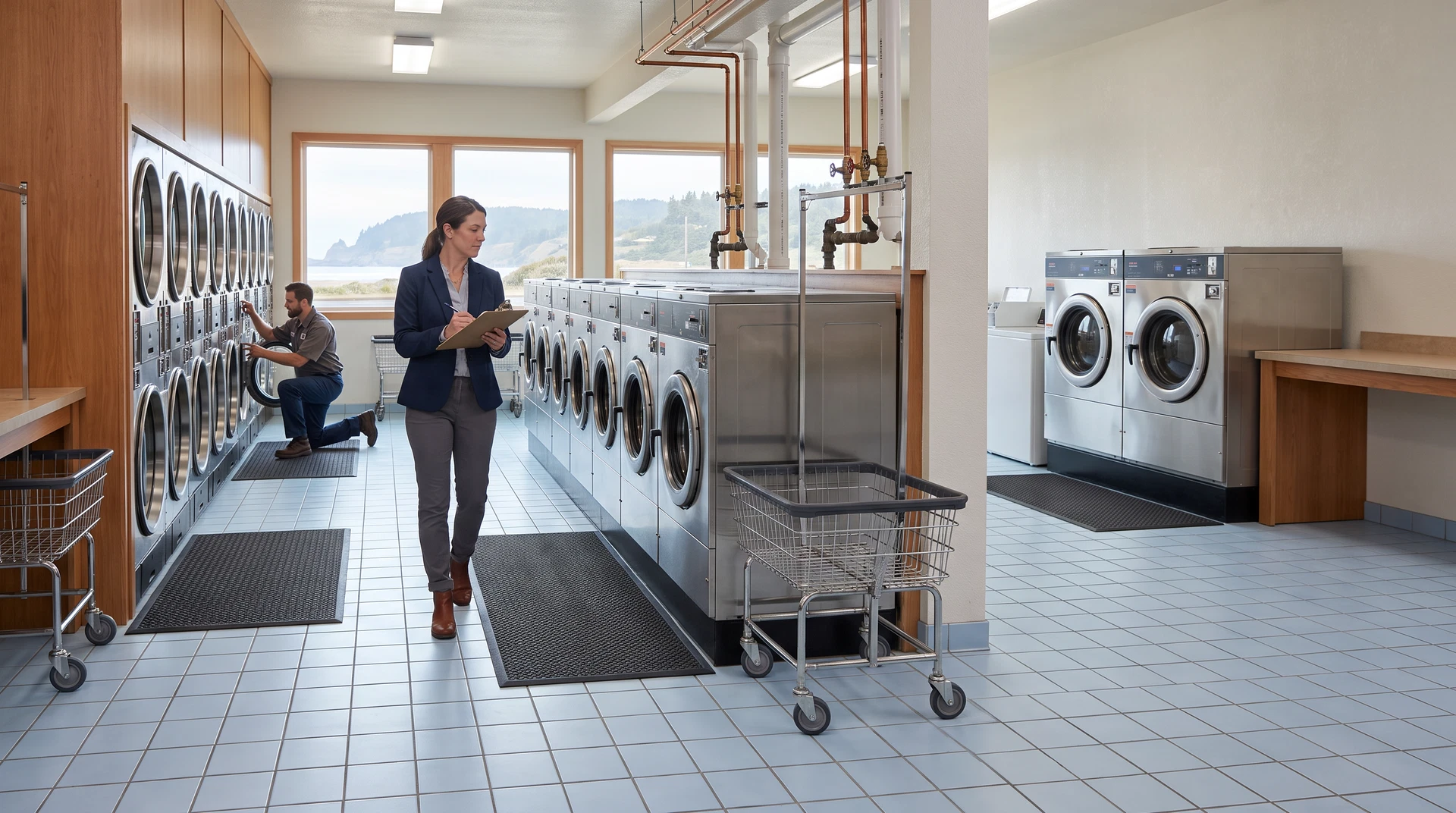

Laundromats and car washes are often described as simple, self-service businesses. In practice, they depend on machinery, water, drainage, electricity, payment systems, customer traffic, premises upkeep, and a reliable operating schedule. A washer that will not spin, a dryer that overheats, a wash-bay drain that backs up, a hose that leaks, a wet entry mat, a damaged customer vehicle, or a card-system outage can each produce a different type of insurance question. For owners in Oregon, Washington, and Northern California, the starting point is an accurate picture of how the location actually operates—not an assumption that one generic business policy handles every situation.
Key takeaways
- Property, equipment-breakdown, business-income, general liability, customer-property, cyber, commercial auto, workers compensation, and umbrella coverage can address different questions and depend on policy wording.
- Wet operations require intentional maintenance, drainage, inspection, and response practices; insurance does not replace safe operations or required compliance.
- Customer service changes the exposure. Drop-off laundry, pickup and delivery, staffed detailing, key handling, and employee vehicle movement can introduce facts that a self-service location may not have.
Why these businesses need a more detailed insurance conversation
A laundromat may have a long row of washers and dryers, hot-water equipment, change machines, payment terminals, customer seating, folding tables, a restroom, vending machines, security cameras, and a leased building. A car wash may add wash bays, pumps, pressure systems, vacuums, chemicals, drainage, a point-of-sale system, employees moving vehicles, fleet accounts, or a detailing operation. When one part stops working, the operational impact can be larger than the replacement cost of a single component.
The most useful review starts by mapping the property, machines, utilities, customer services, employees, vehicles, contracts, maintenance arrangements, and income the business relies on. A business owners policy discussion can then distinguish the premises, business personal property, liability, and possible business-income questions from specialized equipment or service exposures. Policy terms, exclusions, deductibles, sublimits, waiting periods, and insurer underwriting determine the actual result.
Operations map
Three operating zones that should be part of the review
A single location may contain all three. The goal is to surface the operating facts before a loss, claim, contract, or renewal creates urgency.
Machines and utilities
Washers, dryers, boilers, pumps, vacuums, compressors, water heaters, electrical panels, payment equipment, and plumbing systems each have different failure and restoration questions.
Wet floors and drainage
Entries, loading areas, drains, hoses, leaks, mat placement, inspection routines, cleaning response, and lighting can affect both customer experience and premises-safety planning.
Customer-facing systems
Card readers, mobile apps, cameras, self-service controls, keys, drop-off services, vehicle movement, and staff assistance can add customer-property, data, and liability questions.
Equipment breakdown is not the same as ordinary property damage
Property insurance and equipment-breakdown coverage can respond differently to different causes of loss. The distinction matters for washing machines, dryers, boilers, water heaters, pumps, compressors, vacuums, electric controls, payment kiosks, circuit boards, and other machinery. For example, a covered fire, wind event, leak, electrical failure, mechanical breakdown, or utility interruption may be handled differently depending on policy language and endorsements.
Build a practical equipment schedule before renewal. Identify the make, model, age, replacement cost, maintenance provider, warranty status, electrical and water dependencies, and the revenue impact if each critical machine is out of service. Ask what equipment-breakdown coverage, service interruption, spoilage or damage, extra expense, and business-income terms are available. A commercial property review can also help organize building, contents, tenant improvements, signage, money and securities, and location-value questions without assuming that any particular loss will be covered.
Water damage, drainage, and the difference between routine maintenance and insurance
Water is central to both business models. It also creates a reason to document drains, hoses, valves, floor conditions, maintenance schedules, leak-response procedures, and who is responsible for repairs under a lease. A slow leak behind machines, a failed supply line, a clogged drain, roof intrusion, sewer backup, freeze event, or water from a neighboring suite may all require different facts and may be treated differently under a policy.
OSHA's general walking-working-surface standard requires employers to keep floors clean and, to the extent feasible, dry; when wet processes are used, the rule calls for drainage and, where feasible, dry standing places such as mats or platforms.[1] That is a workplace-safety rule, not an insurance promise. It nevertheless provides a useful prompt for owners to make wet-floor inspection, cleanup, mat condition, lighting, warning practices, and incident documentation part of ordinary operations.
Water-loss organizer
Keep the facts that make a water event easier to understand
Maintain equipment service records, plumbing and drain maintenance invoices, photographs of key shutoffs and drains, a current lease, vendor contacts, emergency cleanup contacts, before-and-after incident photographs, customer or employee observations, receipts for temporary measures, and a list of any affected machines or spaces. Notify the insurer or broker according to policy requirements. Documentation supports the review of an event; it does not decide coverage.
Customer slips, customer property, and daily premises liability
A customer who slips near an entry, trips on a hose, falls on a damaged surface, is hurt by equipment, or alleges damage to personal property can create a liability question. A general liability insurance conversation should reflect the site layout, regular customer traffic, unattended hours, posted rules, floor and mat maintenance, lighting, security, restrooms, parking areas, and incident-response process. It should also address how the business handles property that belongs to customers.
Self-service use differs from a drop-off laundry, wash-and-fold service, staffed detailing operation, valet line, pickup-and-delivery route, or car wash where staff move vehicles. Clothing, keys, vehicles, accessories, packages, payment cards, and personal information can create different care, custody, control, or service-related questions. Do not rely on a broad statement such as “we do not touch customer property” if employees sometimes do. Describe the real operating practice, including exceptions during busy hours or after a machine problem.
Review the location before the next outage or renewal
A focused commercial insurance conversation can start with your equipment list, water and drainage facts, customer services, lease, contracts, and current policies.
Request a commercial insurance reviewCar wash wastewater, chemicals, and site operations
For a car wash, site operations can include more than the equipment the customer sees. Wash water, detergents, degreasers, oils, solids, drains, curbs, recovery equipment, storage, outdoor areas, and vendor services may all be relevant. Portland's Environmental Services notes that wash water can contain pollutants and that city code prohibits discharge to the stormwater system; its guidance discusses dedicated wash pads, containment, sanitary drainage, and recovery or reuse approaches.[2] Local rules, permits, and utility requirements vary. Owners should work with the appropriate regulator or qualified professional for compliance guidance.
From an insurance perspective, document the actual wash-water system, chemicals, storage, maintenance contractor, drainage plan, spill-prevention steps, and lease or property-owner responsibilities. Explain whether the business is an automated wash, self-serve wash bay, mobile detailer, full-service wash, fleet wash, or a combination. Insurance is not environmental advice and should not be used as a substitute for permit, water-quality, safety, or legal review; it is one part of a larger operational-risk conversation.
Employees, vehicle movement, and pickup-and-delivery services
Hiring an attendant, maintenance worker, detailer, driver, or manager changes the business. Employees may work around hot equipment, water, detergents, moving vehicles, electrical systems, ladders, cash-handling, and customer interactions. OSHA's laundry-machinery standard addresses moving equipment parts and includes requirements related to guards, steam pipes, and employee instruction for laundry operations.[3] A workers compensation review can help an employer identify state-specific questions about payroll, job classifications, employee duties, subcontractors, seasonal helpers, and safety responsibilities.
Pickup and delivery, mobile laundry, fleet-service wash contracts, employee errands, and moving customer vehicles can also shift the vehicle analysis. A commercial auto insurance review should identify owned, leased, borrowed, hired, or employee-owned vehicles used for business; regular drivers; trailers; delivery radius; customer vehicles; and any written service arrangements. Coverage depends on the policy and actual facts, so describe the operation precisely.
Annual operations check
Eight changes that should trigger a fresh review
You replaced, added, financed, or materially upgraded washers, dryers, boilers, pumps, vacuums, payment systems, plumbing, or electrical equipment.
Your building, tenant improvements, machines, contents, signage, or other property values changed materially.
You started wash-and-fold, pickup and delivery, detailing, fleet service, key handling, mobile service, or employee vehicle movement.
A landlord, lender, franchise, vendor, municipality, or commercial customer requested new insurance documentation or contract terms.
You experienced a leak, sewer or drain issue, equipment outage, customer fall, theft, security incident, or recurring maintenance problem.
You hired, reclassified, or added employees, changed payroll, used new subcontractors, or added a new shift or unattended operating hours.
You added online booking, stored customer information, networked payment terminals, security cameras, smart equipment, or cloud-based controls.
Your location faces new weather, wildfire, power-outage, road-access, construction, or neighboring-tenant conditions that could interrupt operations.
Technology, payment systems, and interrupted operations
Modern self-service locations often rely on app-based payments, networked machines, card terminals, security cameras, door controls, loyalty programs, cloud dashboards, email accounts, remote controls, and vendor access. That means an outage or compromised account can disrupt operations even if no machine is physically damaged. A cyber liability insurance review should begin with the systems, customer information, vendors, backups, account access, and incident-response steps the business actually uses.
It is also worth discussing the financial impact of a lengthy closure. Equipment service, water mitigation, repair lead times, utility outages, fire, wind, vandalism, or a required cleanup can affect revenue and continuing expenses. Ask how business-income, extra-expense, utility-service, equipment-breakdown, and waiting-period provisions interact. Available coverage and the result of a specific claim depend on policy language, limits, endorsements, cause of loss, and insurer underwriting.
When higher limits or layered protection deserve a conversation
A busy location can have many customer visits, vehicles, wet surfaces, equipment, vendors, employees, and neighboring properties. Higher-limit questions are not answered only by revenue. They can also depend on lease requirements, contracts, property values, traffic volume, service mix, vehicle exposure, prior incidents, and the owner's overall asset-protection goals. A commercial umbrella insurance conversation can help clarify how an excess layer may sit over qualifying underlying policies and what limits, exclusions, self-insured retention, and insurer requirements apply.
Gerald Ross Agency can help you organize the information for a more useful review. Bring current policies, a list of equipment and values, lease and service agreements, maintenance records, customer-service practices, payroll, vehicle details, water and drainage information, online systems, and any certificate requests. If a question involves building code, water quality, permits, safety, employment, contracts, or legal responsibility, consult the appropriate qualified professional as well.
Make the insurance review match the wash business you actually run
Whether you operate a self-service laundromat, wash-and-fold business, automatic car wash, detail shop, or mixed service location, our team can help organize the insurance questions around your operation.
Frequently asked questions
Does equipment breakdown cover all machine problems?
No. Whether coverage applies depends on the policy, endorsement, equipment, cause of loss, exclusions, deductible, waiting period, and other conditions. Ask for the wording that applies to your specific equipment rather than relying on a broad label.
Does a wet-floor claim automatically mean the business is liable?
Liability is fact-specific. Incident circumstances, inspection and cleanup practices, condition of the area, warnings, records, injuries, applicable law, and policy terms can all matter. Preserve the facts and notify the insurer or broker according to policy requirements.
What should a car wash owner ask about customer vehicles?
Describe whether staff drive, park, load, unload, detail, repair, or otherwise take possession of customer vehicles or keys. The relevant policy and endorsements may differ from a location where customers operate their own vehicles throughout the visit.
Can a customer payment system create a cyber insurance question?
It can. A review may be appropriate when the business uses online accounts, networked terminals, customer contact information, cameras, remote controls, cloud systems, or vendor access. The right conversation depends on the systems and data involved.


