


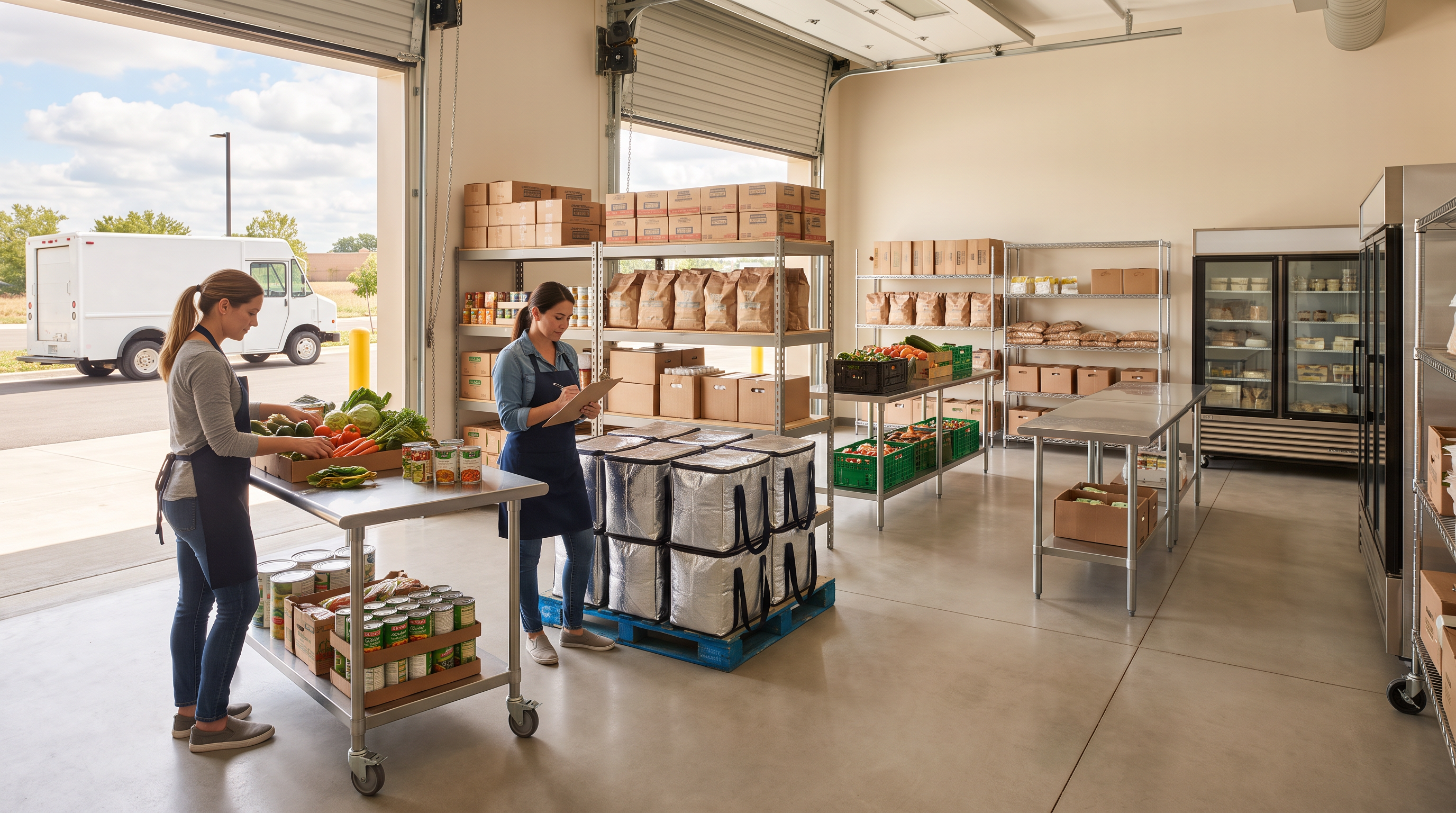

A donation arrives at a pantry. A volunteer checks the shipment while another team prepares meal carriers. A driver loads a van for an off-site distribution point. That mission crosses food handling, refrigeration, public interaction, volunteers, employees, vehicles, temporary locations, property, participant information, contracts, and continuity. This guide explains the operational questions that often matter—and the insurance questions worth reviewing before an incident forces the conversation.
At a glance
Key takeaways for nonprofit leaders
- Map the whole service flow: where food comes from, how it is handled, who works with it, how it travels, where it is served, and what records follow it.
- Confirm food, permit, mobile-unit, labor, reporting, and privacy requirements with the authority responsible for the actual activity and location.
- General liability, property, equipment breakdown, spoilage, auto, workers compensation, volunteer accident, cyber, crime, D&O, and business-income questions are not interchangeable.
- Update the insurance conversation before adding a route, borrowed kitchen, refrigerated storage, temporary meal site, volunteer driver, trailer, generator, or participant-data system.
The mission happens beyond the building
A food pantry may receive donated and purchased food, sort and repack items, maintain dry and cold storage, welcome participants, coordinate volunteers, and move food into the community. A community-meal program may use a borrowed kitchen, temporary booth, church hall, fairground, or outdoor site. A mobile outreach team may add employee or volunteer drivers, personal vehicles, trailers, generators, coolers, weather exposure, changing routes, and field decisions away from a supervisor.
Begin with the agency’s broader nonprofit insurance overview and non-profits and events resource center, but do not stop at the organization’s tax status or facility address. The insurance submission and renewal discussion should describe what the nonprofit actually does, including food preparation, public service, transportation, volunteer duties, off-site property, participant contact, and data collection.
The U.S. Food and Drug Administration explains that its Food Code is a model for state and local adoption rather than one nationwide operating statute. Oregon and California food oversight is implemented through state and local systems.[1][2][3][4] The correct permit, exemption, temperature, equipment, and operating requirements therefore depend on the activity, facility, county, event, route, and current law.
Operations map
Three connected areas to document
These areas organize the review. They do not determine coverage, which depends on the issued policies, endorsements, contracts, underwriting information, and facts of a loss.
Food and equipment
Donations, purchased food, cold storage, hot holding, coolers, freezers, generators, serving supplies, recalls, spoilage, and corrective actions.
Places and people
Pantries, borrowed kitchens, temporary sites, participants, employees, volunteers, vendors, supervision, accessibility, safeguarding, and incident response.
Vehicles and continuity
Owned and personal vehicles, trailers, routes, loading, cargo, off-site property, data, vendor dependencies, power loss, weather, and alternate service plans.
Start with the service flow—not an insurance form
A useful operations map follows food and people from receipt through final distribution. Record the source, condition, storage, preparation, transport, service, remaining inventory, complaints, incidents, and corrective actions. Identify the facility, responsible person, employees and volunteers, equipment, vehicle, driver, route, host-site contact, vendor, and data system at every step. This factual map helps leadership find operational gaps and gives an insurance professional a clearer picture than a generic description such as “community services.”
One controlled service flow
Document each decision and handoff
Receive and decide
Identify the source, inspect condition and labels, check applicable temperatures, accept or reject, and record any corrective action.
Store and protect
Move food promptly to approved dry, refrigerated, or frozen storage; rotate stock; separate holds; maintain equipment; and control access.
Prepare and stage
Use the approved facility, recipe, ingredients, allergen information, sanitation process, serving equipment, and volunteer assignments.
Transport and serve
Confirm drivers, vehicles, route, load security, food controls, site permission, handwashing, weather response, and participant flow.
Reconcile and learn
Record remaining food, temperatures, complaints, incidents, near misses, discarded items, equipment issues, and follow-up responsibilities.
Receiving, storage, and donation controls protect the pantry
A pantry’s exposure begins before food reaches a shelf. A practical receiving process can identify the source, inspect package condition and available labels, note when temperature-sensitive food arrived, move accepted food promptly into appropriate storage, and document rejection or corrective action. Virginia Cooperative Extension recommends practical controls for hunger-relief organizations, including cold-chain checks, rejection of damaged or spoiled items, first-in-first-out rotation, pest control, and separation of food that should not enter distribution.[5] That resource is useful operational guidance; the responsible authority determines what applies in Oregon or California.
Temperature guidance requires care. FoodSafety.gov advises refrigerators at 40°F or below and freezers at 0°F or below. Oregon food rules and mobile-unit guidance use additional time-and-temperature controls, including 41°F or colder for cold holding and 135°F or hotter for hot holding in specified contexts.[6][7] The practical lesson is not to argue over one degree. Identify the applicable standard, use accessible and reliable thermometers, assign authority to act, and record what happened when a reading fell outside the approved threshold.
USDA notes that perishable prepared-food donations may require refrigerated transport, insulated containers, or prompt distribution and encourages consultation with local health departments.[8] Federal food-donation protections are limited; Congress’s summary of the Bill Emerson Good Samaritan Food Donation Act states that protections do not cover gross negligence or intentional misconduct and do not supersede state or local health regulations.[9] Charitable intent does not replace food-safety controls, legal guidance, or a policy-specific insurance review.
A commercial property insurance review should identify the building or tenant improvements, freezers, refrigerators, shelving, computers, generators, donated property, food stock, mobile equipment, property in vehicles, property at temporary sites, property owned by others, valuation method, seasonal peaks, deductibles, and covered locations. Equipment breakdown, utility interruption, spoilage or contamination, property, business income, and extra expense can have different triggers, definitions, sublimits, exclusions, and conditions.
Pantry control question
Can the organization explain the receiving decision?
For food that needs special handling, can the team show who accepted it, its condition when received, how it was stored, whether an applicable temperature was checked, and what happened if something was wrong? Records support operations and investigation; they do not amend an insurance policy or guarantee a claim outcome.
Community meals need a site plan before service begins
Clean, separate, cook, and chill remain useful foundations, but a community meal also needs a site-specific plan.[10][11] Who controls the kitchen? Is the food source approved? Where are handwashing, potable water, wastewater, refrigeration, hot holding, utensils, sanitizing, restrooms, trash, and power? What changes in wind, rain, smoke, extreme heat, or a power failure? Who can stop preparation or service when a core control fails?
Oregon’s temporary-restaurant guide addresses advance licensing, approved sources, handwashing, water, thermometers, sanitation, and food handling; it also says home-prepared food may not be served to the public.[12] California’s retail-food program is primarily enforced through local environmental-health agencies. Sonoma County offers one local example of advance temporary-food-facility permitting and separate authorization for simultaneous service points.[13] That county example is not a universal Northern California timetable. Confirm the permit or exemption path with the responsible local authority before choosing a menu, reserving equipment, or announcing the event.
Borrowed kitchens and host sites add contracts. Identify who supplies, inspects, maintains, and cleans equipment; who controls the premises; who secures the facility; and who responds to a spill, injury, fire alarm, utility loss, or food complaint. A commercial general liability discussion can address premises and operations questions, products/completed operations, temporary sites, host agreements, certificates, additional-insured requests, and limits. It should not be treated as a substitute for property, auto, workers compensation, cyber, crime, professional, participant, or volunteer injury analysis.
When the service model changes, update the risk description
A borrowed kitchen, refrigerated donation, temporary meal site, new route, volunteer driver, trailer, generator, or participant-data system can change the operation. Bring those facts, contracts, records, and current policies into one coordinated review.
Request a nonprofit insurance reviewAllergens and vulnerable diners require a no-guessing system
The FDA identifies nine major food allergens: milk, eggs, fish, crustacean shellfish, tree nuts, peanuts, wheat, soybeans, and sesame.[14] Programs should retain ingredient labels, keep recipes current, document substitutions and brand changes, separate utensils or surfaces where appropriate, train the people who answer questions, and make “I need to check” the required response when an ingredient is uncertain. A sign or disclaimer cannot replace accurate information and practical cross-contact controls.
Oregon State University Extension recommends extra precautions for older adults, pregnant people, infants and young children, and people with weakened immune systems.[15] A nonprofit serving these groups should seek current food-safety and medical guidance for its program. No protocol can promise that illness or an allergic reaction will never occur.
Food products/completed-operations, product liability, contamination, recall or withdrawal expense, medical payments, and professional or participant-related coverage can treat an allegation and the organization’s own response costs differently. Review the actual activities and forms. The agency’s shared commercial kitchen insurance guide offers additional questions about kitchen agreements, equipment, food safety, delivery, and business continuity.
Mobile outreach adds vehicles, loading, routes, and field decisions
Not every outreach van is a mobile food facility. One nonprofit may transport sealed boxes; another may carry refrigerated meals, use a trailer, prepare food in an approved unit, or combine food distribution with case management and supplies. The review should identify the actual model, including what happens inside the vehicle, what equipment travels, where food is prepared, and where the vehicle returns for water, waste, cleaning, maintenance, and storage.
Oregon says a qualifying mobile food unit may be approved as self-sufficient rather than using a commissary when preparation, dishwashing, storage, equipment, and menu capacity remain integral to the approved unit.[16] California requirements vary locally. The California Office of the Small Business Advocate identifies potential local business, zoning, health, fire, worker, modular-unit, and insurance-certificate requirements; Placer County’s guidance illustrates commissary functions and notes that nonprofit status does not automatically remove food-vendor permitting questions.[17][18]
Create a route record that fits the operation. It may include the source, loading time, applicable temperature, cooler or hot-box reading, stops, arrival and service time, corrective action, remaining food, vehicle inspection, cargo check, observed defects, and incident outcome. Federal Motor Carrier Safety Administration cargo-securement rules apply only to covered commercial motor vehicles and operations, but they illustrate a sound principle: cargo and securement equipment should be appropriate, working, and capable of keeping the load from shifting or falling.[19]
A commercial auto insurance review should distinguish owned, leased, rented, hired, borrowed, employee-owned, and volunteer-owned vehicles; approved drivers; territory; frequency; trailers; physical damage; loading and unloading; and contractual requirements. Do not assume a volunteer’s personal auto policy or the nonprofit’s general liability policy will respond. Auto liability, physical damage, cargo or inland marine, workers compensation, volunteer accident, and general liability address different interests.
Field-service control
Know who may drive, what may move, and who makes the stop decision
Document driver approval, vehicle condition, load security, applicable food controls, communication, weather, route changes, breakdown response, crash reporting, and authority to stop a trip or service. Operational discipline and insurance review should use the same accurate facts.
Volunteer and employee safety is part of participant safety
Volunteers need defined roles, task limits, supervision, training, emergency contacts, and escalation paths. Their status does not eliminate lifting, driving, heat, slips, participant-contact, privacy, or safeguarding risk. Screening, releases, job descriptions, and supervision can support a risk-management program, but they are not universal legal safe harbors and do not guarantee that an organization or volunteer cannot face a claim.[20]
NIOSH identifies lifting, pushing, pulling, carrying irregular objects, awkward posture, and excessive task intensity, frequency, or duration as musculoskeletal risk factors. It recommends designing work around worker capabilities and using assistive devices where possible.[21] Smaller loads, carts, appropriate shelving, team lifts, task rotation, and authority to stop an unsafe task are more useful than relying only on generic lifting slogans.
OSHA requires walking-working surfaces to be clean, orderly, sanitary, and as dry as feasible; hazards should be corrected or guarded before reuse.[22] Apply that discipline to pantry aisles, kitchen spills, loading areas, cords, tent edges, wet sidewalks, parking lots, and temporary service sites. Heat risk can exist indoors or outdoors. Federal OSHA, Oregon OSHA, and Cal/OSHA provide different frameworks and thresholds, so the nonprofit should confirm current rules for its workers and worksites and consider equivalent practical safeguards for volunteers.[23][24][25]
A workers’ compensation insurance review should reflect actual payroll, duties, facilities, off-site work, heat exposure, drivers, seasonal staff, and contractor relationships. Volunteer accident or medical arrangements, participant accident, abuse or misconduct protection where relevant, and general liability are separate questions. Serious events also require timely, jurisdiction-specific emergency, regulator, legal, and policy-notice decisions.
Incident records should preserve facts—not conclusions
After addressing life safety, record neutral facts: time and place; people involved; witness contacts; food, lot, label, recipe, and temperature information; vehicle and driver details; site conditions; photographs; equipment; permits; contracts; training; corrective actions; and communications. Preserve original records. Avoid speculation, diagnosis, admissions, or changing a completed log.
Separate four responsibilities: immediate safety, internal escalation, external reporting, and insurance or broker notice. Oregon OSHA’s reporting page illustrates why scope and timing matter: it describes an eight-hour deadline for a death or catastrophe and a 24-hour deadline for certain serious injuries, while noting that reporting does not determine fault or workers’ compensation eligibility.[26] Obtain prompt qualified guidance for the jurisdiction and facts rather than applying one deadline to every situation.
Data, governance, and cyber risk follow the outreach program
Food-service nonprofits may hold donor details, participant information, volunteer contacts, driver records, payment data, dietary or accommodation notes, incident files, and vendor credentials. Map what is collected, why it is needed, who can access it, where it is stored, who receives it, how long it is retained, and what happens when a vendor or system is unavailable. California Attorney General guidance says the California Consumer Privacy Act generally does not apply to nonprofits, but nonprofit status does not eliminate every privacy, breach, contractual, health, employment, program, or payment obligation.[27]
A cyber liability insurance discussion can review privacy response, forensics, data restoration, ransomware or extortion, social engineering, funds transfer, system failure, vendor events, dependent interruption, limits, retentions, exclusions, and security conditions. CISA recommends leadership ownership, multifactor authentication, patching, a written and exercised incident-response plan, and tested backups with a restoration process.[28] Controls support resilience; they do not create coverage.
Board oversight also matters. IRS Form 990 Part VI addresses governance structure, conflicts, whistleblower and document-retention policies, related organizations, and board review, while the IRS notes that not every reported policy is universally required by federal tax law.[29] Oregon and California charity regulators publish registration, reporting, complaint, and disclosure resources.[30][31] A nonprofit directors and officers insurance review can address governance and management-liability questions, but current legal and tax obligations should be confirmed with qualified advisers.
Connect the mission, operations, and policy story
Gerald Ross Agency can help organize a commercial-insurance discussion around food handling, sites, property, equipment, volunteers, employees, vehicles, drivers, participant interaction, data, contracts, and continuity.
Talk with our nonprofit insurance teamContinuity planning keeps essential services visible
A food program can be interrupted by fire, refrigeration failure, utility loss, contaminated or recalled food, wildfire smoke, flood, earthquake, heat, vehicle loss, road closure, cyber incident, vendor outage, key-person absence, or volunteer shortage. FEMA defines continuity as maintaining critical services and essential functions while preserving organizational viability before, during, and after a disruption.[32]
Define essential services, minimum service levels, decision authority, alternate sites and work methods, participant and donor communications, food and fuel dependencies, backup power, priority vendors, data access, spending authority, and recovery order. Exercise realistic scenarios and record corrective actions. The plan should also explain when leadership pauses service because safe minimum conditions cannot be maintained.
Business income, extra expense, civil authority, utility service, equipment breakdown, dependent property or system, cyber interruption, and catastrophe provisions can require different triggers and evidence. A continuity plan does not make every disruption insurable. A commercial umbrella insurance review may address higher-limit questions over qualifying underlying policies, but it cannot repair inaccurate applications, uninsured contract promises, excluded activities, or a missed notice requirement.
Turn the operations map into an insurance-review agenda
Bring representative operating documents rather than relying on memory: facility and site lists, menus, permits, donor or supplier information, receiving and temperature records, property and equipment schedules, vehicle and driver lists, payroll and volunteer roles, contracts, certificates, incident history, data and vendor maps, continuity plans, and current policies. Records can improve clarity; they do not alter the policy or promise a result.
Annual review checklist
Update the facts before the policy renews
List every pantry, kitchen, warehouse, borrowed space, temporary site, delivery route, distribution point, vehicle, trailer, freezer, refrigerator, generator, and storage location.
Describe each food activity accurately: receiving, sorting, repacking, preparing, cooking, cooling, reheating, holding, serving, transporting, donating, delivering, or discarding.
Reconfirm permits, exemptions, commissary or kitchen arrangements, contracts, landlord or host-site requirements, certificates, indemnity language, and additional-insured requests.
Update employee and volunteer roles, payroll, driving, lifting, food handling, participant contact, supervision, screening, safeguarding, heat exposure, and emergency responsibilities.
Reconcile peak food and property values, refrigerated stock, donated goods, equipment, mobile property, property at temporary sites, property in vehicles, and items owned by others.
Review approved drivers, licenses, vehicle ownership, rentals, employee or volunteer personal vehicles, trailers, maintenance, route territory, loading, cargo security, and incident procedures.
Test temperature monitoring, power-loss response, alarms, backup equipment, recall holds, allergen records, complaint escalation, spill response, and shutdown authority.
Map donor, participant, volunteer, employee, payment, health-related, and incident data; reduce unnecessary access and retention; require multifactor authentication and tested backups.
Exercise a refrigeration failure, food recall, vehicle crash, serious injury, wildfire-smoke closure, heat event, flood, earthquake, cyber incident, vendor outage, and volunteer shortage.
Compare the current operation with applications, schedules, policy forms, endorsements, limits, sublimits, deductibles or retentions, exclusions, conditions, security requirements, and notice duties.
Discuss the full program rather than asking whether one policy “covers food outreach.” Depending on the organization, the review may include general liability and products/completed operations; property, mobile property, equipment breakdown and spoilage; owned, hired and non-owned auto; workers compensation and volunteer accident arrangements; cyber and crime; directors and officers or employment practices; participant, professional, abuse or misconduct exposures where relevant; business income and extra expense; and umbrella or excess liability. The issued wording and facts control.
Ready for a policy-specific nonprofit outreach review?
Bring your operations map, sites, food activities, property, equipment, employee and volunteer roles, vehicles, drivers, data systems, contracts, continuity plan, and current policy documents.
Frequently asked questions
Are food donations protected from liability claims?
Federal food-donation protections are limited and should not be treated as blanket immunity. They do not replace applicable food-safety requirements, sound operating controls, legal guidance, or an insurance review. The facts, current law, and actual policy language matter.
What food temperatures should a pantry or community-meal program use?
The controlling temperature depends on the food, activity, facility, jurisdiction, and responsible authority. A program should confirm the applicable standard, use reliable thermometers, establish written action thresholds, and record corrective action when a reading is outside the approved range.
Does a nonprofit need a permit to serve food at a temporary site?
It depends on the jurisdiction, activity, food, site, and any available exemption. Oregon and California requirements are administered through state and local systems. Confirm the current permit or exemption path with the responsible local authority before planning the menu or event.
Does general liability automatically cover volunteer drivers and personal vehicles?
No assumption should be made. The organization should identify owned, rented, borrowed, employee-owned, and volunteer-owned vehicles, along with drivers, routes, frequency, cargo, and loading activity. Coverage depends on the actual policy forms, endorsements, exclusions, limits, conditions, and facts.
What records are useful after a food, vehicle, or participant-safety incident?
After addressing life safety, useful records may include receiving and temperature logs, menus and ingredient labels, driver and vehicle information, photographs, witness contacts, site conditions, training files, corrective actions, contracts, permits, and communications. Follow applicable emergency, regulator, legal, and policy-notice requirements promptly.
Does a continuity or cybersecurity plan change insurance coverage?
No. A continuity or cybersecurity plan is an operational resilience tool, not an insurance endorsement. It does not create coverage, waive exclusions, or guarantee compliance, but it can help leadership describe operations accurately and respond more effectively during a disruption.
Important information
References
- FDA, “New FDA Food Code Reduces Barriers to Food Donations”
- FDA, “Adoption of the FDA Food Code”
- Oregon Health Authority, “Oregon Food Sanitation Rules”
- California Department of Public Health, “Retail Food Program”
- Virginia Cooperative Extension, “Best Food Safety Practices for Hunger Relief Organizations”
- FoodSafety.gov, “4 Steps to Food Safety”
- Oregon Health Authority, “Mobile Food Unit Operation Guide”
- USDA, “Donating”
- Congress.gov, “Bill Emerson Good Samaritan Food Donation Act”
- USDA FSIS, “Keep Food Safe! Food Safety Basics”
- CDC, “Preventing Food Poisoning”
- Oregon Health Authority, “Temporary Restaurant Operation Guide”
- Sonoma County Environmental Health, “Temporary Food Facility Permit”
- FDA, “Food Allergies”
- Oregon State University Extension, “Food Safety Tips for At-Risk Populations”
- Oregon Health Authority, “Mobile Unit Information”
- California Office of the Small Business Advocate, “Mobile Food Vendors”
- Placer County Environmental Health, “Mobile Food Facility FAQs”
- FMCSA, “Cargo Securement Rules”
- California Water Boards, “Safety and Liability for Non-Profit Organizations”
- CDC NIOSH, “Ergonomics and Work-Related Musculoskeletal Disorders”
- OSHA, “Walking-Working Surfaces”
- OSHA, “Heat”
- Oregon OSHA, “Heat Illness Prevention”
- Cal/OSHA, “Heat Illness Prevention Guidance”
- Oregon OSHA, “Report a Fatality or Injury”
- California Attorney General, “CCPA Overview and FAQs”
- CISA, “Cyber Guidance for Small Businesses”
- IRS, “Governance: Form 990, Part VI”
- Oregon Department of Justice, “Charitable Activities”
- California Attorney General, “Charities”
- FEMA, “Continuity Resource Toolkit”