


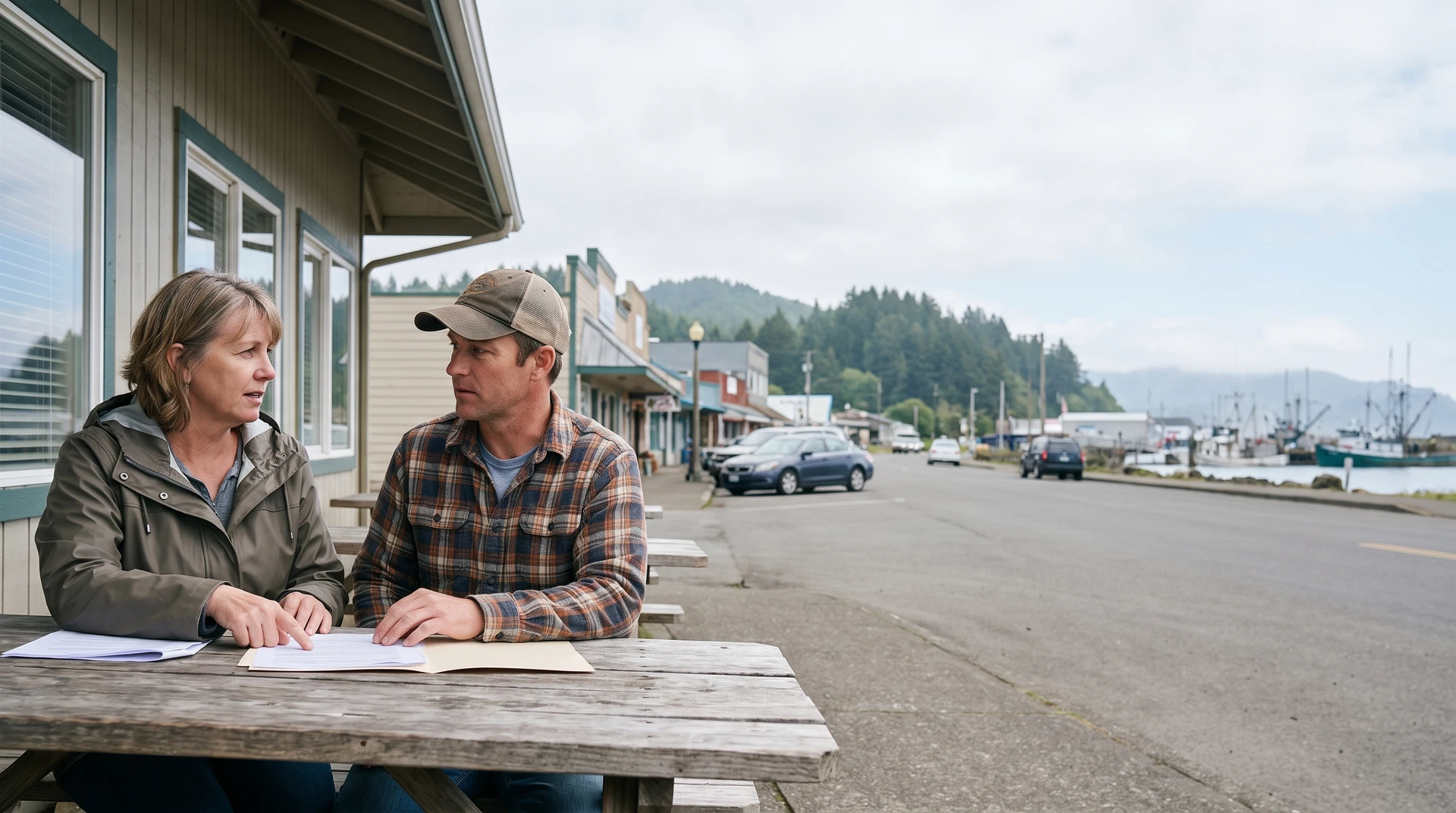

You filed a claim. The damage was real, the process was stressful, and you thought the worst was behind you. Then the letter arrived — a non-renewal notice from your insurance carrier. You are not alone. Across the Oregon Coast, Southern Oregon, and Northern California, homeowners are receiving these notices in record numbers, and many of them filed a claim that had nothing to do with the broader forces reshaping the insurance market. This guide is for you: a clear, honest, step-by-step account of what your options are, how the markets work, and why the right independent agent makes all the difference right now.
Received a Non-Renewal Notice? Don't Wait.
Oregon law gives you 45 days. That window closes fast. Gerald Ross Agency has access to surplus lines markets, specialty carriers, and the Oregon FAIR Plan — and we can often find replacement coverage within 24–48 hours.
Why This Is Happening — and Why It Is Not Just About Your Claim
The first thing to understand is that the non-renewal wave hitting Oregon and Northern California is not primarily about individual policyholders. Oregon homeowners insurance premiums have risen an average of nearly 30% since 2020, according to the Oregon Department of Consumer and Business Services. In Bend, Ashland, Medford, and Hood River, premiums have doubled or quadrupled. Some properties near Ashland have seen increases of 600% in four years. State Farm non-renewed 72,000 California policies in a single action. Allstate stopped accepting new California applications in 2022. These are not isolated decisions — they reflect a fundamental reassessment of risk across the entire Pacific Coast.
That said, your claim history matters. Carriers use a database called the Comprehensive Loss Underwriting Exchange — the CLUE report — to track every claim filed against a property for the past five to seven years. A single large water damage claim, a fire loss, or a mold remediation can trigger non-renewal. Multiple smaller claims within a three-to-five-year window almost certainly will. Even claims that were not your fault — a neighbor's tree falling on your roof, a break-in while you were traveling — appear on your CLUE report and affect how every future carrier evaluates your property.
The combination of a challenging claims history and a market that is already contracting creates a genuinely difficult situation. But it is not hopeless. Understanding the full range of options available to you — and moving quickly — is what determines the outcome.
Step One: Read the Notice and Understand Your Timeline
Under Oregon Revised Statute 742.706, your insurer is required to give you at least 45 days written notice before non-renewing your policy. This is your working window. Read the notice carefully: it should state the reason for non-renewal, the effective date of termination, and any steps you can take to address the carrier's concerns. If the reason is unclear, you have the right to ask for a written explanation.
If your carrier failed to provide the required 45-day notice, you may have additional rights under Oregon law — including the ability to cancel the renewal policy within 45 days of receiving the late notice. Contact the Oregon Division of Financial Regulation (DFR) if you believe your carrier did not comply with the notice requirements. The DFR's consumer helpline exists precisely for situations like this.
Do not wait until the last week of your coverage window to act. The replacement coverage search takes time, and if you allow your policy to lapse — even for a single day — you create a coverage gap that will follow you to every future carrier and may trigger force-placed insurance from your mortgage lender.
Step Two: Notify Your Mortgage Lender Immediately
If you have a mortgage, your lender requires continuous homeowners insurance as a condition of your loan. The moment you receive a non-renewal notice, contact your lender and let them know you are actively working to find replacement coverage. This is not optional — it is a loan requirement, and lenders monitor insurance status closely.
If your coverage lapses before you secure a replacement policy, your lender will force-place insurance — also called lender-placed or creditor-placed insurance — to protect their collateral. Force-placed insurance is typically two to three times more expensive than standard market coverage, and it protects only the lender's interest, not yours. Your personal property, liability coverage, and additional living expenses are not covered under a force-placed policy. Avoiding this outcome is one of the most important reasons to act quickly.
Step Three: Contact an Independent Agent Before Anyone Else
This is the most important step in the entire process, and the one most homeowners get wrong. When you receive a non-renewal notice, the instinct is to call the carrier directly or to go online and fill out quote forms with the major national insurers. In a normal market, that approach works. In the current Oregon and Northern California market, it will likely fail — and waste the time you do not have.
A captive agent — one who represents only a single carrier, like a State Farm or Allstate agent — can only offer you that carrier's products. If that carrier is pulling back from your area, a captive agent cannot help you. An independent insurance agent like Gerald Ross Agency has relationships with dozens of carriers across the admitted market, the surplus lines market, and specialty programs. We know which carriers are currently writing in coastal Curry County, which surplus lines markets are competitive for Southern Oregon wildfire risk, and how to position your application to maximize your chances of approval.
Gathering the right information before you call helps the process move faster. Have your current policy declarations page, your claims history for the past five years, your property's square footage and year built, any recent improvements (roof replacement, updated electrical, wildfire mitigation work), and the reason stated in your non-renewal notice. The more complete the picture you can provide, the faster we can find the right market for your property.
Already Received a Non-Renewal? We Can Help.
Gerald Ross Agency serves homeowners across the Oregon Coast, Southern Oregon, and Northern California. We specialize in finding coverage for properties that standard carriers have declined — including surplus lines, specialty wildfire programs, and the Oregon FAIR Plan.
Understanding the Surplus Lines Market: Your Most Likely Path Forward
When standard admitted carriers decline to write your property, the surplus lines market — also called the excess and surplus (E&S) market — is typically the next step. Surplus lines carriers are non-admitted insurers: they are not licensed in Oregon, but they are legally authorized to write policies here through licensed surplus lines brokers. The Oregon Surplus Line Association (SLAOR) has been regulating this market since 1939.
The key difference between admitted and surplus lines carriers is regulatory flexibility. Admitted carriers must file their rates and forms with the Oregon Division of Financial Regulation and cannot deviate from approved terms. Surplus lines carriers can react to market conditions more quickly, write risks that admitted carriers will not touch, and offer coverage structures that are not available in the standard market. This flexibility is exactly what makes them valuable for high-risk properties — coastal homes, wildfire-exposed properties, and homes with challenging claims histories.
The trade-off is important to understand: surplus lines carriers are NOT backed by Oregon's guaranty fund. If an admitted carrier becomes insolvent, the Oregon Insurance Guaranty Association steps in to pay claims up to certain limits. No such backstop exists for surplus lines carriers. This is why working with a reputable independent agent matters — we vet the financial strength of every surplus lines carrier we place business with, and we only recommend carriers with strong ratings from A.M. Best or similar rating agencies. Lloyd's of London, one of the most recognized names in the surplus lines market, has been a key resource for Oregon coastal and wildfire-exposed properties.
Surplus lines policies are typically more expensive than standard market coverage, and they may come with higher deductibles or more limited coverage terms. But for a homeowner facing a coverage gap, a surplus lines policy is infinitely better than no coverage — and it is often a bridge back to the standard market once your claims history ages off your CLUE report.
The Oregon FAIR Plan: The True Last Resort
If the surplus lines market cannot accommodate your property, the Oregon FAIR Plan Association (OFPA) is the state's insurer of last resort. The FAIR Plan — Fair Access to Insurance Requirements — exists in more than half of U.S. states and is designed to ensure that responsible property owners can obtain at least basic coverage when the private market will not serve them.
The Oregon FAIR Plan provides Named Peril coverage — meaning it covers only the specific perils listed in the policy, not the broad "open perils" protection of a standard homeowners policy. Maximum coverage for dwellings is $600,000. The FAIR Plan does consider your loss and claims history, and you must demonstrate that you have been declined by at least two standard carriers before applying. Premiums are typically higher than the standard market, and the coverage is less comprehensive.
The FAIR Plan is not a permanent solution — it is a bridge. The OFPA itself recommends that policyholders continue to check the standard market regularly and transition back to a standard policy as soon as one becomes available. New FAIR Plan applications rose to approximately 500 in 2023, up from 168 in 2020, reflecting the growing pressure on the Oregon market. The FAIR Plan can be reached directly at 503-643-5448, but working through a licensed agent typically results in a faster and more complete application.
What About the Oregon Coast Specifically?
The Oregon Coast presents a unique insurance challenge that goes beyond wildfire risk. Coastal properties face wind, storm surge, flooding, erosion, and the accelerating effects of sea-level rise. Carriers that are comfortable writing inland Oregon properties may decline coastal homes in Curry County, Coos County, Lincoln County, and Tillamook County based on their proximity to the ocean alone — regardless of claims history.
Coastal homeowners insurance in Oregon requires a carrier that understands the specific risk profile of Pacific Coast properties. Standard wind and hail coverage may have separate deductibles for named storms. Flood insurance — which is not included in any standard homeowners policy — is a separate policy through the National Flood Insurance Program (NFIP) or private flood carriers, and it is essential for coastal properties regardless of your elevation. If your carrier non-renewed your policy, this is also an opportunity to review whether your flood coverage is adequate.
Gerald Ross Agency has deep experience placing homeowners insurance for properties throughout the Oregon Coast and understands which carriers are currently writing in coastal markets and at what terms. If you have received a non-renewal notice for a coastal property, the surplus lines market is often the most viable path, and we have the carrier relationships to navigate it efficiently.
Southern Oregon and Northern California: The Wildfire Non-Renewal Crisis
Southern Oregon — Ashland, Medford, Grants Pass, Klamath Falls, and the surrounding communities — and Northern California's Siskiyou, Shasta, and Trinity counties are at the epicenter of the wildfire insurance crisis. The 2020 Almeda Fire, which destroyed more than 2,500 structures in Talent and Phoenix, changed the calculus for every carrier writing in the Rogue Valley. Carriers that had been writing Southern Oregon properties for decades began non-renewing entire zip codes.
If you have received a wildfire insurance non-renewal notice in Southern Oregon or Northern California, the path forward typically involves one of three options: a specialty wildfire carrier that uses its own risk modeling rather than the standard carrier models, the surplus lines market, or the Oregon FAIR Plan. The good news is that wildfire mitigation work — defensible space, ember-resistant vents, Class A roofing, and fire-resistant siding — can meaningfully improve your insurability in the surplus lines market and may eventually allow you to return to the standard market.
The wildfire insurance crisis in Oregon is not a temporary disruption — it reflects a fundamental repricing of risk that is unlikely to reverse in the near term. The homeowners who navigate it successfully are those who act quickly, work with an experienced independent agent, and invest in the mitigation measures that make their properties more insurable.
Can You Dispute the Non-Renewal?
In some cases, yes. If you believe your non-renewal was improper — if the carrier failed to provide adequate notice, if the stated reason is inaccurate, or if you believe the decision was discriminatory — you can file a complaint with the Oregon Division of Financial Regulation. The DFR has a consumer advocacy team that investigates complaints against insurers and can sometimes facilitate a resolution.
You can also contact your carrier directly and ask whether there are specific improvements or conditions that would allow them to reconsider. Roof replacement, updated electrical panels, wildfire hardening, or installation of a monitored security system are examples of changes that sometimes move a property from the non-renewal list back to the renewal list. Your independent agent can help you have this conversation and frame your property's improvements in the most favorable light.
However, in the current market, many non-renewals are driven by portfolio-level decisions — a carrier exiting a geographic area or a risk category entirely — rather than property-specific concerns. In those cases, disputing the non-renewal is unlikely to succeed, and your energy is better spent finding replacement coverage as quickly as possible.
The Path Back to the Standard Market
Being placed in the surplus lines market or the FAIR Plan is not a permanent sentence. CLUE reports retain claims for five to seven years, and as older claims age off your record, your insurability in the standard market improves. In the meantime, there are steps you can take to accelerate the process.
Maintaining a clean claims record going forward is the single most important factor. This means carefully evaluating whether small claims are worth filing — a $3,000 water damage claim that you could cover out of pocket may cost you far more in future premiums and insurability than the claim is worth. It also means investing in the property improvements that reduce risk: updated plumbing and electrical, impact-resistant roofing, wildfire defensible space, and storm shutters for coastal properties.
Your independent agent should be reviewing your coverage annually and actively monitoring the standard market for opportunities to transition you back from surplus lines or the FAIR Plan. This is one of the core services that distinguishes an independent agent from a direct-to-consumer insurance platform — we are not just placing your policy and moving on. We are managing your insurance relationship over time and working to improve your position in the market.
For homeowners in Southern Oregon and Northern California, the cross-border insurance expertise that Gerald Ross Agency provides is particularly valuable. We write policies in both Oregon and California, which means we can access markets on both sides of the border and find the most competitive terms regardless of which state your property is in.
Your Non-Renewal Action Plan: Step by Step
Use this checklist to guide your response to a non-renewal notice. Time is your most limited resource — start at the top and work through each step as quickly as possible.
Non-Renewal Response Checklist
Why Gerald Ross Agency Is Your Best Lifeline Right Now
The insurance market that existed five years ago — where you could call a 1-800 number, get a competitive quote in minutes, and have coverage bound the same day — is not the market that exists today for high-risk properties in Oregon and Northern California. The carriers that are still writing in coastal and fire-prone areas are selective, their underwriting requirements are more demanding, and the process of finding the right fit requires market knowledge that most consumers simply do not have.
Gerald Ross Agency is an independent agency serving the Oregon Coast, Southern Oregon, and Northern California. We have carrier relationships across the admitted market, the surplus lines market, and specialty programs designed specifically for the risks our region faces. When you receive a non-renewal notice, we are not starting from scratch — we know which markets are open, what their underwriting requirements are, and how to present your property in the most favorable light.
We also understand the emotional weight of this situation. Receiving a non-renewal notice after filing a claim — after you did exactly what insurance is supposed to allow you to do — is genuinely unfair. It is a consequence of market forces that have nothing to do with your individual decisions as a homeowner. Our job is to help you navigate those forces and come out the other side with the coverage your home deserves.
If you are facing a non-renewal, explore our homeowners insurance resources, learn about wildfire insurance after non-renewal, and review our guide to coastal homeowners insurance in Oregon. Then call us. We are here to help.
Frequently Asked Questions
Can my insurance company drop me after I file a claim in Oregon?▼
What is surplus lines insurance and is it safe?▼
What does the Oregon FAIR Plan cover?▼
How long does a claim stay on my CLUE report?▼
Will my mortgage lender force-place insurance if I can't find coverage?▼
Can I dispute a non-renewal notice in Oregon?▼
Why are so many Oregon Coast and Southern Oregon homeowners being non-renewed?▼
You Filed a Claim. You Deserve Coverage. We Can Help.
Non-renewals are exploding along the Oregon Coast and in fire-prone Southern Oregon and Northern California. Gerald Ross Agency has the carrier relationships, the market knowledge, and the experience to find you replacement coverage — often within 24–48 hours. Don't let your coverage lapse. Call us today.


