


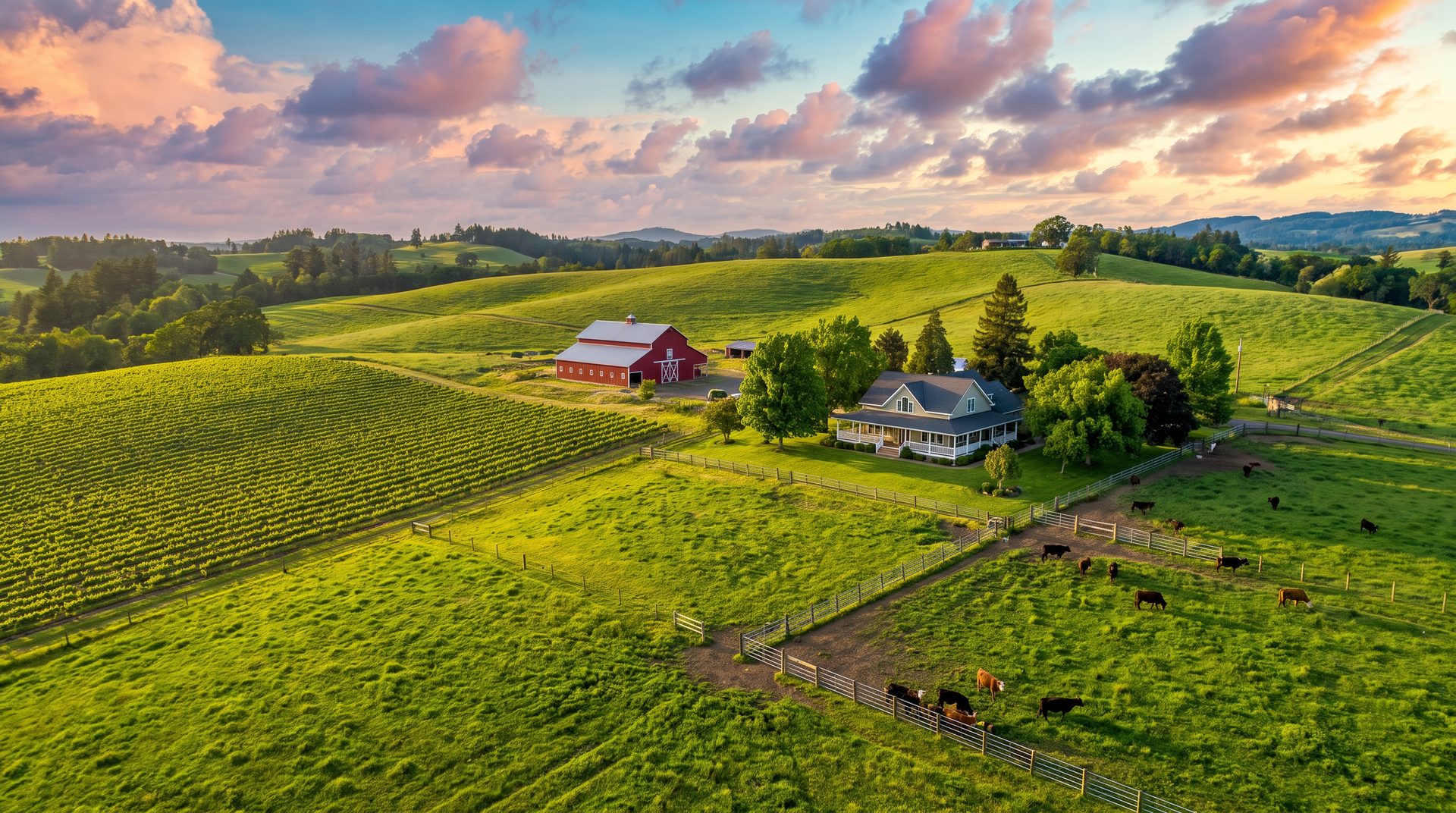

If you farm or ranch in Southern Oregon or Northern California and you're relying on a standard homeowners policy to protect your operation, you have a serious coverage problem — and you may not find out about it until after a loss. Homeowners insurance was designed to protect a residence. The moment your property becomes a working farm, a vineyard, a cattle ranch, a timber operation, or even a hobby farm with a few animals and a barn, that policy stops covering the things that matter most.
Southern Oregon counties — Josephine, Jackson, Klamath, Douglas, and Curry — and Northern California counties including Del Norte, Humboldt, Siskiyou, Trinity, and Shasta are home to a diverse and growing agricultural economy: wine grapes, pears, cattle, timber, specialty crops, cannabis, and agritourism operations of every kind. This guide explains what a proper farm and ranch insurance program covers, where homeowners policies fall short, and what every ag operator in this region needs to carry in 2026.
Is your farm or ranch properly covered?
Gerald Ross Agency has been insuring Oregon and Northern California agricultural operations since 1935. We shop 50+ carriers to find the right fit for your operation.
Why a Homeowners Policy Is Not Enough
A standard homeowners policy covers your home, its contents, and personal liability. It does not cover farm buildings, farm equipment, livestock, harvested crops, or liability arising from farm operations. Most policies contain explicit exclusions for "business pursuits" and "farming operations," which means that if a visitor is injured in your barn, a wildfire destroys your equipment shed, or your tractor rolls into a neighbor's fence, your homeowners policy will likely deny the claim.
Common Coverage Gaps for Oregon and California Ag Operators
- Barns, equipment sheds, and outbuildings excluded from homeowners coverage
- Farm equipment and machinery not covered under personal property limits
- Livestock losses — fire, theft, disease, transit — not covered
- Farm liability for employee injuries, visitor accidents, and product liability excluded
- Agritourism activities (tasting rooms, farm stays, u-pick) explicitly excluded
- Harvested crops and stored grain not covered
The solution is a dedicated farm and ranch insurance policy — sometimes called a farmowners policy — that combines personal residential coverage with commercial agricultural coverage in a single program. Here is what a complete farm and ranch program looks like for Southern Oregon and Northern California operators.
The Core Coverage Layers Every Farm Needs
1. Farm Dwelling and Personal Property
Your farmhouse is covered under the residential portion of a farm policy, similar to a homeowners policy but with higher limits appropriate for rural properties. This includes the dwelling structure, personal property inside the home, and personal liability. Unlike a standard homeowners policy, a farm dwelling policy is written with the understanding that the property is part of an agricultural operation — so there are no exclusions for farm-related activities on the premises.
2. Farm Structures and Outbuildings
Barns, equipment sheds, grain bins, silos, irrigation pump houses, farm labor housing, and processing facilities are covered under the farm structures portion of the policy. Coverage is typically written on a scheduled or blanket basis. In wildfire-prone areas of Southern Oregon and Northern California — particularly Josephine, Jackson, Klamath, Siskiyou, and Trinity counties — it is critical to ensure that your farm structures are insured to full replacement cost, not actual cash value, and that your policy includes wildfire as a covered peril. Some carriers have restricted or non-renewed farm policies in high-risk fire zones; Gerald Ross Agency works with surplus lines markets to place coverage where standard carriers have withdrawn.
3. Farm Equipment and Machinery
Tractors, harvesters, sprayers, irrigation equipment, ATVs, and other farm machinery are covered under the farm personal property section. Equipment can be scheduled individually or covered on a blanket basis. Coverage typically includes fire, theft, collision, and overturn. For vineyards and orchards, specialized equipment — grape harvesters, frost protection systems, orchard sprayers — should be scheduled separately with agreed value coverage to avoid depreciation disputes after a loss. Farm equipment used on public roads also requires commercial auto coverage in addition to the farm policy.
4. Livestock Coverage
Cattle, horses, sheep, goats, and other livestock can be covered for mortality, theft, and transit losses. Livestock mortality coverage pays the market value or scheduled value of an animal that dies from a covered cause — fire, lightning, windstorm, theft, or accidental death. For high-value breeding stock or performance horses, individual scheduled mortality policies are available. Note that disease losses are typically excluded from standard livestock mortality coverage; separate livestock disease or herd health policies exist for operations with significant disease exposure.
5. Farm Liability
Farm liability covers bodily injury and property damage claims arising from your farming operations — a visitor injured on your property, a neighbor's fence damaged by your equipment, a customer who becomes ill from your farm products. Standard farm liability limits start at $300,000 per occurrence, but most operations should carry at least $1 million. For operations with significant public exposure — roadside stands, farm markets, CSA programs — a commercial umbrella policy providing an additional $1–5 million in coverage is strongly recommended.
Agritourism Insurance: A Critical Gap for Southern Oregon Vineyards and Farms
Southern Oregon's Rogue Valley and Applegate Valley have become major wine tourism destinations, and agritourism operations — tasting rooms, farm stays, u-pick orchards, farm dinners, wedding venues, and educational farm tours — are growing rapidly across the region. Most standard farm liability policies explicitly exclude agritourism activities. If you host visitors for any commercial purpose, you need a specific agritourism endorsement or stand-alone agritourism liability policy.
Oregon's ORS 30.930 provides limited liability protection for agritourism operators who post required warning signs, but this statutory protection does not replace insurance — it only limits certain types of claims. California has similar agritourism liability statutes, but neither state's law eliminates the need for proper insurance coverage.
Wildfire and Drought: The Region's Biggest Agricultural Risks in 2026
The 2020 Almeda Fire in Jackson and Josephine counties, the 2021 Bootleg Fire in Klamath County, and ongoing wildfire seasons in Siskiyou and Trinity counties have fundamentally changed the farm insurance market in this region. Many standard carriers have non-renewed farm policies in high-risk fire zones or added wildfire sublimits that dramatically reduce coverage after a loss.
If your farm is in a wildfire-prone area, review your policy carefully for:
Wildfire Sublimits
Some policies cap wildfire losses at 50–75% of the policy limit. Ensure your policy covers wildfire at full policy limits.
Replacement Cost vs. ACV
Actual cash value coverage deducts depreciation from older structures. Insist on replacement cost coverage for all farm buildings.
Smoke Damage
Smoke damage to crops, equipment, and structures is a separate coverage question from fire damage. Confirm your policy covers smoke.
Business Interruption
If a wildfire forces you to halt operations, farm business interruption coverage replaces lost income during the recovery period.
For farms in areas where standard carriers have withdrawn, Gerald Ross Agency has access to surplus lines markets and specialty agricultural carriers that continue to write coverage in high-risk fire zones. Our wildfire insurance specialists can help you find coverage when other agents cannot.
Workers' Compensation for Farm Employees
Oregon requires workers' compensation coverage for all farm employees, including seasonal workers, H-2A visa workers, and family members who are paid employees of the farm. California has similar requirements and is particularly strict about agricultural workers' comp compliance. Penalties for non-compliance in both states can include fines, stop-work orders, and personal liability for medical costs and lost wages.
Agricultural workers' compensation is a specialty line — not all carriers write it, and rates vary significantly based on crop type, harvest methods, and claims history. Workers' compensation coverage for farm operations should be reviewed annually as your workforce and operations change. Gerald Ross Agency works with carriers that specialize in agricultural workers' comp for Oregon and California operations.
Homeowners vs. Farm and Ranch Insurance: What's Actually Covered
| Coverage Item | Homeowners Policy | Farm & Ranch Policy |
|---|---|---|
| Farm dwelling / residence | ✅ Yes | ✅ Yes |
| Personal property (household) | ✅ Yes | ✅ Yes |
| Barns and outbuildings | ⚠️ Limited | ✅ Full coverage |
| Farm equipment and machinery | ❌ No | ✅ Yes |
| Livestock | ❌ No | ✅ Yes |
| Harvested crops / stored grain | ❌ No | ✅ Yes |
| Farm liability | ❌ No | ✅ Yes |
| Agritourism liability | ❌ No | ✅ With endorsement |
| Farm workers' comp | ❌ No | ✅ Separate policy |
| Wildfire (farm structures) | ⚠️ May be excluded | ✅ Available |
| Farm business interruption | ❌ No | ✅ Available |
Ready to review your farm coverage?
Our agricultural insurance specialists have been serving Southern Oregon and Northern California farms since 1935. We'll review your current coverage and identify any gaps — at no cost.
Farm Insurance Checklist for Southern Oregon and Northern California Operators
Use this checklist to evaluate your current coverage. If you cannot answer "yes" to all of these questions, contact Gerald Ross Agency for a coverage review.
Do you have a dedicated farm and ranch policy (not just a homeowners policy)?
Are all farm structures — barns, sheds, grain bins, pump houses — scheduled and insured to replacement cost?
Is your farm equipment and machinery covered for fire, theft, collision, and overturn?
Do you have livestock coverage appropriate for the value of your herd or flock?
Does your farm liability policy cover agritourism activities if you host visitors?
Is your wildfire coverage at full policy limits (not a sublimit)?
Do you have workers' compensation coverage for all farm employees, including seasonal workers?
Do you have a commercial umbrella policy providing at least $1 million in additional liability coverage?
Has your policy been reviewed in the last 12 months to reflect changes in your operation?
Frequently Asked Questions
Does a homeowners policy cover my farm or ranch in Oregon?
No. Standard homeowners policies exclude commercial farming and ranching activities. The moment you operate a farm, raise livestock for sale, or run any agricultural enterprise, you need a dedicated farm and ranch policy to be covered.
What does farm and ranch insurance cover in Oregon and Northern California?
A complete farm and ranch policy covers your farm dwelling, barns and outbuildings, farm equipment and machinery, livestock, harvested crops, farm liability, agritourism liability, workers' compensation for farm employees, and optional wildfire and drought endorsements.
Do I need agritourism insurance for my Southern Oregon vineyard or farm?
Yes. If you host tasting rooms, farm stays, u-pick operations, farm dinners, or any public event on your property, standard farm liability does not cover those activities. You need a specific agritourism endorsement or stand-alone agritourism policy.
How much does farm and ranch insurance cost in Oregon?
Costs vary widely by operation size, crop type, equipment value, and location. A small hobby farm may pay $1,500–$3,000 per year. A working cattle ranch or vineyard operation with equipment and workers' comp can range from $8,000 to $25,000 or more annually. Gerald Ross Agency shops 50+ carriers to find the best fit for your operation.
Protect the Operation You've Built
Gerald Ross Agency has been insuring farms, ranches, vineyards, and agricultural operations across Southern Oregon and Northern California since 1935. We work with 50+ carriers — including specialty agricultural markets — to find the right coverage for your operation at the right price.
Or visit our Commercial Insurance page to explore all business coverage options.


