


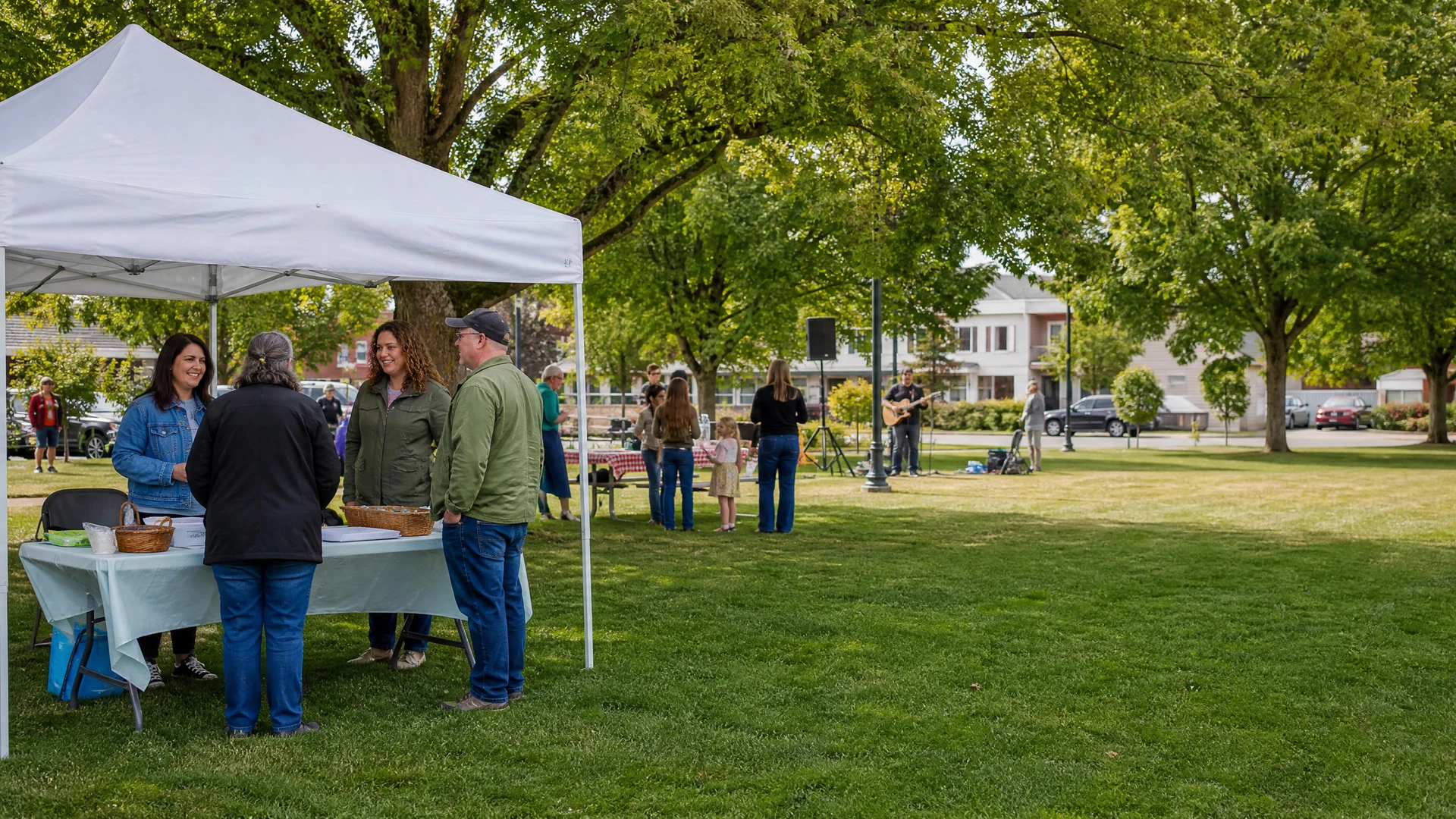

A community event may be a hometown festival, charity 5K, auction, street fair, concert, seasonal market, school fundraiser, or volunteer-led celebration. What they share is a web of moving parts: people, equipment, food, cash handling, temporary structures, public space, contracts, and changing weather. Insurance is only one part of responsible planning, but an early coverage conversation can help an Oregon or Northern California organizer understand what a venue, permit, sponsor, or activity may require.
Key takeaways
- Do not assume an organization’s annual policy automatically fits every event, activity, venue contract, or vendor arrangement.
- Review certificates, additional-insured requests, alcohol, volunteers, food service, children’s activities, temporary equipment, and weather planning before commitments are signed.
- Each party should understand its own responsibilities; a venue’s or vendor’s policy is not automatically the organizer’s protection.
Why an event needs its own risk conversation
Even a modest fundraiser can create new exposures that are not part of ordinary day-to-day operations. A nonprofit may use a public park, rent a hall, invite vendors, sell tickets, serve food, collect donations, set up a stage, or recruit volunteers. A business sponsor may be named in a contract. A town, county, or venue may require a certificate of insurance and additional-insured endorsement. Those details should be read—not guessed—before a deposit is paid.
For example, the City of Eugene states that many of its special-event permits require liability insurance, a certificate, and additional-insured status; its requirements depend on the particular permit and may change for alcohol service.[1] Oregon State University similarly emphasizes planning, risk assessment, and separate attention to vendors, food, elevated activities, and facility-use agreements.[2] Those are examples, not a universal rule for every Oregon or Northern California event. The actual venue and permit paperwork always control.
Read the contract first
Identify certificate requirements, limits, additional-insured wording, indemnity provisions, deadlines, and activity restrictions.
Map every participant
List the host organization, venue, volunteers, vendors, food providers, performers, sponsors, security, and activity operators.
Identify elevated activities
Alcohol, minors, animals, inflatables, athletic activities, pyrotechnics, waterfront access, and road closures all deserve early review.
Collect proof and coordinate
Confirm who needs certificates or endorsements, then organize contact details and documents in one event file.
Start with the event’s real-world facts
The best coverage discussion starts with a concise event profile: the date and location, expected attendance, admission or donation process, schedule, set-up and tear-down, activities, vendors, food, beverages, performers, volunteers, overnight storage, weather backup plan, and contracts. A clear description helps an agent and the organizations involved identify questions early rather than after a venue has set a deadline.
It is also useful to distinguish an event hosted by an established nonprofit from a one-time gathering organized by a new committee, a school booster group, a business, or a family. A nonprofit insurance program may be part of the discussion for recurring operations, while a special-event arrangement can raise separate issues. A community organizer should never assume that another group’s policy or the venue’s policy will respond to the organizer’s own obligations.
Common coverage questions for festivals and fundraisers
General liability is commonly discussed when guests, exhibitors, vendors, or members of the public could allege bodily injury or property damage connected with an event. The available terms, exclusions, deductibles, limits, and insureds vary. Depending on the event, a contract may also request an additional-insured endorsement, a waiver of subrogation, or a primary-and-noncontributory provision. Those are contract and policy questions that should be compared carefully—not copied from another event.
Property and equipment questions can include tents, sound equipment, rented furniture, portable stages, merchandise, silent-auction items, volunteer supplies, generators, signage, and cash boxes. Ask who owns each item, who is responsible for it, where it will be kept, and whether the rental agreement shifts damage obligations. The agency’s business property insurance information can help organizations prepare their property questions for a review.
Event cancellation or postponement can be a separate discussion for events with meaningful nonrefundable deposits or weather-sensitive revenue. Policy availability and covered causes vary materially. It is important to identify the actual financial commitments—including venue, performers, catering, security, portable toilets, tents, and equipment—before asking whether a policy may address cancellation or postponement risk.
Planning a festival or fundraiser?
Bring the venue agreement, event schedule, vendor list, and activity plan to a coverage conversation before key deadlines arrive.
Request an event coverage reviewAlcohol requires early, specific questions
Alcohol changes the event conversation because responsibilities may differ depending on whether alcohol is sold, furnished, donated, sampled, catered, served by a licensed vendor, or simply allowed on the premises. The organizer, venue, sponsor, bartender, caterer, and alcohol provider may each have separate contracts and insurance responsibilities. Do not rely on a label such as “beer garden” or “hosted bar” to answer the insurance question.
Review contracts, permits, the party responsible for service, age-verification procedures, security, transportation planning, and any requested liquor-liability or host-liquor coverage. The right answer depends on facts and policy terms. Organizations serving alcohol as part of recurring operations can also review the agency’s liquor liability insurance guidance before the event is advertised.
Vendors, food trucks, exhibitors, and performers
A community fair can involve a very different risk profile from a sit-down dinner. Food vendors, caterers, food trucks, artisans, rides, musicians, auction providers, transportation companies, and exhibitors may each bring their own operations and insurance needs. The organizer should use a written vendor agreement appropriate for the event and ask which documents are needed before set-up day. Oregon State University, for example, identifies food service and elevated-risk vendors as situations that may require proof of insurance under its event practices.[2]
Organizers can ask vendors to provide a certificate of insurance as evidence of their own coverage, where appropriate. A certificate is not the policy itself, and it does not automatically change coverage or create an additional-insured relationship. If a contract requires a particular endorsement, obtain and review the requested documentation before the event. Mobile vendors should also consider their commercial auto insurance and equipment exposures separately from the event organizer’s needs.
Volunteers, minors, and participant activities
Community events depend on volunteers, but a volunteer’s good intent does not eliminate injury, supervision, transportation, or employment-practices questions. Assign clear roles, provide orientation, document who is responsible for cash, keys, set-up, first aid, and closing procedures, and explain when volunteers should contact emergency services. If volunteers use personal vehicles for organization business, ask whether hired-and-non-owned auto coverage is relevant.
Events involving unaccompanied minors, youth activities, athletic participation, animals, inflatables, rides, waterfront access, or strenuous recreation need a more tailored review. Oregon State University identifies these and other activities as elevated-risk factors in its event guidance.[2] Waivers, supervision, vendor controls, and emergency planning are operational tools; they are not replacements for reading the actual contract and insurance requirements.
Weather, wildfire smoke, and location-specific planning
Outdoor events throughout Oregon and Northern California can be affected by rain, wind, heat, wildfire smoke, road closures, power interruptions, and evacuation conditions. A written contingency plan should identify who decides whether to postpone, how attendees are notified, how temporary structures are secured, where participants shelter, and how the event team handles refunds or nonrefundable commitments. FEMA’s special-event planning resources emphasize pre-event planning, hazard analysis, and coordination with the organizations that may respond if an incident occurs.[3]
For outdoor venues in wooded or rural areas, event leaders may also want to use the agency’s wildfire readiness resources to organize practical property and alert-plan questions. That is preparedness education, not a guarantee that an event can operate through adverse conditions.
Protect the organization beyond the event day
Fundraisers often collect donations, maintain mailing lists, process online ticket sales, rely on payment apps, and use volunteers with access to personal or financial information. A charity’s risk management should therefore extend beyond the event site. Review who has access to donor data, which vendors handle payments, what happens if a device is lost, and how suspicious payment-change requests are confirmed. For organizations that handle electronic records or online contributions, the agency’s cyber liability insurance resources can guide a separate conversation.
Board members and officers also make decisions about budgets, contracts, staffing, grants, vendors, and events. A directors and officers insurance review is distinct from event liability but can be relevant to a nonprofit’s broader governance protection strategy.
A simple pre-event document organizer
- Venue, municipal, park, parade, or road-use agreements and permits.
- Certificate-of-insurance and endorsement requests, plus the deadline for each.
- Vendor, caterer, performer, and sponsor agreements.
- Event schedule, site map, attendance estimate, emergency contacts, and weather plan.
- Alcohol service plan, food plan, security plan, and youth-participant procedures.
- Equipment rentals, property inventory, donation-handling process, and cancellation commitments.
Get the insurance questions organized early
Gerald Ross Agency can help organizers identify the information needed for a practical event coverage review.
Frequently asked questions
How far in advance should an organizer start the insurance review?
Start before signing the venue agreement, paying nonrefundable deposits, accepting vendors, or publicizing alcohol service. The contract may specify certificate and endorsement deadlines, and some activities can require additional underwriting time.
Does a venue’s insurance protect the organizer?
Do not assume it does. The venue’s policy may protect the venue’s interests and operations. Read the agreement and ask what coverage the organizer is required to carry, whether the venue must be additional insured, and what documentation is required.
What if the event has multiple sponsors?
Sponsorship contracts should be read carefully. Each organization should understand its own role, name, indemnity obligations, insurance requirements, and whether it is asking for or being asked to provide additional-insured status.


