


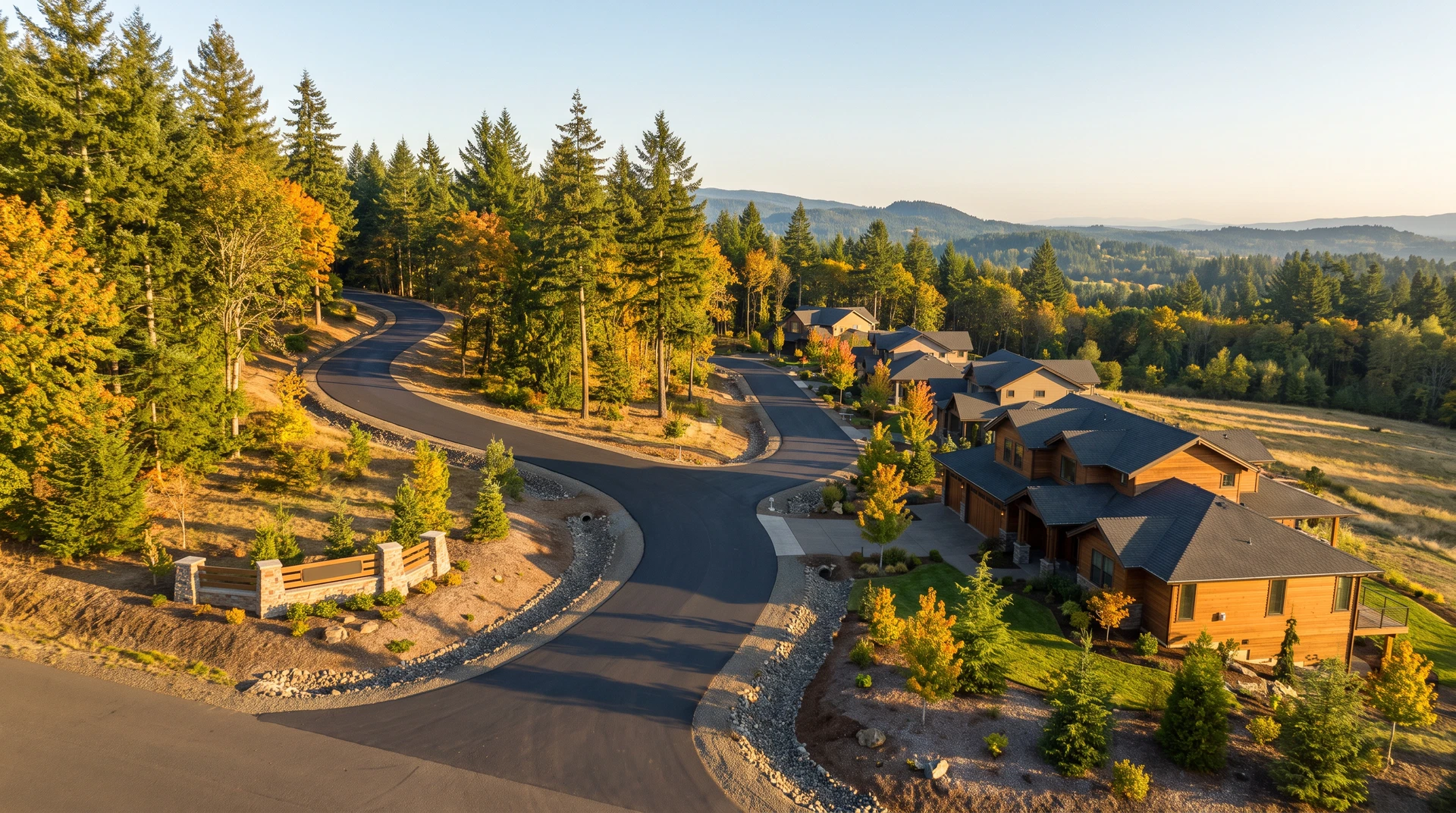

A community association may oversee a few homes on a shared driveway, a hillside subdivision with drainage and private roads, a condominium community, or a neighborhood with gates, signs, landscaping, trails, common buildings, and reserve funds. The insurance questions become more complicated when the community is responsible for shared assets, contracts, money, board decisions, or an access road used by multiple owners. A careful review does not guarantee that every loss is covered; it helps the group understand who owns what, who is responsible for what, and which questions need answers before a claim, repair project, or disagreement arises.
Key takeaways
- Association insurance and individual owner insurance work together, but they do not automatically cover the same property, obligations, or people.
- A shared private road needs a clear ownership, easement, maintenance, funding, contractor, and insurance conversation; a neighbor's individual policy is not a substitute for that work.
- Boards should review contracts, reserves, property schedules, liability limits, deductibles, crime controls, cyber controls, and disaster planning on a regular schedule.
Why the insurance question is bigger than an HOA master policy
Community associations are operational organizations. They collect assessments, contract for repairs, manage shared property, maintain records, communicate with owners, and make decisions that can affect an entire neighborhood. The policy commonly called an “HOA master policy” is important, but it is only one part of the risk picture. The declaration, bylaws, CC&Rs, recorded easements, association budget, reserve plan, maintenance agreement, and vendor contracts often determine which property and responsibilities the association is expected to manage.
For Oregon planned communities subject to ORS 94.675, the board is directed to obtain and maintain property insurance for insurable improvements in common property and public-liability insurance for common property and association negligence, subject to the law and policy availability.[1] The same statute also addresses crime and fidelity protections for certain communities and people with access to association funds.[1] In California, the default maintenance allocation in a common-interest development generally places common-area repair, replacement, and maintenance with the association unless the declaration provides otherwise.[2] These are not one-size-fits-all insurance instructions; the governing documents and policy wording must be read alongside state and local requirements.
Start with the documents
Read the declaration, bylaws, CC&Rs, easements, road-maintenance agreement, contracts, and policy declarations before assigning a responsibility.
Map the shared property
List roads, culverts, signs, gates, drainage, slopes, lighting, mail areas, amenities, common buildings, and equipment the group owns or maintains.
Identify decision makers
Clarify who can contract, collect assessments, approve repairs, access funds, communicate with owners, and make emergency decisions.
Coordinate coverage roles
Compare association insurance, contractor certificates, individual owner policies, and any required endorsements before work begins.
Start with ownership and maintenance—not an insurance label
Before asking “Does the association policy cover the road?” ask a more basic question: What exactly is the road, and who is responsible for it? A road can be common property, an easement across one or more parcels, a private access route managed by a road-maintenance association, a public road with a special assessment structure, or a combination of those arrangements. The answer can affect who signs construction contracts, who collects money, who maintains drainage, who posts warnings, and who should be listed as an insured.
Lake County, California, notes that residents with a private-road maintenance dispute may consider structures such as a homeowners association or road-maintenance association and should consult an attorney familiar with those organizations before forming one.[3] The county also describes permanent road divisions as a separate public-road improvement and maintenance structure.[3] That example illustrates why a group should not assume every private road is governed the same way—or that insurance can resolve a missing maintenance agreement.
Bring the governing records to a coverage review. In addition to the declaration and bylaws, collect recorded easements, road-maintenance agreements, plats, reserve studies, the current budget, minutes describing prior repairs, contractor agreements, and photographs or schedules of the shared assets. This paper trail helps define the practical questions for an HOA and community association insurance review.
Property, liability, and the common-property inventory
Many associations begin with obvious assets—clubhouses, pools, roofs, fences, parking areas, landscaping, and signs—but omit less visible property and operational exposures. A full inventory may include a private road surface, culverts, bridges, retaining walls, drainage systems, entry gates, lighting, mail kiosks, shared utilities, pumps, irrigation controllers, storage sheds, trail structures, common furniture, tools, and snow or vegetation equipment.
For each item, the board should identify ownership, replacement responsibility, maintenance responsibility, current condition, location, estimated value, and whether a contractor or management company controls it. The goal is not to create a claim guarantee. It is to give an insurer and the association enough accurate information to discuss property values, deductibles, exclusions, valuation methods, and loss-control priorities. A business property insurance conversation may also be relevant when the association owns office equipment, maintenance tools, or other movable property.
Liability questions should be mapped with the same discipline. Consider pedestrian areas, roads, gates, pool or recreation areas, events, contractors, volunteers, board communication, parking, seasonal hazards, wildlife, water features, and emergency access. A general liability insurance discussion can help the board frame its premises and operations questions, while vendor agreements and individual homeowner policies may address different responsibilities. Limits, exclusions, retentions, and additional-insured requirements can vary substantially.
A clearer board conversation
Three review lanes keep the questions organized
Separating the discussion by shared assets, operations, and individual owners helps a board see which records belong in each conversation.
Shared assets
Inventory common buildings, road surfaces, culverts, gates, lighting, tools, equipment, and the records that explain ownership or maintenance.
Operations and vendors
Review board authority, reserve funds, contracts, certificates, payment controls, contractor access, and emergency decision-making.
Individual owners
Help owners understand the master-policy information, deductible questions, documented responsibilities, and their own insurance review needs.
Organizing an association or road-insurance review?
Bring the governing documents, policy declarations, property inventory, road agreement, reserve information, and contractor list to the conversation.
Request a community coverage reviewShared private roads: the details that deserve special attention
Shared private roads combine property, liability, contract, and practical safety concerns. The road may be the only fire, emergency, utility, school-bus, delivery, or resident access route. Drainage failures, fallen trees, washouts, ice, potholes, poorly marked curves, gate problems, inadequate turnarounds, and heavy contractor traffic can all create planning questions before they become dispute or loss questions.
An effective road file usually documents the road's ownership and easement rights; the party authorized to contract; the maintenance and emergency-contact plan; annual funding or assessment process; contractor qualifications and insurance requirements; snowfall, vegetation, drainage, and surface-maintenance practices; and a current list of residents and emergency contacts. The group should also keep prior invoices, inspection reports, incident records, and photographs of repairs. A policy cannot replace a clear plan for calling a contractor after a storm or deciding who can authorize emergency work.
If the association hires a paving company, arborist, excavation crew, snowplow operator, engineer, or gate-service provider, obtain the contract and ask what insurance documentation is required. A certificate of insurance is evidence of insurance at a point in time; it is not the same as the policy and does not by itself amend the vendor's policy. The actual contract should address insurance requirements, indemnity, scope, access, safety procedures, and any additional-insured endorsement request.
Board decisions, money controls, and directors-and-officers questions
Boards make decisions about budgets, special assessments, reserve spending, contractors, rules, maintenance priorities, architecture, communications, and records. A disagreement over one of those decisions can create a governance issue even when nobody suffered physical property damage. That is why a separate directors and officers insurance review is often important for community associations. It is distinct from the association's premises or general-liability coverage and should be discussed in light of the board's actual responsibilities, prior acts, limits, defense terms, exclusions, and retention.
Association funds also need operational controls. Dual approval for substantial payments, independent bank verification for payment-change requests, separation of accounting duties where practical, review of management-company controls, documented reserve transfers, and regular bank reconciliation are governance practices that may reduce fraud risk. In Oregon, ORS 94.675 includes fidelity and computer/funds-transfer fraud provisions for certain planned communities; the specific statutory application and coverage should be reviewed with counsel and an insurance professional.[1]
Digital operations add another layer. Online portals, payment platforms, homeowner rosters, email lists, gate codes, vendor invoices, and remote banking can make a community association vulnerable to account takeovers, social engineering, ransomware, and privacy incidents. A cyber liability insurance discussion can help boards identify their data, payment, and incident-response questions before selecting a policy.
Individual owners: understand the line between association and personal coverage
Association insurance does not eliminate the individual owner's need to review personal coverage. Homeowners, condo owners, and renters should know what the association's policy covers, the deductible amount, how a loss assessment could be allocated, what the governing documents say about interior improvements, and whether they need higher personal-liability or loss-assessment limits. Individual circumstances vary, especially in communities with detached homes, attached townhomes, condos, rentals, second homes, or shared structures.
A home insurance review can help an owner compare personal property, dwelling, personal liability, and deductible choices with the association's master-policy information. An umbrella insurance review is another separate discussion for households that want to consider additional personal-liability protection. Neither policy should be assumed to insure association property or replace the association's own coverage.
Wildfire, water, weather, and access continuity
Oregon and Northern California associations may need to plan for wildfire smoke, evacuation access, falling trees, runoff, heavy rain, coastal wind, power outages, slope movement, and extended road closures. Shared roads and common areas can complicate emergency response when the association has gates, narrow access, unmarked homes, overgrown vegetation, poor drainage, or limited turning space. These are operational and property-maintenance issues first; insurance is one part of a broader risk-management conversation.
Boards may find it useful to document emergency access routes, contact lists, gate procedures, contractor contacts, drainage inspection schedules, and communications plans. The agency's wildfire preparedness resources can support an educational discussion about property readiness, alert planning, and documentation. It does not promise coverage, installation, or loss prevention.
Annual board worksheet
A practical annual document organizer
Current declarations, endorsements, deductibles, renewal proposals, and carrier notices.
Declaration, bylaws, CC&Rs, recorded easements, road-maintenance agreements, and management contracts.
Current common-property and equipment schedule, including photos and recent improvements.
Reserve study, budget, assessment history, and projected capital projects.
Contractor agreements, certificates of insurance, and endorsements required by the association.
Incident log, maintenance records, drainage or road inspections, and emergency-contact plan.
Board roster, access-to-funds list, online-payment controls, vendor payment-change procedure, and cyber-response contacts.
Put the community's insurance questions in one place
Gerald Ross Agency can help an HOA, road association, or community board organize a practical coverage-review conversation.
Frequently asked questions
Does a road-maintenance association need general liability insurance?
It depends on the entity, ownership and maintenance role, contracts, governing documents, activities, and policy availability. The group should discuss the road's real-world use, property, contractors, and liabilities with its legal and insurance advisers rather than assuming an individual owner's policy protects the group.
Can an association use a homeowner's policy for common property?
Individual homeowner policies are generally designed for the named insured's personal residence and personal liability—not necessarily association-owned common property, collective operations, board decisions, or shared-road obligations. The documents and insurance policies should be reviewed together.
What should boards ask when an insurer raises the deductible?
Ask how the deductible applies by peril and location, how it could affect an assessment, what the reserve plan provides, whether it is per occurrence or another structure, and whether the association's governing documents require notice or an owner vote. Do not focus only on premium; understand the possible out-of-pocket responsibility after a loss.
Are shared private roads a legal or insurance issue?
They are often both. Easements, recorded agreements, organizational structure, property ownership, local requirements, and contracts may determine maintenance responsibilities. Insurance can be part of the risk-management plan, but it does not decide ownership or settle every maintenance dispute.


